Leaders of the ASEAN grouping on Sunday formally created a unified economic community larger than the European Union, a move that could bolster economic ties with India and give it greater access with a market whose combined GDP is $2.57 trillion.
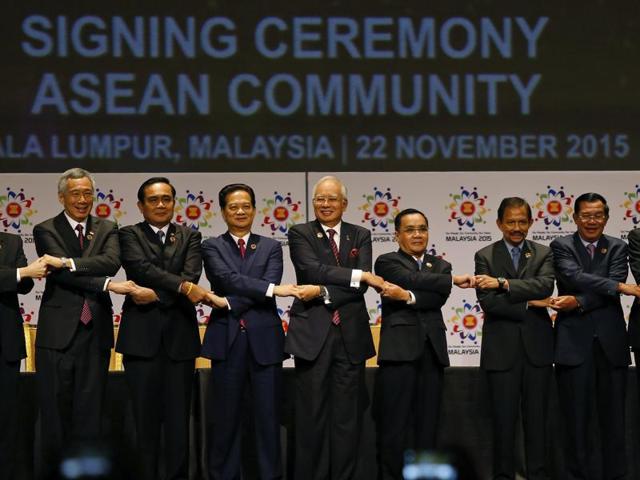
Prime Minister Narendra Modi was in the audience, seated next to his Chinese counterpart Li Keqiang, as 10 leaders of the Association of Southeast Asian Nations formally signed the 2015 Kuala Lumpur Declaration on Establishment of the ASEAN Economic Community.
The community, known by its acronym AEC, was initially envisaged in 2002. The ASEAN members have already taken several steps, such as the removal of tariff barriers and visa restrictions, to make it a reality. The move is also expected to boost political and diplomatic cooperation between members of the grouping.
India already has a strong connect with the ASEAN grouping, with which it has some 30 dialogue mechanisms. This includes a summit and seven ministerial groups that cover foreign affairs, commerce, telecommunications, tourism, agriculture, environment and renewable energy.
{{/usCountry}}India already has a strong connect with the ASEAN grouping, with which it has some 30 dialogue mechanisms. This includes a summit and seven ministerial groups that cover foreign affairs, commerce, telecommunications, tourism, agriculture, environment and renewable energy.
{{/usCountry}}The core of the ASEAN-India partnership is economic – the grouping is India’s fourth largest trading partner and India, in turn, is the sixth largest trading partner for ASEAN. Trade between the two sides amounted to $76.52 billion in 2014-15, with India’s exports worth $31.8 billion and imports $44.7 billion.
India is currently negotiating a Regional Comprehensive Economic Partnership (RCEP) with the 10 ASEAN nations and the grouping’s FTA partners. Indian officials said there had been some breakthroughs in the negotiations and the agreement is likely to be concluded in 2016.
There is also the human connect – more than five million citizens of the ASEAN nations trace their roots to India. Malaysia alone is home to two million people of Indian origin and some 130,000 expatriates.
Indian officials said the ASEAN-India Strategic Partnership had gained momentum after Prime Minister Modi unveiled his “Act East” policy at the last ASEAN-India Summit in Myanmar in November 2014.
India and ASEAN are also working jointly to address non-traditional security threats such as terrorism, human and drug trafficking, cyber crimes and piracy in the Malacca Straits.
The new ASEAN Economic Community could give India greater access to a market with a combined GDP of $2.57 trillion. The grouping is also seen as a huge middle-class market that Indian industries and services can take advantage of.
Investment flows between ASEAN and India too are growing. Between April 2007 and March 2015, India invested $38.6 billion in ASEAN while the grouping invested $32.4 billion in India. The economic integration process got a boost with the creation of the ASEAN-India Free Trade Area in July this year.
For this reason, Modi highlighted the need for greater connectivity, both physical and digital, during the ASEAN-India Summit on Saturday. He also unveiled a $1 billion line of credit to boost projects that enhance connectivity with the grouping.
However, experts believe the ASEAN Economic Community will take more time to become fully functional even after becoming a legal entity on December 31. Leaders of the grouping are yet to address politically sensitive areas such as opening up agriculture, steel, automobile production and other protected sectors.
Intra-regional trade is around 24% of ASEAN’s total global trade for the past decade, far lower than 60% in the European Union.
The ASEAN Economic Community “is not the finished article. Neither is it officially claimed to be. There is much work to be done,” Mohamad Munir Abdul Majid, chairman of a council that advises ASEAN on business matters, told AP.
“There is a disparity between what is officially recorded as having been achieved ... and what the private sector reports as their experience.”
(With inputs from agencies)
Read | ASEAN: Modi to address Indian community, unveil Vivekananda statue