
 E-Paper



Did climate change lead to decline of Indus Valley?
Did climate change contribute to the decline of the Indus Valley civilisation 4,100 years ago? Experts say this is a distinct possibility, based on new research that is part of a wider project led by the University of Cambridge and Benaras Hindu University. Indus Valley 2,000 years older than thought

 Prefer HTon Google


Did climate change contribute to the decline of the Indus Valley civilisation 4,100 years ago?

Experts say this is a distinct possibility, based on new research that is part of a wider project led by the University of Cambridge and Benaras Hindu University, which has been funded by the British Council UK-India Education and Research Initiative.
The multi- disciplinary project hopes to provide new understanding of the relationships between humans and their environment, and also involves researchers at Imperial College London, the University of Oxford, the Indian Institute of Technology Kanpur and the Uttar Pradesh State Archaeology Department.
Project experts have demonstrated that an abrupt weakening of the summer monsoon affected northwest India 4,100 years ago.
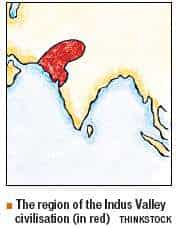
The resulting drought coincided with the beginning of the decline of the metropolis-building Indus Civilisation, which spanned present-day Pakistan and India, suggesting that climate change could be why many of the major cities of the civilisation were abandoned.
The research, reported this week in ‘Geology’, involved the collection of snail shells preserved in the sediments of an ancient lake bed.
Read:Harappan-era seal found in Rajasthan
By analysing the oxygen isotopes in the shells, the scientists were able to tell how much rain fell in the lake where the snails lived thousands of years ago.
“We think that we now have a really strong indication that a major climate event occurred in the area where a large number of Indus settlements were situated,” said David Hodell, from Cambridge’s Department of Earth Sciences.
“Taken together with other evidence from Meghalaya in northeast India, Oman and the Arabian Sea, our results provide strong evidence for a widespread weakening of the Indian summer monsoon across large parts of India 4,100 years ago.”
The Cambridge experts that included Gates scholar Yama Dixit collected Melanoides tuberculata snail shells from the sediments of the ancient lake Kotla Dahar in Haryana.


