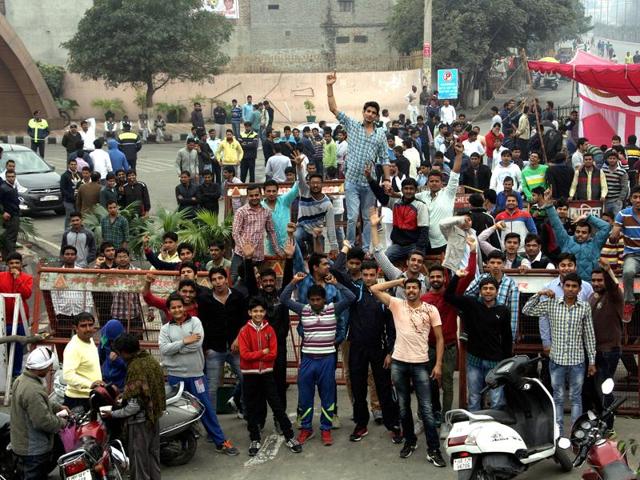
The ongoing Jat agitation for reservation in jobs and educational institutions in Haryana has thrown the normal life out of gear in several parts of the state. The continuous blockade of rail tracks and arterial roads by agitating Jats has befuddled the state government. While the Khattar government has tried to resolve the crisis by promising Jats inclusion in economically backward persons (EBP) quota for general castes and increase in the quota from 10% to 20%, the restive community is far from impressed. Haryana chief of bureau Hitender Rao dissects the quota issue.
Why Jats are protesting now?
It’s a double whammy for them. The Punjab and Haryana high court on July 27 last year stayed the decision of the state government to grant 10 % quota to Jats and four other castes — Jat-Sikh, Bishnoi, Ror and Tyagi — under the special backward class (SBC) category. Earlier, the apex court on March 17, 2015, had quashed the decision of the Congress-led UPA government at the Centre to provide reservation to Jats under other backward classes (OBC) of the central government.
How Jats were included in Centre’s OBC list in 2014?
While the National Commission for Backward Classes (NCBC) had rejected the demand to include the Jats in the OBC central list, the UPA cabinet overruled its recommendation to include Jats of Haryana, Himachal Pradesh, NCT of Delhi, Uttar Pradesh, Uttarakhand Bihar, Gujarat, Madhya Pradesh and Bharatpur and Dholpur districts of Rajasthan in the OBC list.
How Jats, 4 other castes were granted quota by Haryana?
{{/usCountry}}How Jats, 4 other castes were granted quota by Haryana?
{{/usCountry}}The previous Congress regime re-constituted the Haryana Backward Classes Commission (HBCC) to look into the quota demands of Jats, Jat Sikhs, Rors, Tyagis and Bishnois. The HBCC recommended 10% quota for five castes under the SBC category, which was implemented by the Congress regime. This took the reservation to 57% in the state.
Whether any other castes were also given quota in 2013?
Soon after granting SBC quota to Jats and four other castes, the previous regime also gave 10% reservation to economically backward persons (EBP) of general castes such as Brahmins, Rajput, Punjabi, Aggarwals etc. The total annual income to qualify for the EBP quota was fixed at Rs 2.5 lakh. With this, the reservation reached 67% in Haryana.
Was 10% quota under SBC and EPB categories legally tenable?
No. The Supreme Court in its 1992 judgment in the Indra Sawhney case has held that reservation contemplated in clause 4 of Article 16 of Constitution should not exceed 50 %. Article 16 provides for equality of opportunity in matters of public employment.
What does inclusion of Jats and 4 other castes in EBP quota entail?
While under 10% SBC quota five castes-Jats, Jat Sikhs, Rors, Bishnois and Tyagis -- competed with each other for jobs and admissions in educational institutions, the inclusion in 20% economically backward persons quota for general castes will mean more competition with other castes thus reducing their chances considerably
What was SC/BC quota in jobs, education institutes before 2013?
It was 47%. For SCs, the quota was 20% and for BCs it was 27%.
Was there a bifurcation in percentage of quota for BCs?
The reservation for BCs was bifurcated into two blocks- A & B. For block A — having 71 castes — the reservation was 16%. For block B — having five castes, Ahir, Gujjar, Lodh/Lodha, Saini and Meos — the quota was 11%.