This election is historical because, once again, upper castes have been kept out of power. This has been the trend in the state for the past two-and-a-half decades. Secondly, this election can also be seen as a backlash of upper castes against the consolidation of Dalit power in Uttar Pradesh. Dalit workers and a number of officials have told that upper castes were heard saying that, “anybody should win, but not the BSP; the Dalits have lost their sense and gone mad”. But the irony is that they did not have any political party led and dominated by upper castes to which they could vote. Hence, wherever they found that someone is defeating BSP, they voted for the SP, BJP and Congress respectively. This is why we have upper caste votes spread across the upper caste parties.
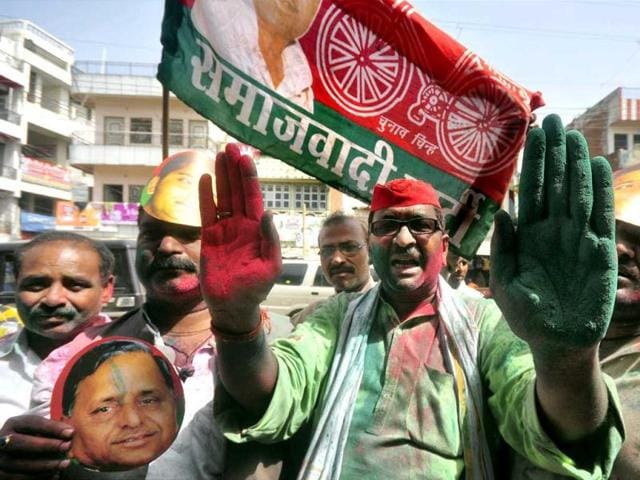
This election has broken the myth of Dalit-Brahmin and rainbow coalition victory of Mayawati in 2007 state elections in UP. Now it has become clear that that was a negative vote for BSP. The upper castes voted for the BSP just to save themselves from the violence of “goonda raj’ of SP. In this election also, one cannot rule out a clandestine give and take between BJP and SP.
Another fact which comes out of this election is that caste and communal cards were played to the hilt. The epitome of that reached when Sam Pitroda, a high profile technocrat, had to come and advertise that he belongs to a backward caste — Vishwakarma. Secondly, the BJP had to organise OBC and Dalit rallies. Backward Muslim reservation and Batla-like issues were also raked up in UP by the central ministers. The distribution of tickets also took place strictly on the basis of caste and religious lines. Two political parties on religious lines — Peace Party and the Ulema Council — spoiled BSP’s game.
Although people, pollsters and media persons have blamed BSP government for mis-governance and lack of development, facts and data suggests otherwise. If we really stick to four years and eight months of government in UP, the development indicators are at par with many developed states of India. The growth rate in 2007 when the BSP government began, the GDP was only 5.2%; now it is 7.6%. It has become a revenue surplus state. Food production has been highest in the country. Four universities and same number of medical colleges were built during this period of four years and eight months. NCERT’s report declared UP’s quality of education as being equal to Tamil Nadu and Maharashtra. There were more than two dozen welfare schemes.
{{/usCountry}}Although people, pollsters and media persons have blamed BSP government for mis-governance and lack of development, facts and data suggests otherwise. If we really stick to four years and eight months of government in UP, the development indicators are at par with many developed states of India. The growth rate in 2007 when the BSP government began, the GDP was only 5.2%; now it is 7.6%. It has become a revenue surplus state. Food production has been highest in the country. Four universities and same number of medical colleges were built during this period of four years and eight months. NCERT’s report declared UP’s quality of education as being equal to Tamil Nadu and Maharashtra. There were more than two dozen welfare schemes.
{{/usCountry}}However, the irony is that the BSP government, which avoids media, could not take all the aforesaid works to people. Government’s image was spoiled again and again by media reports on parks, NHRM and MNREGA scams. The party functionaries could not tell the general public that it is not all. Hence, BSP government got a bad name.
The caricaturing of Mayawati as the arrogant leader, who is not accessible to masses and her own leaders further angered the voters. Inspite of all the criticism, canards and controversy, BSP has not lost its ground. It still has around 28% of poll. This means it has not lost popularity. One has to congratulate Ms Mayawati for holding its party together amidst all round attack from every class, media and political parties. It is down, but definitely not out and will remain a force to reckon with for long.
In this way we can argue that although change looks inevitable in UP, but qualitatively there is not going to be any change in UP politics. It will remain bipolar only with BSP and SP as two main contenders in the state. The state has also crystallised into split politics; voting differently at the state and national level.
But one thing is sure that UP politics has kept the two national political parties in the state at bay, telling them that they do not have any role. On the other hand it has been proved that public memory is very short. Just five years back, the very same population, which had rejected SP, has now chosen it with a thumping majority. SP has never gained so many seats in its history.
Now, it is to be seen how the SP functions. People are really keeping their fingers crossed. The questions before them: Have they repeated their mistake by electing the SP? Or, has the SP changed itself totally?
The author is Visiting Associate Professor (Department of Sociology) at the University of Columbia, US