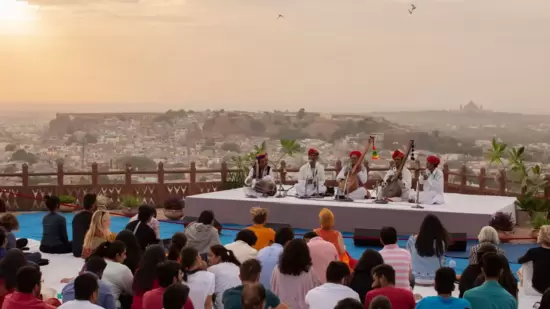
Backed by a gritty oral narrative passed on from one generation to another, folk musicians around the world have been providing healing and happiness to society for centuries through their storytelling.
In Rajasthan, where the folk music tradition is deeply entrenched in its rich rural culture, that backing received a big boost when the Rolling Stones frontman Mick Jagger, impressed by what he saw during a visit to Rajasthan in 2007, decided to become an international patron of the state's roots music festival, now called the Jodhpur RIFF (formerly the Rajasthan International Folk Festival).
Since then, the unsung musical heroes of the desert state's border districts of Barmer, Bikaner and Jaisalmer have been faithfully carrying their communities' folk music traditions on their shoulders to catapult Jodhpur RIFF to the global folk music festival calendar.
"The Manganiyar and Langa folk musicians of Rajasthan see Jodhpur RIFF as their own festival," says Jodhpur RIFF festival director Divya Bhatia. "And that adds a wonderful energy to the event," adds Bhatia, ahead of this year's edition of the festival to be held in Jodhpur from October 2 to 6.
Perform and preserve
First held in 2007, the Jodhpur RIFF has so far witnessed the participation of over 1,250 folk artists from Rajasthan. While a handful of music historians and scholars have been attempting to archive the state's fast-dwindling oral music narrative, many folk musicians from the Manganiyar and Langa communities continue to defy the odds by preserving their tradition for the future.
{{/usCountry}}First held in 2007, the Jodhpur RIFF has so far witnessed the participation of over 1,250 folk artists from Rajasthan. While a handful of music historians and scholars have been attempting to archive the state's fast-dwindling oral music narrative, many folk musicians from the Manganiyar and Langa communities continue to defy the odds by preserving their tradition for the future.
{{/usCountry}}One of the ways of conserving roots music, as Jodhpur RIFF has shown in recent years, is a platform for the performers so that their music lives in the audience. Another is a series of collaborations between Rajasthani folk musicians and their counterparts around the world.
"At its core, a successful collaboration is suffused with artistic openness and freedom, and mutual respect among all the artists. Add to that a strong willingness to engage with and work with the artist from the other tradition," explains Bhatia, a jury member at the World Music Expo (Womex) in Finland in 2019.
Albums that have come out of such collaborations helmed by the Jodhpur RIFF include Blue City, a Rajasthani-Australian collaboration in 2015 called Maru Tarang, featuring Manganiyar and Langa musicians, Dhun Dhora, a partnership between Rajasthani and Scottish folk musicians in 2017, Journeys by the Scottish Brian Molley Quartet and Rajasthan's Asin Langa Ensemble released in February this year and The Weaving of Voices, a collaboration between Welsh folk musician Gareth Bonello and Meghalaya's Khasi musicians.
Such partnerships and discovering folk musicians from the remote villages of Rajasthan's border districts have weaved a success story for Jodhpur RIFF, making the festival one of the most sought-after roots music festivals in the world along with such famous events as Viljandi Folk Music Festival in Estonia, Celtic Connections in Scotland and Sauti za Busara in Tanzania.
Life and legacy
"We’ve received our folk music traditions as a legacy from our elders who have been working as musicians and singers generation after generation," says Asin Khan, an internationally-known folk musician from Badnava in Rajasthan's Marwar region.
"Our traditional jajman (patrons), diverse songs, oral transmission and our musical instrument, Sindhi sarangi, are unique to the Langa community, constituting the foundations of our legacy and existence," adds Asin Khan, a winner of the prestigious Aga Khan Music Award.
"Our bread and butter comes from this inheritance. So to secure our future generations who will still be dependent on it, we must pass it on. In spite of technology and new means of music making, we are finding ways to keep our future alive," adds Asin Khan, who, together with fellow Langa musicians Sadiq Khan and Zakir Khan, launched the Rajasthani band, SAZ, at the Jodhpur RIFF in 2021.
Manzoor Khan, a Manganiyar musician from Sanawada in Jaisalmer district echoes the sentiment: "The musical traditions remind us of our roots, culture, tales of our valiant heroes and stories of the soil. If we abandon them, our identity will fade away. These traditions are not just songs, but the soul of Rajasthan."
Sometimes Rajasthan's folk musicians break away from traditions to bring inclusiveness and gender equality to roots music. Among the Rajasthani women folk musicians who have performed at the Jodhpur RIFF include prominent folk musicians Sundar Devi and daughter Ganga Devi, Sumitra Devi, Rajasthan's gypsy community Kalbeliya dancer Asha Sapera and gypsy community singers Mohini Devi and Sugna Devi.
The 2025 edition
Langa musicians Asin Khan and his SAZ partners Zadiq Khan and Zakir Khan as well as Sanawada's Manganiyar musician Manzoor Khan will be among the Rajasthani folk musicians performing this year at the Jodhpur RIFF that has had famous previous participants like the Malian folk musician Ballaké Sissoko, who carries on the West African tradition of storytellers called griots in the 2019 edition, Zimbabwean-born musician Louis Mhlanga, considered one of the finest African jazz guitarists last year, and Estonian folk band Puuluup, a Eurovision song contest semi-finalist in 2024.
Also performing at the towering 16th century Mehrangarh Fort main venue of the festival, which coincides with the Sharad Poornima -- the brightest full moon in North India -- will be Manganiyar folk singer Sawan Khan from the border village of Dablgarh in Jaisalmer, known for his collaboration with Oscar-winning musician A R Rahman, Rajasthan's Damami community sisters Anita and Prem Dangi in their centuries-old Maand tradition, Portuguese musician Helder Moutinho, a famous exponent of his country's fado tradition, Finnish folk fiddle musician Emilia Lajunen, Uzbek musician Gulzoda Khudoynazarova, who represents the Central Asian country's Shashmaqam tradition born in the Samarkand region, and Bhutan's Sonam Dorji, whose chant-based ballads are sung in the endangered Kheng language.
As the tunes of Rajasthan's unique musical instruments kamaicha and Sindhi sarangi echo in the hills surrounding the Mehrangarh fort every year, folk musicians approach a new festival edition with a mix of uncertainty and optimism.
"Our songs were once alive with stories of kings and queens, of weddings and wars, of politics and royalty. These songs gave courage in battle, they inspired rulers to protect society, culture, art, and nature," says Barkhat Khan, a Langa musician from Chhattangar village in Jaisalmer district who will be performing at the festival this year.
"Today those powerful songs are vanishing with time," laments Khan. "But let us not forget that the roots of all music lie in folk traditions. If we lose it, we lose the soul of music itself."