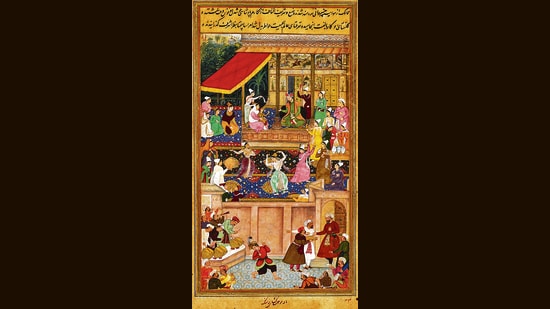
Celebrations in the women’s quarters at the time of Akbar’s circumcision. The British Library blog notes: 'One of the ladies is almost certainly Gulbadan.' (Akbarnama, BL Or. 12988, fol. 114r, British Library. With permission from the British Library / Granger)
Advertisement
Gulbadan Begum, author of the Humayun-nama, was the Mughal empire’s only woman historian. A new book looks at her intriguing life.
For Ruby Lal, the tale begins when she stumbles upon a rare book in a Delhi market, in 1996.
It is a 1902 translation of Ahval-e Humayun Badshah, popularly called the Humayun-nama, an account of the emperor Humayun’s life and reign.
{{^htLoading}} {{/htLoading}}
Few people know that it was written by a woman, Gulbadan Begum, Humayun’s half-sister.
Lal didn’t know, when she picked up the memoir, that the long-gone Mughal princess would hover at her shoulder, slowly having her own story told,
The cover features one of the few existing paintings of Gulbadan.
Lal has been fascinated by the Mughal empire since her years as a student of history in New Delhi. She was drawn in by its “deeply plural ways of being”, and its existence at the intersection of so many religious, cultural and ethnic identities, she says. The idea that Babur, a descendant of Timur and Genghis Khan, could have left his home in present-day Uzbekistan as a young man of about 20, conquered kingdoms halfway across a continent, and settled in, shaped and changed her country, intrigued her.
{{^htLoading}} {{/htLoading}}
What was missing in the histories she read, she says, were the women.
While studying at Oxford in the late-1990s, Lal set out to bridge this gap, conducting research that led to her 2005 book, Domesticity and Power in the Early Mughal World, a feminist history that challenged Orientalist notions of the Mughal harem. Much of that research was inspired by a deep engagement with Gulbadan’s slim chronicle.
Lal spent weeks at the British Library, reading the text in the original Farsi. The princess’s stories of royal domesticity, bloody inter-family conflict and cross-continental adventure thrilled her.
“I was struck by her unique stream-of-consciousness writing, almost replicating the way we tell stories [in person],” says Lal, 56, a professor of Middle-Eastern and South-Asian Studies at Atlanta’s Emory University. “One thing leads to another naturally; there’s a sense of improvisation. And the content is unique. It was all quite staggering to me — be it bartered women, dying children, the sense of a wider female community.”
{{^htLoading}} {{/htLoading}}
Curiously, the manuscript ends mid-sentence, on Page 83, during a section describing the blinding of Kamran Mirza, Babur’s second son, at Humayun’s orders.
Lal finished her doctoral research and moved on, but the mystery stayed with her. Where was the rest of the book? What did it contain?
Between the lines
There was another detail that nagged at Lal. In 1576, a 53-year-old Gulbadan, leading a cohort of royal women, left the confines of the royal harem in Fatehpur Sikri on a historic pilgrimage to Mecca, spending four years in Western Arabia.
Could this one-of-a-kind voyage be what was documented in the missing pages? If so, were they removed in a royal flourish of censorship?
’My gut felt that the sudden break in the book and the four years in the desert were linked,’ says Ruby Lal. (Danish Saroee)
“My gut felt that the sudden break and the four years in the desert were linked,” Lal says. She began to pay attention to the events and processes of royal history and censorship as they may have related to these two aspects: the missing pages and the pilgrimage.
{{^htLoading}} {{/htLoading}}
The first half of Vagabond Princess is thus a vividly detailed portrait of the Mughal empire, as reflected in the lives of its first three rulers, drawn from the writings of Gulbadan. The princess emerges as a sort of “Mughal Jane Austen”, Lal has said, chronicling the everyday minutiae and jaw-dropping drama of her times, and narrating for posterity the lives of the many powerful women she knew.
Strikingly, it is also the story of an empire on the move. “Movement and migration were key aspects of the Mughal empire,” says Lal. “And that movement is not unique to the Mughals. Migration is what formed us as human beings. Through history, humans have moved about. It is only the nation-states that confine us in some senses.”
{{^htLoading}} {{/htLoading}}
The second half of Vagabond Princess focuses on Gulbadan’s historic hajj, which Lal characterises as an act of rebellion.
With details of this voyage sanitised and marginalised in the official history, Lal casts further afield, “restoring and reanimating” Gulbadan’s life from fragments and clues left behind in visual, textual, architectural and legal sources from Mughal India, Ottoman Turkey and Ottoman Arabia. Crucial among these are five eviction orders against Gulbadan and her entourage, issued by the Ottoman Sultan Murad III, which she found in Turkey’s national archives.
From deep readings of such sources, Lal reconstructs and reimagines the four-year period. She details the political ramifications of the pilgrimage, the royal women’s arrival in the Hejaz region, and their eventual return to India after their generous almsgiving causes a political scandal. There’s even a shipwreck off the coast of Aden.
{{^htLoading}} {{/htLoading}}
How does one draw the line between imagination and historical rigour, in a work like this?
“The enterprise of writing history for figures and experiences that have been erased by historians, for a variety of political or intellectual reasons, is a long philosophical engagement with the idea of who decides what history is. Who decides what a source is,” says Lal.
She is challenging this idea of the “given-ness” of sources, she adds. Because without that challenge, we must remain silent on the multitudes of stories — of women, migrants, refugees, slaves, the marginalised, poor, imprisoned and unlettered — that remain untold. And in exchange, we are given not incontrovertible fact, but rather a “historical record” that indulges the imaginative flourishes of those who wielded the pen.
{{^htLoading}} {{/htLoading}}
Lal is among a number of contemporary historians writing critical oppositional histories that seek to alter such narrow views of our shared past, often by re-examining one event or figure at a time.
“The reason I’m charting these stories is to share with our readers a sense of negotiation that all humans in history are involved in, no matter where we are or what we do,” Lal says. “It’s not like the script is laid out. In fact, the script is being written and rewritten all the time.”
All Access. One Subscription.
Get 360° coverage—from daily headlines to 100 year archives.
Explore the latest Lifestyle News on health, fashion, travel, relationships, food and festivals. Find useful tips, expert advice, trends and inspiring stories for everyday living.
Explore the latest Lifestyle News on health, fashion, travel, relationships, food and festivals. Find useful tips, expert advice, trends and inspiring stories for everyday living.