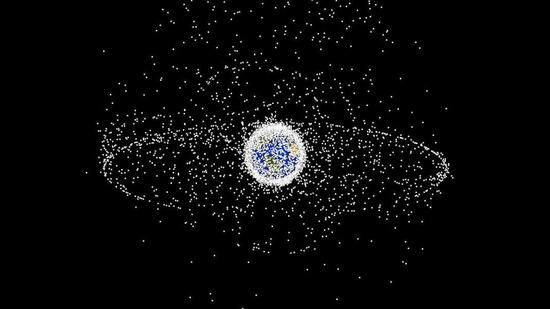
The halo of junk around Earth is growing bigger. There are no two ways about that.
In fact, those headed into space are starting to ask: What are we going to do about this?
There are more than 50,000 objects larger than 10 cm floating around out there, according to the US-based NGO Space Debris Foundation (SDF). There are more than 1.2 million fragments in the 1 cm to 10 cm range. And tens to hundreds of millions of smaller
The halo of junk around Earth is growing bigger. There are no two ways about that.
In fact, those headed into space are starting to ask: What are we going to do about this?
There are more than 50,000 objects larger than 10 cm floating around out there, according to the US-based NGO Space Debris Foundation (SDF). There are more than 1.2 million fragments in the 1 cm to 10 cm range. And tens to hundreds of millions of smaller bits and bobs measuring 1 mm to 1 cm.
Such debris ranges from massive dead satellites and rocket stages to tiny flecks of paint.
This is a problem because these fragments typically move so fast, they can act on other objects like a tiny explosive. This is potentially worrying for those planning data centres in orbit, as well as hotels, laboratories, and missions to aid construction projects on the moon.
Debris could disrupt such operations, or make them substantially more expensive and more complicated, as new technology attempts to map threats and dodge them in real time.
“The concern now is that certain regions of Low Earth Orbit (LEO) could become increasingly hazardous or expensive to traverse or inhabit,” says Tate Few, founder and CEO of SDF, “and the concern is that this could happen fairly soon.”
WASTE OF SPACE
How did things get to this point? As with the oceans, we assumed orbital space was so large that we wouldn’t have to worry, or revisit, what we tossed into it.
“It would have been best if all satellites in disuse, whether big or small, had been deorbited from the start,” says astrophysicist and astronomer Jonathan McDowell. “But we lacked the technology to do so early in the space age.”
Things then proceeded as they had begun. There are still no international laws on clean-up.
A domestic norm set by the US in 2022 mandates that a satellite in LEO be disposed of within five years of the end of its mission (this used to be 25 years). Such practices are followed by other countries too. By the 1980s, space agencies had begun to control re-entry and guide vessels to the remote South Pacific Ocean, famously turning Point Nemo (the point in this ocean that is furthest from any land) into a watery spacecraft cemetery.
But these practices are not internationally enforced. Even if they could be, they could only address vessels that can still be maneuvered remotely; not the many fragments and large parts of defunct craft.
TIDYING UP
What will it take to really clean up?
The answer, as it often does, boils down to money.
“There has been little economic incentive for an operator to undertake the costs of cleaning up an orbital environment,” says Few.
Currently, it is cheaper to launch a small satellite than to launch a clean-up mission, adds McDowell. A conventional launch, after all, must leave Earth and get into orbit. A clean-up mission must launch, find an object, match its orbit, approach it safely, stabilise and capture it, dock or house it, and then drag it down to burn in re-entry.
The European Space Agency (ESA) and Swiss start-up ClearSpace, for instance, have announced the world’s first active space debris removal effort, scheduled for launch in 2029. It plans to deorbit just one thing: the large, defunct upper-stage adapter from ESA’s Vega launch vehicle. And the cost of the mission is being pegged at €86 million.
Meanwhile, it turns out that even if someone is willing to foot the bill, it isn’t just a matter of grab, secure and go. Some of the discards belong to someone else. A lot of the old projects, now defunct, are Soviet. Can the US or China or Japan simply pick up their junk? It isn’t clear.
“A clear solution to the problem is to create robust space laws and legal systems that make every country responsible and accountable for their debris,” says McDowell.
EXCESS BAGGAGE
The clock is ticking on such a charter, because new fragments are being generated too. Some by the kinds of collisions that governments and space entrepreneurs are trying to prevent.
In 2009, for instance, a defunct Russian military satellite rammed into an active commercial American communications satellite at 42,000 kmph, generating so many thousands of fast-moving fragments that it is one of the reasons conversations about decluttering Earth’s orbit began.
Eventually, there are plans to use robotic arms and claws, net and harpoon systems, magnetic and docking plates to capture debris. The US-based TransAstra and Starfish Space, Tokyo-based Astroscale and Hyderabad Cosmoserve Space are among the start-ups experimenting in this space.
Others are devising new technology to watch more closely for hazards.
California-based start-up LeoLabs, for instance, is developing a radar network that will help with high-precision tracking, calculate collision risks, and offer this data and analytics to satellite operators and governments as a service.
ON THE HOME FRONT
India has been conducting experiments in the LEO-decluttering space too.
Two years ago, the Indian Space Research Organisation (ISRO) began a series of space-junk tracking and docking experiments. Project NETRA (Network for Space Object Tracking and Analysis) uses high-power optical telescopes and phased-array radar to track and catalogue large pieces of debris so that Indian satellites can be maneuvered away from them.
The ISRO SpaDeX (Space Docking Experiment), meanwhile, is testing how satellites could be used to align with and capture debris, working as a sort of tow truck. This experiment is in its early stages.
TransAstra has made some interesting progress. Last year, it demonstrated, on board the International Space Station, that its inflatable CaptureBag can serve as a giant sack to potentially ensnare debris as large as a bus.
Meanwhile, in 2024, Tokyo-based Astroscale was commissioned by the Japan Aerospace Exploration Agency (JAXA) to conduct a recce for a possible future decluttering mission.
Its ADRAS-J inspector satellite navigated to an 11-metre-long Japanese H-IIA rocket stage (also about the size of a bus), returned with high-resolution imagery, and demonstrated collision-avoidance capability. But it will take another mission to actually get the rocket stage out of orbit.
Of course, “out of orbit” simply means “into the atmosphere”.
Components may burn up, but they add to air pollution and release metallic aerosols and chemical byproducts into the air. This is far from ideal, on a heavily polluted and already warming planet.
Repair and reuse would be the ideal answer, says McDowell. That, and an international charter that regulates who goes up there, why, and what they leave behind.
One Subscription.
Get 360° coverage—from daily headlines
to 100 year archives.
Archives
HT App & Website