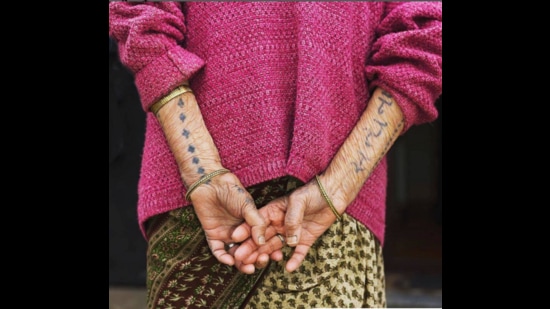
They have served as marks of tribal identity, as jewellery for those who couldn’t afford any. Some tattoos have passed into Indian tradition through ancient cultural practices: a bride-to-be is inked so she is “never nude”; young women’s faces are tattooed for protection from the gods. Others are just patterns an old woman liked and passed down through the generations (read on for the story of one such tortoise tattoo).
Traditionally, in India, “people have looked at tattoos as the
They have served as marks of tribal identity, as jewellery for those who couldn’t afford any. Some tattoos have passed into Indian tradition through ancient cultural practices: a bride-to-be is inked so she is “never nude”; young women’s faces are tattooed for protection from the gods. Others are just patterns an old woman liked and passed down through the generations (read on for the story of one such tortoise tattoo).
Traditionally, in India, “people have looked at tattoos as the only thing they can carry into the afterlife,” says tattoo artist Shomil Shah, 39. For three years, Shah, a former graphic designer, has been researching and archiving traditional Indian tattoo patterns. He became obsessed with the art form after getting his first tattoo in London, in 2018: a symmetrical maze-like kolam pattern (traditionally worn to invoke the gods and ward off the evil eye).
After that hand-poke tattoo experience, Shah ended up getting two more in a week. Soon after, he then learnt that his great-grandmother from Kutch had tattoos on her neck and hands, a tradition known as Trajva. Among women in parts of Gujarat and Rajasthan, particularly those of the Mer and Rabari tribes, these dots were symbols of beauty and endurance. He started to dig deeper.
By 2020, Shah was back home amid the pandemic, and decided to dedicate himself to researching tattoo traditions across the country while also training and practising as a tattoo artist. He has since travelled the country, engaging with tribes and communities that have a history of tattoo art, recording their stories and taking images of the art they wear.
He discovered unique patterns in regions ranging from Sind in Pakistan to Arunachal Pradesh, Nagaland, Uttar Pradesh, Bihar and Tamil Nadu. He stumbled upon a folk song from Chhattisgarh that goes: “If you buy bangles, my daughter, they will break in a few days / But if you are tattooed, that will last forever...”
In July, Shah started the crowdsourced Instagram page India Ink Archive (@india.ink.archive), where he invites submissions about traditional tattoo patterns and stories and memories linked to them, which he then researches and archives. The account features tattoos from Maharashtra, Goa, Tamil Nadu, Karnataka, Chhattisgarh, Gujarat, Haryana, Madhya Pradesh, Odisha, Uttarakhand and West Bengal, as well as some from Nepal and Trinidadians of Tamil descent.
“It was intriguing to learn how tattoo practices have evolved,” Shah says, “from using thorns to using a bunch of sewing needles to, now, rudimentary tattoo machines.” The dyes too were once custom-made using soot and milk, oil or water. “Artists would also mix in local herbs and plants for pigments like blue or green. The juice of certain medicinal leaves or fruit would be added to help with the healing process.”
Dot matrix
In terms of motifs, Shah was surprised to find similar tattoo designs in culturally distinct communities spread across India. A design made up of four Vs pointing inward, for instance, occurs over and over, as a floral motif, in Gujarat, Maharashtra, Madhya Pradesh and Chhattisgarh, where each community calls it by the name of a different local flower. The scorpion motif, a symbol of protection, is seen across India too, from Madhya Pradesh and Maharashtra to Karnataka.
As interesting as the similar patterns are those that remain distinct. The women of the Baiga tribe in Madhya Pradesh get their first tattoo at five: a triangular pattern on the forehead, a unique mark of belonging. In Gujarat’s Kalavad village in Jamnagar, it was customary for girls to get tattoos of grains, flowers or bees at puberty, symbols of fertility marking their entry into adulthood.
New patterns are entering the traditional visual lexicon. As a five-year-old, Vithalbhai Joshi, now 89, selected a double band on the wrist, drawn in the traditional Trajva style, to represent a watch, an ornament only worn by the wealthy in his village in Kathiawar, Gujarat.
In recent decades, however, indigenous traditions have seen a steady decline amid urbanisation and the desire to fit in. Those seeking to stand out today opt for Western patterns, often not realising that there are rich tattoo traditions tucked away in their own family tree.
Sometimes, magically, the two meet. Shah recalls a client in Mumbai asking for the tattoo of a tortoise. Her grandmother had one on her arm, drawn in the hand-poke style. It wasn’t a traditional motif; she just liked tortoises. That had been her grandmother’s first tattoo; now the young woman wanted a tortoise to be her first tattoo, and so a new tradition was born.
In Trinidad, 25-year-old nurse Vena Devi Kurup and her cousins have opted for traditional Tamilian tattoos inspired by their grandmother’s: a flower etched in dots and V-shaped motifs on their hands.
“The beauty of the art form lies in the fact that although all tattoos have a story, they don’t necessarily need to have a meaning,” says Shah. “It is self-expression at its best — the tattoos you love and the ones that are a mistake, they are all a part of what makes you, you.”
One Subscription.
Get 360° coverage—from daily headlines
to 100 year archives.
Archives
HT App & Website