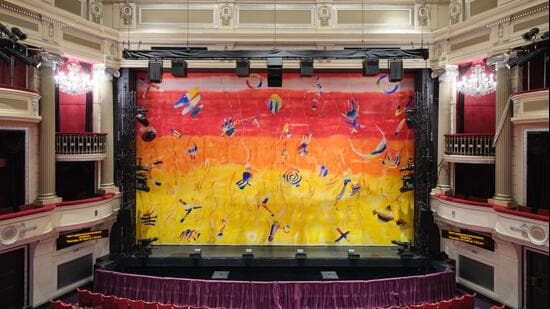
If you’ve ever had the chance to visit the Birmingham Hippodrome, a public theatre for musicals and theatre in the United Kingdom, you would have come across the massive safety curtain behind the proscenium arch. The painting on the curtain, spanning eight metres in height and 13 metres in width, was made exactly 25 years ago; its red, yellow, orange gradient in the background, with motifs such as planes, spirals, and kites, a familiar sight in the few moments before the curtain is raised and the show begins. Few know who made the work (it’s titled Astral Dance) and fewer still would be aware that the artist is one of India’s most significant modernists who paved the way for other Indian artists to gain recognition in the United Kingdom. A retrospective in Birmingham’s Ikon Gallery seeks to rectify this.
Balraj Khanna was a prolific painter, and starting October to February 21, Ikon Gallery will showcase 40 works made over the course of six decades. This includes other large-scale paintings such as Festival (1970), a vibrant red canvas that his daughter Kaushalia Khanna remembers being sprawled across the floor of their dining room, while her father composed its abstract lines and geometric shapes. Kaushalia describes it as a “beating heart”.
Born in 1939 in undivided Punjab, Khanna moved to England in 1962 and quickly became “a man on the scene,” gallerist Amrita Jhaveri who has been working with the artist’s estate for over two years, said. At 23, Khanna became the youngest artist to join the Indian Painters Collective. This group was formed in London in 1963 by four formerly Mumbai-based artists: Gajanan Bhagwat, Yashwant Mali, Lancelot Ribeiro and Ibrahim Wagh, to create space for young Indian painters to exhibit their art in the UK. In 1964, the members put together their first exhibition titled Six Indian Painters at the India House in Aldwych and together began to combat the barriers to entry that existed within the art world.
In his autobiography, Born in India Made in England: Autobiography of a Painter — written in 2021, three years before his death — Khanna describes the lasting impact the Partition had on him. For instance, in Unravelled made in 1967, directionless, white lines cover the entire black canvas that can be interpreted as visual manifestations of the trauma of forced borders and boundary lines created during the Partition. These overlapping lines also became a symbol of the self-taught artist’s mastery. Made from embedded masking tape, pulled out slowly when the painting was close to completion, the lines stand in for the flux he experienced, not just in his youth but also the migration born from it.
{{/usCountry}}In his autobiography, Born in India Made in England: Autobiography of a Painter — written in 2021, three years before his death — Khanna describes the lasting impact the Partition had on him. For instance, in Unravelled made in 1967, directionless, white lines cover the entire black canvas that can be interpreted as visual manifestations of the trauma of forced borders and boundary lines created during the Partition. These overlapping lines also became a symbol of the self-taught artist’s mastery. Made from embedded masking tape, pulled out slowly when the painting was close to completion, the lines stand in for the flux he experienced, not just in his youth but also the migration born from it.
{{/usCountry}}The migration to England, however, was in no way simple or welcoming. In post-war Britain, few opportunities greeted Indian — or as they were then called, Commonwealth — artists. What’s more, Khanna’s exploration of international modernism and a blend of European and Indian sensibilities did not conform to the traditional Indian paintings that the West was used to. An indifference, born out of hostility towards foreigners, in a country still recovering from war, greeted his practice initially. Yet, Khanna persisted in pursuing his transnational sensibility.
In Metz, France, during a period of recovery from a motorcycle accident, Khanna became absorbed in his surrounding landscapes and began to draw parallels with the fields in Punjab he had left behind as a child of Partition. In Remote Region (1965), he divides his abstract landscape into small boxed segments, referencing both the division of land he witnessed and also, the grid-like layout of Le Corbusier’s capital city, Chandigarh. Burgundy swirls and patches of yellow appear at random across the canvas, standing out against the brown, grey and white background. The aerial view of the field hides within itself the chaos of past borders and can be seen as Khanna’s way of referencing the history buried beneath modern cities.
In 1987, Khanna opened Horizon Gallery in London to showcase artists from South Asia, the diaspora and the Global South. Run by the Indian Arts Council and chaired by Khanna, this independent space allowed him to “champion other Indian artists”, Jhaveri notes, and create meaningful change in the representation of Indian art. He was also pushing to make the arts more inclusive and offered the gallery as a platform to artists part of the British Black Arts Movement as well as women and disabled artists.
In 1989-90, Khanna’s work was included in Hayward Gallery’s exhibition, The Other Story. Over the course of the next decade, Khanna curated a series of three exhibitions on Indian art for Hayward: Kalighat Paintings 1800-1930 (1994), Krishna - The Divine Lover (1997) and Human Divine: 2000 years of Indian Sculpture (2000).
The Hayward Gallery has continued this long-standing tradition of showcasing Indian artists well into today’s times. Curatorial assistant Ananya Jain discusses the importance of Kulpreet Singh’s recent exhibition, Indelible Black Marks, the artist’s first solo exhibition in the UK that opened in June this year, which allowed the gallery “to bring his urgent reflections on the climate crisis to a global London audience”.
“There is something significant happening in the UK at the moment, with a number of Indian and Indian-origin artists being given greater visibility. I think this reflects a growing curiosity about South Asian art, but also a recognition that these artists are an important part of the larger story of global art,” Roshini Vadehra, director, Vadehra Art Gallery, said. The gallery has “made a sustained effort in programming” of their exhibitions in London at Cork Street Galleries.
In July, auction house Christie’s collaborated with Kiran Nadar Museum of Art (KNMA) to showcase The Meeting Ground: Scenes from the KNMA Collection. This landmark exhibition included a wide range of Indian artists from S.H. Raza to Gauri Gill, presenting the growing strength and reputation of Indian/ Indian-origin artists through UK-based galleries, museums and auction houses and into the global art market.
This month itself, contemporary artist-duo Thukral & Tagra will debut their solo exhibition, Arboretum, in London’s Carpenters Workshop Gallery; their painted brass sculptures and canvases exploring ecology and memory. In Mayfair, designer Vikram Goyal’s Wings and Tales will showcase his new collection of furniture, objects, and brocades inspired by the mythical world of the Ramayana. Reena Saini Kallat will debut her solo exhibition, Elsewhere is Already Here at the Richard Saltoun Gallery in London. The exhibition will bring together works across drawing, sculpture and video to showcase her explorations on the intersection of histories, geographies and identities. Earlier this year, Bharti Kher’s sculptures including the 2026 bronze, titled Gaia, were showcased at the Victoria and Albert Museum and will remain on display till January 2027. Amar Kanwar’s seven-screen installation titled The Charcoal Man (2026), premiered at the Serpentine North gallery last month, and will be on display till January.
When reflecting on the importance of showcasing her father’s legacy during this period of boom for modern and contemporary Indian art in the UK, Kaushalia asked, “Where do today’s artists get their strength from, if not from artists like Balraj Khanna?”
“Some of these paintings [at the Ikon Gallery] have not seen the light of day for 40 years,” Jhaveri said. Though Khanna’s work, Festival, found a showcase in 2024 at Tate Britain in its Theatre of the Natural World, this is the first such look at the entirety of his work — coming as it does in a period of greater focus on Indian art.