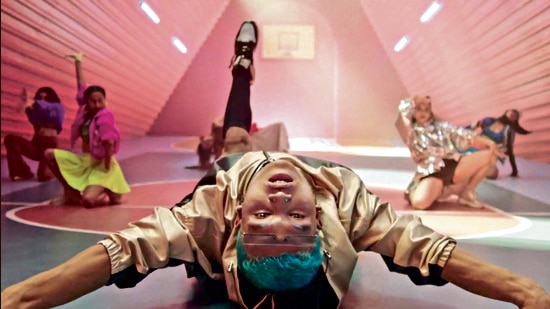
Sunil Bormahela, 22, is part of @VoguingInIndia, an Instagram page and collective founded in June. The group hosts sessions where members of the LGBTQ+ community and allies can learn about ballroom culture. (KuldeeGoswami)
Advertisement
You’ve likely heard of voguing, perhaps through the Madonna song. But what is this dance form from the drag subculture? Who are the young Indians promoting it?
“Come on, vogue
Let your body move to the music…”
You can probably sing the rest of that chorus. But what was Madonna talking about in her 1990 song? Most listeners assumed it had something to do with being trendy, knowing the latest moves. Which, in a way, it did.
{{^htLoading}} {{/htLoading}}
But voguing is a subculture all its own, and before we get to the story of how it’s being celebrated in India today, let’s take a quick look back. Voguing
A still from the music video for Madonna’s 1990 hit, Vogue.
Vogue was released a whole decade before Sunil Bormahela, 22, was born. So it was a different generation of LGBT icons that got him interested in the art form.
{{^htLoading}} {{/htLoading}}
He’d enjoyed dancing in high heels since he was 15. “I got interested in Stiletto Dance through the YouTube videos of Yanis Marshall, a finalist on the reality show Britain’s Got Talent,” says Bormahela, now a mass media student. “I would dance on my toes, pretending I was wearing heels.” In 2016, he got his first pair of stilettos, a gift from his sister. The following year, he discovered voguing through the videos of transgender Afro-Puerto Rican activist and ballroom dancer Leiomy Maldonado. “Her energy was electrifying. That’s when I began to dig deeper into its cultural significance,” Bormahela says.
The founder of the collective, Krish, hopes to get community representatives from international ballroom scenes in Paris and New York to conduct voguing sessions in India. (Pho_ance)
By the time he was 18, he was strutting into dance battles, throwing shade at opponents, using pantomime and rigid movements such as clicks, tuts and locks, as a voguer. He began to dance at LGBTQ+ community events such as those organised by The Gay Gaze Bombay and at Kitty Su, a queer-friendly nightclub also in Mumbai.
{{^htLoading}} {{/htLoading}}
He’s now joined an initiative that aims to spread word about the history, beauty and drama of voguing. @VoguingInIndia is an Instagram page and a collective founded in June by model, choreographer and student Krish (who goes by only one name), 19, and Muskan Singh, 22, who is a yoga trainer and an ally. The collective operates offline, hosting voguing sessions and teaching attendees, allies and members of the community about ballroom culture.
Krish, Singh and Bormahela have held three such sessions so far, at dance studios in Mumbai, and attendance has ranged from 10 to 25 people per event. “The session was invigorating. We learned a lot. It was also exciting to meet other people in the queer community who were interested in learning more about this history,” says Atharva Kulkarni, 24, a pharmacist and dancer who attended a session held in September.
{{^htLoading}} {{/htLoading}}
Krish has big dreams for the collective. He is hoping to get community representatives from international ballroom scenes in Paris and New York to conduct voguing sessions in India.
For now, the focus is outreach. Bormahela recently performed for an audience of hundreds at The Gay Gaze Bombay Halloween Showcase held at the Mumbai antiSocial in October. Because voguing has always followed the “battle” format, “there’s drama, there’s chaos, and there’s a lot of throwing shade with no scope for getting offended,” Bormahela says. “We look at this as a training ground for trans and queer people who want to eventually stand up for themselves confidently in the real world, rebel and retaliate against societal norms.”
“We need more ballroom culture-focused events so that it is accessible to the masses with the right context,” adds Gurleen Arora, a theatre artiste and the co-founder of The Gay Gaze. “And we need to remember that voguing isn’t a performance that can be treated as entertainment. It is a way of owning years of oppression and this is what makes it so powerful.”
{{^htLoading}} {{/htLoading}}
At such events, Krish says, he and Bormahela often get questions from allies wanting to learn more about the subculture. “I’m happy to extend the knowledge as long as they respect the history behind it. We want to remind all people that queer history is full of moments of celebration too, of finding one’s identity and of surviving through stigmatised times,” Krish says. “Voguing gave me a voice and for many others struggling with self-expression, this can be a good start. Irrespective of how you have been marginalised as a queer person, it forces you to stick to the set rules and revisit the past, in order to tell your own story in front of an audience.”
All Access. One Subscription.
Get 360° coverage—from daily headlines to 100 year archives.
Anesha George writes long-form features for HT Wknd. Her stories explore culture, science, technology, and the odd internet rabbit hole. She finds youth culture particularly fascinating because it lets her pretend she hasn't aged out of the conversation. Yet.
Explore the latest Lifestyle News on health, fashion, travel, relationships, food and festivals. Find useful tips, expert advice, trends and inspiring stories for everyday living.
Explore the latest Lifestyle News on health, fashion, travel, relationships, food and festivals. Find useful tips, expert advice, trends and inspiring stories for everyday living.