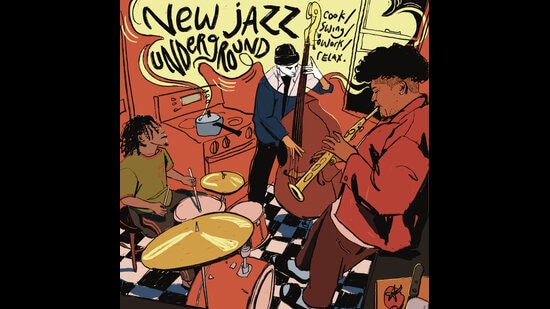
Three years ago, when the band New Jazz Underground put out a 17-minute YouTube video called The MF Doom Suite, an early commenter wrote: “John Coltrane on sax, Art Blakey on drums, McCoy Tyner on piano, and Ron Carter on bass. Who doesn’t believe in reincarnation?”
The count was accurate; the tribute was heartfelt (although, in the interests of accuracy, Carter is 89 and very much alive).
The MF Doom video features four players: Abdias Armenteros on sax, TJ Reddick
Three years ago, when the band New Jazz Underground put out a 17-minute YouTube video called The MF Doom Suite, an early commenter wrote: “John Coltrane on sax, Art Blakey on drums, McCoy Tyner on piano, and Ron Carter on bass. Who doesn’t believe in reincarnation?”
The count was accurate; the tribute was heartfelt (although, in the interests of accuracy, Carter is 89 and very much alive).
The MF Doom video features four players: Abdias Armenteros on sax, TJ Reddick on drums, Sebastian Rios on bass, and pianist Eric “Elew” Lewis.
It’s a classic quartet, but the repertoire is a masked rapper’s back catalogue. The set sounds like a Brooklyn street-corner rap session and a hushed Manhattan jazz club set at the same time, and it doesn’t seem contrived at all.
NJU is technically a trio (Elew is a frequent guest). Its members are aged 25 to 27. They belong to a generation of digital natives routinely accused of gnat-like attention spans, and not generally credited with a proclivity for jazz.
Does the charge stick? Is Gen Z really listening to jazz, and what does it mean if they’re also the ones making it?
The 17-minute tribute makes sense once you remember who Doom was. Daniel Dumile aka MF Doom, born in London and raised on Long Island, spent the last two decades of his life behind a metal mask, a supervillain persona borrowed from Marvel’s Doctor Doom. Acclaimed as a rappers’ rapper, he died in 2020, aged 49.
Madvillainy, his 2004 album with the influential DJ Madlib, remains the high-water mark of the jazz-inflected underground rap record. For the young musicians of NJU, raised in both traditions, playing it back was an obvious move.
A word on that band’s line-up, because it matters.
Armenteros (saxophone and vocals), Rios (bass) and Reddick (drums) met as students at Juilliard, in 2020. Theirs is a chordless band, with no piano or guitar to fill in the harmony, so the three carry everything themselves.
When the pandemic closed the Juilliard conservatory, they took their music to the parks of New York, as buskers; and then to YouTube. The clips spread.
This was hard bop, hip-hop grooves and Afro-Cuban rhythm, played by musicians who knew the tradition and were not treating jazz as a walk in a museum. Most listeners first met them in the recommendation sidebars, because their music fit so well into a range of genres.
If their 17 minutes of jazzified Doom was a hook, 22 became proof of their staying power.
Released in 2022, it is a full-length concert film, over an hour long, shot before a live audience, in a small rented room in New York. There is no studio polish here. The framing is upfront and casual. The drums ring as they would in a living room, and Rios’s upright has a woody, unruly resonance that sounds natural.
The trio plays Nicholas Payton’s Jazz Is a Four-Letter Word (2017) with reverence, then pivots to originals such as bassist Rios’s Pseudo Latin Vibe, where traditional bebop meets a groove one could dance to.
They talk to the crowd, and clearly enjoy being where they are.
Armenteros’s sax holds the melody, while Rios and Reddick push from below. Tempos stretch, and even as solos go out on a limb, one can sense how tightly knit the band is.
For many fans (including a newly-minted one such as me), 22 is a true document of the band. They seem at their most authentic when performing jazz live.
TREBLE MAKERS
Then came the album.
Hoodies, released this May via Artwork Records, holds 13 tracks and runs to nearly 53 minutes. One reviewer noted that the opener, Oney Ones One, slides from hazy funk into bebop and then hard bop. Conceptually, Hoodies has two halves. In the first, trad jazz meets modern influences; the second is a blues suite, with Rios as the main composer.
The title is the band’s thesis in one word. A hoodie is the uniform of street culture, and as several tragic incidents have shown, also carries risk for young men of colour. The album’s themes of brotherhood and survival make that plain.
A hoodie is also the opposite of the dinner jacket in which jazz has for so long been formally presented.
Here are musicians who have studied the tradition at one of jazz’s finest schools (Juilliard’s jazz programme is led by Wynton Marsalis), can play the changes instinctively, but show up in everyday clothes. They take their music seriously but themselves lightly.
Is Hoodies a great album? It is an ambitious one, but I would rate it below 22, because of the latter’s sheer electricity.
Studio sessions can often omit the spontaneity that makes a live gig thrilling. What Hoodies has a tad more of is disciplined structure, and Rios’s composition shows thinking outside the box.
Two questions arise about the band’s future. First, how far can a format without chords go?
It can be appealing for a set or two but a narrow harmonic range can get tiring for listeners. Expanding to a quartet could be a good choice. Elew, who also plays on a track or two on Hoodies, makes a clear difference.
Second, the band’s viral hook was covers, Doom and then a 2025 EP, Dying of Thirst, reimagining Kendrick Lamar. I suspect many of their young fans know them as people who jazz up rap. For a band with very strong original compositions, NJU will now need to spotlight these more.
The potential is undeniable, though. At the 2025 edition of the Newport Jazz Festival, the bassist Christian McBride called them “one of the hottest new groups in all of jazz”. They are unusually self-possessed for musicians in their mid-20s. (Check out a playlist of some of my favourite tracks here.)
NJU, of course, did not arrive out of nowhere.
In the UK, Ezra Collective made jazz-rooted, dancefloor-friendly music that won them a Mercury Prize, while Moses Boyd and Nubya Garcia have pulled grime, dub and Afro-Caribbean rhythm into the genre. In the US, Robert Glasper and Terrace Martin made the jazz and hip-hop link respectable long before the three Juilliard students even began playing.
What they all have in common is this: None of these contemporary jazz musicians treats the genre as something that should be preserved in amber.
That brings us back to the question: Are young people really into jazz?
As far back as 2018, Spotify reported that UK listeners under 30 on its Jazz UK playlist had more than doubled in six months. While such figures may signal a revival, it is probably not a stampede.
Should any of it be a surprise? Every few years, someone proclaims jazz is dead, only for others to declare a few years later that a new generation has discovered it all over again. This time, the camera is a phone, the venue is a living room, and the recommendation sidebar is where discovery happens.
Evolving technology, soundscapes and audiences? That’s exactly how jazz has always survived.
(To reach out, email sanjoy.narayan@gmail.com. The views expressed are personal)
One Subscription.
Get 360° coverage—from daily headlines
to 100 year archives.
Archives
HT App & Website