We all feel it: the sense of something intensifying; unravelling.
We see it in what unfolds as we scroll on our lonely screens.
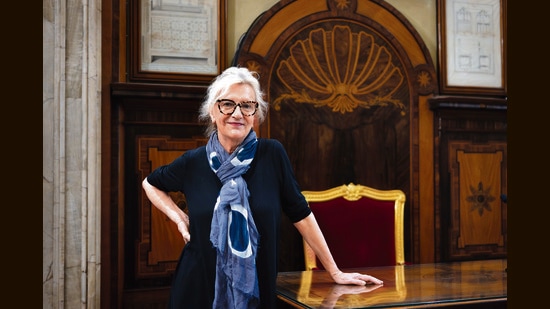
Elizabeth Strout, 70, weaves some of the chaos and division of our times into her new novel, via the character of Artie Dam, a teacher of history, in contemporary America.
The Things We Never Say is on the Booker Prize shortlist (the winner will be announced early next month). Strout has previously won the Pulitzer, for Olive Kitteridge (2009), a set of stories about a sharp-tongued woman in Maine.
A lot has changed since 2009 and her new protagonist, Dam, a 57-year-old living and teaching in a small Massachusetts town, is struggling. He is, by turns, suicidal and morose, though always generous and immeasurably kind. He is “decent”, says Strout, in a time when decency has begun to feel like a radical virtue.
As he fights to keep from losing his moorings in this world that, for the moment, is growing darker, Strout sees him as something of a role model. He is the kind of stranger she would like to know.
Born in Portland, Maine, and raised in New Hampshire, Strout moved to New York to study law. Always a writer, she developed a fascination with strangers there, and a deep need to hear the details of unfamiliar lives.
{{/usCountry}}Born in Portland, Maine, and raised in New Hampshire, Strout moved to New York to study law. Always a writer, she developed a fascination with strangers there, and a deep need to hear the details of unfamiliar lives.
{{/usCountry}}Even as a 12-year-old, she was frightened by the idea that the only world she might ever know was the one she held in her head. Now, as she builds new realms through her characters, what does it take to bridge the gap between self and made-up other? What worries her about the bridges we no longer build between each other? And how does technology play into it all?
Excerpts from an interview.
As a child, you’ve said it alarmed you that you would only ever see the world through one pair of eyes: your own. Artie Dam dreads this too. Yet, as a writer, you create complex people with rich internal worlds. How does that happen?
It’s concentration. I concentrate so hard. Once the character has sort of come to me, I just try very hard to see everything through their eyes. I’m not sure I get it right, of course, because I’m me. But it’s a matter of feeling: Okay, I think I now know who you are.
Obviously, I’m making them up. So I can be them. I couldn’t be you, but I can be them.
If I could be anybody, I’d be somebody I make up. Strangers, I think, have been a lifelong obsession.
How did you come up with Dam, this man who chooses kindness without question, no matter how dark and complicated the world around him grows?
A while ago, a friend sent me some obituaries, never mind why, and I saw a photograph of a fellow whose name was Damm with two m’s, and it felt like a fascinating name to me.
The man looked so ordinary, but his face stayed with me. Then I made Artie’s face in my mind. The rest of the book came from what we were living through and continue to live through in our country. I made him have his inner life move against the outer, which has been very distressing in America.
It was a challenging book to write and felt like a risky one in many ways.
Was that because of the America you now inhabit?
America has been swept by a wave of negativity. While we socialise with our friends, like we used to, there’s always a tension now. It’s just in the air we breathe.
We no longer speak openly about politics, because we are not absolutely certain where the other person stands. This wasn’t always the case.
There’s this sense of disorientation, and that is what Artie feels in the book. When I was younger, in the 1960s, what I felt and what I think a lot of the country felt, during the Vietnam War, was a sense of horror. Countering that was also a sense of outrage. People were out in the streets, demonstrating. This always gave the sense that it was getting better, that people were making it better. The Civil Rights Act had finally been passed back then too.
Right now, what I feel is very, very different. This is a feeling of alarm and horror.
Is that why you say writing this book felt risky?
Well, as a narrative, I did unprecedented things. For the first time in my books, the narrator directly addresses the reader a couple of times. For instance, he’ll say: “We humans were so blind”. There are also parenthetical phrases narrating portions that lie ahead in time, which was new for me, and I wasn’t sure if it was going to work.
The subject matter felt risky because of the way people feel about (US President Donald) Trump in this country. I’ve received both ends of it. I’ve sort of got worn down by it all.
You give Dam a best friend who saves his life, but does not share his views. How important is it to really understand someone we don’t agree with at all?
I tried to make Kenneth Moynihan, the man who saves Artie from drowning, a Trump supporter but also a very kind man. But in terms of articulating why he supports him... no, he wouldn’t even talk about it; because people aren’t talking about these things over here. They’re just not.
Dam struggles with this change. His history classroom seems to morph from a neutral space where all views were heard to a heavily polarised one…
Precisely. His classroom has changed from what it was for so many years. He was a very exuberant teacher. He still would be. But first the pandemic came, and now the politics have come into things, in a very different, fierce way.
In the book, they’re telling him he might have to teach Confederate history.
History is rolling over him as he’s teaching it.
I hope he represents our times. He is a decent, unassuming, fundamentally good man trying to do the right thing, and that’s a wonderful thing. His life deserves to be honoured.
But he is also increasingly dismayed because he is different from others in the book. He is dismayed that people no longer share their thoughts honestly with each other.
What might it take to get past this kind of alienation and polarisation?
Perhaps if Earth as we know it survives long enough, we’ll learn to regulate ourselves again. Because a lot of this technology is still so new.
Facebook and TikTok began so people could make themselves look good. In America, it was similar to the Christmas letters we would send to each other. They were so funny and awful because they were so phoney. You could tell that, just from the tone of “everything’s perfect here”.
I think the true danger of such falsehood is that it alienates us from each other. In the past, the deeper parts of us were more accessible to those in our lives.
That’s why, when I make a rare connection with a stranger, it becomes more precious than it used to be. I can feel this is felt by all of us.
There’s such a loneliness among us that, here in Maine, the taxi driver is happy to have somebody ask him how he is, even though strangers never talked much here.
It’s a polycrisis world, isn’t it: climate, polarisation, scarcities looming, and of course AI.
Right now, AI feels like potentially a very bad crisis. The climate change is terrible. And I think the politics come third, even though the political situation stemming from our country is terrible. Because governments come and go, but the Earth can’t come and go, you see. So my concern is that Earth as we know it will be overcome by climate change, or by AI. We just don’t know.
What does it feel like to be a writer in these times?
It is a strange thing to be my kind of writer these days. Since this book has come out, things have got worse. Every day seems to bring a new horror, and I’m not sure how to internalise that into another book.