The first work by Umika Mediratta-Shriram that caught my attention was a large Buddha rendered in shades of grey, with beautiful flowing streaks of red and gold moving through the composition. It was displayed alongside in a group show (that included my own work) at the Egg Art Gallery in Delhi in 2016. It may have been the soothing, reflective palette. Or maybe it was the artist’s seamless blend of centuries-old Thangka painting and a clear contemporary style.
Thangka art has been around since the 7th century BCE and largely depicts the Buddha and scenes from his life, placed within a cosmic landscape. Artists have delicately rendered themes of enlightenment, and the human’s place in the universe. The compositions are mathematically precise, aligned, symmetrical – not a figure out of place, nothing running wild. They’ve long served as scripture. So, it’s common for them to be created on cotton or silk, using mineral pigments and fine gold dust. Mediratta-Shriram uses the same techniques and materials to make her art. But there’s a modern fluidity that is entirely her own.
Mediratta-Shriram was born in Raipur, Chhattisgarh, and trained at Kala Bhavana in Santiniketan, West Bengal. She grew to love Thangka art on her trips to Dharamshala and Bhutan. And she has painted everything from nature-focussed canvases to massive murals on the island of Flores in Indonesia using Thangka techniques.
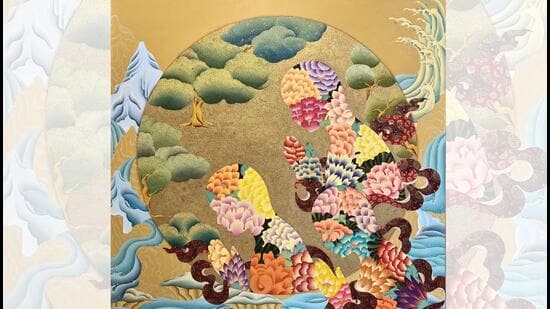
Equanimity (2023), her acrylic on canvas, is a great gateway to understanding her work. The focus is a circular shape, containing within it bountiful trees, clouds and three human figures made of intricately painted flower petals. Water bodies and mountain ranges form a serene backdrop. Yet, despite the luminous colours, extraordinary detailing and movement, the painting remains remarkably still, as if in a state of balance.
{{/usCountry}}Equanimity (2023), her acrylic on canvas, is a great gateway to understanding her work. The focus is a circular shape, containing within it bountiful trees, clouds and three human figures made of intricately painted flower petals. Water bodies and mountain ranges form a serene backdrop. Yet, despite the luminous colours, extraordinary detailing and movement, the painting remains remarkably still, as if in a state of balance.
{{/usCountry}}Look also at Echoes of Enlightenment (2025), a panoramic work. It’s like seeing a landscape unfold like a universe. A Buddha-like figure meditates at its centre, surrounded by elements of nature. The same figure is repeated through the work but in hazy forms, perhaps to signify the single-mindedness of his meditation despite the seasonal and structural changes around him. Mediratta-Shriram uses gold leaf on some parts of the work. It catches the light differently as one moves around the work.
Tiny details by any artist, are a flex – they show not just technical skill, but how smoothly the whole becomes greater than the sum of its parts. In Mediratta-Shriram’s Swarna Dvara (2025) those details make up a magnificent garden just visible through an arched doorway. Upon closer inspection, the flowers are shaped as human figures bent in supplication to their lord, or to nature – which perhaps are the same thing. It’s a way of preserving an old, vanishing form but giving it an update that brings in new ideas, new ways of thinking about Buddhist philosophy.
Several artists have connected their artistic practice to spirituality, nature and the inner world. GR Santosh did it with symbolism. Mediratta-Shriram’s path is to take the preciseness of Thangka art, and bring it into the present day. It’s the larger detail that many viewers tend to forget about.
Sarika Dandona is a Delhi-based photographer and visual artist.
From HT Brunch, October 17, 2026
Follow us on www.instagram.com/htbrunch