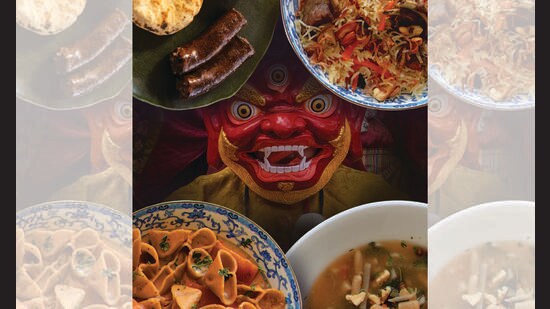
For most travellers #LadakhVibes largely means saluting the stereotypes: Dramatic mountainscapes, bucket-lists with the motorcycle, hiking flexes, finally making it to Pangong lake after watching 3 Idiots in 2009. This includes food too: thukpa, momos, yak cheese. So, local restaurants rarely serve more than this trifecta.
But a shift is underway. Over the past decade, Ladakhi chefs have begun celebrating their varied and storied cuisine. They’re fighting misconception: The meat dumplings are not momos, they’re mokmoks. Local pastas and khambir (a sourdough flatbread) are being championed over generic European claptrap. Time-consuming old recipes are the star attraction at pop-ups. Even vegetarian preparations are making it to restaurant menus. No one expects the cuisine to go national. But each new experiment is its own little revolution. And a reinvention of #LadakhVibes. Take a look.
Trotting down the Silk Road
Padma Yangchan and Jigmet Disket set up Namza Dining in Leh in 2017, hoping that visitors to the chilly capital would want to sample more than the landscape. Much of their menu consists of homestyle preparations that fell out of favour because they were so time and labour intensive, and food even Ladakhis didn’t eat often because they were expensive to make. Now, locals and tourists drop in for the gyuma (indulgent handmade mutton sausages typically eaten at feasts) and the morel dumplings. They relish kabra, wild caper shoots foraged in April and May. “It’s very bitter, so it is traditionally boiled for some time, or left under running spring water for a few days to wash away the bitterness,” says Disket.
{{/usCountry}}Padma Yangchan and Jigmet Disket set up Namza Dining in Leh in 2017, hoping that visitors to the chilly capital would want to sample more than the landscape. Much of their menu consists of homestyle preparations that fell out of favour because they were so time and labour intensive, and food even Ladakhis didn’t eat often because they were expensive to make. Now, locals and tourists drop in for the gyuma (indulgent handmade mutton sausages typically eaten at feasts) and the morel dumplings. They relish kabra, wild caper shoots foraged in April and May. “It’s very bitter, so it is traditionally boiled for some time, or left under running spring water for a few days to wash away the bitterness,” says Disket.
{{/usCountry}}The menu reflects the region’s aspirations as much as its traditions. “We need nourishment in the extreme cold, so we had soupy, simple food. Extravagance was only for special occasions and for wealthier households,” she says. So, while simpler staples such as barley appear in desserts, there’s also Yarkhandi pulao, which is slow-cooked for six hours and is flavoured with caraway, black cardamom and cloves - spices that were traded along the Silk Route and possibly passed though the Chinese province that gives the dish its name.
The restaurant’s chutagi, pasta dish, is served as a trotter stew or with sun-dried vegetables. Both reflect the tough mountain life, where veggies weren’t available year-round and everyday meals called for ingenuity. “Earlier when we were completely cut off, we ate what we had. Most families owned livestock. You never wasted any part.”
In August, Namza hosted a pop-up in Gurugram, which drew 180 diners over two days. “Many people are hesitant to visit Ladakh because of altitude, but they are keen to try the food,” Disket says. The dream is to open a Ladakhi restaurant in Delhi. “People think that the food is limited, but we need more storytelling to change this perception.”
Garden of earthly delights
Jigmet Mingyur’s path to food is unusual. He became a monk ate age nine and spent 14 years in a Nepal monastery, doing everything from plumbing to cleaning as part of his tasks. But when an earthquake hit in 2015 and he began cooking during relief efforts, it gave him a different kind of purpose.
He left monastic life shortly after, and worked his way up from dishwashing to waiting tables in Goa, and returned to Ladakh earlier this year to set up Tsamkhang. The al fresco farm-to-table dining experience in Horzey, a 15-minute drive from Leh, serves homestyle food, the kind that even locals have stopped cooking.
“I wanted a space where I could grow my own vegetables, and tell the story of our land, ingredients and traditions,” Mingyur says. So, the menu has such unusual offerings as polda (roasted, ready-to-eat, barley dough), moskot –(buckwheat pancakes with walnut sauce), and nyamthuk (roasted barley flour soup).
As visitors from India and abroad have dropped in, he says there’s a newfound excitement around the cuisine. “Before Covid, domestic tourists mainly wanted North Indian food. Now, along with the landscape, they are also interested in what we eat.” But taking the cuisine out of its mountain home is tough. The wild herbs and produce are hard to find outside of Ladakh, and the food’s subtle flavours might be lost on the rest of India’s spice-loving palate.
“Ladakhi cuisine hasn’t had enough ambassadors,” Mingyur says. That’s good news. It means, as in the mountains, the only way to go is up.
History, cooked by hand
Nilza Wangmo grew up in a household that had 15 to 20 members and a kitchen brimming with food. So, it’s not surprising that in 2016, she and her mother Tsering Angmo opened Alchi Kitchen in Alchi village, 70 kilometres from Leh. “The idea was to showcase the food I grew up eating,” Wangmo says. “My mother thought of expanding it into a cookery school, where guests can cook and taste Ladakhi cuisine.”
The women showcase the kind of recipes that commercial restaurants shy away from. The timsthuk, a type of thukpa, features brown peas, local cheese and hand-rolled noodles. “Few young people can roll the noodle thin, in one go. Fortunately, I learned it from my mother and grandmother,” says Wangmo. There are vegetable stews, apricot-based dishes and thangtur (yoghurt or buttermilk with herbs). Regional variations appear too. “Here in the Sham valley, we use buttermilk or residual chang for to ferment the khambir [sourdough bread], which gives it a deep brown hue.”
Wangmo also does trendy variations: Chocolate mokmoks and pita-style stuffed khambir. But largely, the recipes stay true to the region. They’re not spiced up the way restaurant versions often are. It works, she says. There’s growing pride in Ladakhi identity and traditions, and “visitors come with more curiosity and awareness” than before.
At pop-ups in Mumbai, Uttarakhand, and other parts of India, Wangmo finds that diners tend to be surprised at how diverse the cuisine can be. And they want to hear more about the food. “My narrative skills have improved over time,” she admits. “The challenge is explaining the simplicity of the food. Barley may seem bland, but when you talk about the history, and its nutritional role for us, it takes on another dimension, rooted in this land and its people.”
Changing the course
The longest lunch Kunzes Angmo has hosted lasted six hours. “I had to remind my guests that I had to get home too,” she says. Through her initiative, Artisanal Alchemy, Angmo curates multi-course meals at Stok Palace and Jade House in Leh, peppered with her narratives of Ladakh’s food heritage, preservation practices, and each ingredient’s purpose in a dish. Guests direct the pace of the meal with their questions, and the initiative aims to fill the gaps in what the world knows about Ladakh and its food.
Angmo serves no momos, no Tibetan standards. And yet, the lunches are highly sought after. Only 60 tables are open every year, and Angmo works with experiential travel companies to ensure that only genuinely curious diners secure bookings.
The courses feature indigenous ingredients such as tramnyung (rutabagas), gyalabuk (Chinese radish), chintse (Chinese celery), oosu (local cilantro) and skotse (wild onion chives). “There is no turmeric or red chilli powder,” she says. But the Silk Route legacy shows up in the use of black pepper. The mokmoks are stuffed with red meat, not chicken, because poultry was never part of the traditional diet. And she also highlights baking traditions influenced by Central Asia ̶ breads and biscuits baked in closed pans in the embers of dry leaves.
Guests come away with a newfound understanding of fermentation after sampling the pickles and alcohol. And yet, Angmo says, the cuisine of her people isn’t likely to go viral. “We are very few people. We do travel, study, or work outside Ladakh, but most of us return because of the great quality of life. We were never displaced, so our food has not travelled like that of the Tibetans or Punjabis. The onus is on us to represent Ladakhi cuisine well.”
From HT Brunch, October 11, 2025
Follow us on www.instagram.com/htbrunch