
 E-Paper



Photography: A fine focus

 Prefer HTon Google



A photographer speaks about commercial, documentary and art photography; and making a career from it without any formal training
When photographer Asha Thadani began observing the human-animal equation while photographing the tribes of India, she noticed an interesting evolution of this theme in urban societies and sensed an important collection emerge and began documenting these connections actively from 2010. “That’s how the thought about exploring our history through our relationship with animals a unique perspective came about,” says Asha, speaking about her most recent exhibition in Mumbai’s Piramal Gallery at NCPA.
Her 24-year-old professional journey has been about commercial, documentary and art photography. “All these genres contribute to and influence each other, and I’ve received a few commercial photography awards. My work has been displayed at the Albert Kahn Museum, Paris and my photographs have been exhibited and auctioned at Christie’s Auction house and gallery, Paris,” shares Asha, who was born in Secunderabad.
Asha, 46, went to boarding school in Poona since the age of four. “But I came alive in Bangalore, where I stay. I am a college dropout and since there weren’t any institutes offering photography as a subject back then, I had no option but to be self-taught,” she says.
Asha’s interest in the visual arts and the idea of anchoring thoughts and experiences through images is what has led her to express herself through photography as a medium. Her earlier sociopolitical or economic themes resulted in stark imagery because of an obvious disparity in rank, resources an opportunity of the subjects.
However, her recently concluded exhibition titled Interbeing – India and her animals, brings together a series of photos that is multidimensional. “We worship, tame, slog, flog, celebrate, eat, displace and politicise animals. The spectrum of engagement is complex and contrasted, therefore not apparent at first glance. Which is why a lot of the images are sensitive, quiet, withdrawn and not as aggressive in conveying one single idea but several concepts in a single frame,” says Asha Thadani, speaking of her exhibition titled.
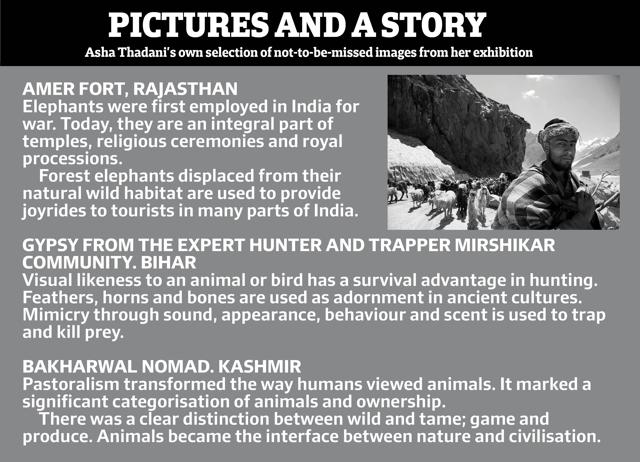
The photo series tell an evolutionary story about the undefined, unsecured and unresolved nature of the man and animal relationship in India. Through the documentary genre, Asha explores discriminatory power structures within our culture and society that lead to indignity and there hasn’t been a single definitive moment, when she decided to come up with this theme for this exhibition.
This series, Asha says, makes the familiar new. Why? “Because despite animals being a huge part of our existence in India, it’s an influence that hasn’t been examined and expressed through such a wide range of ideas and visuals in a single body of work,” reasons Asha, whose other exhibitions were a bit more self-absorbed and did not involve ideology-driven themes.
Speaking of her process, Asha says she began by shortlisting and streamlining photographs that would showcase the idea cohesively. “I ruthlessly discarded pictures that were beautiful but not expressive enough to convey the plot. Then came the technically challenging process of editing and converting images to grayscale and calibration of printing systems to get high quality images on canvas -- a long process!” she quips.
The advertising legend, creative director and writer Ramesh Ramanathan has given the series a lot of structure, perspective and impact with his brilliant ideas and writing. “And Mukesh Pirpiani, a top-notch photojournalist, who heads it and whose work I truly admire was extremely supportive,” recounts Asha.
“The response has been incredible. People have appreciated the subject and my idea, and the back stories supporting the images as well. There are several people, who did mention that they found the approach and representation of the human animal equation very interesting,” she smiles.
Speaking of criticism, Asha says: “My work is mostly classified as social pessimism and I hope it continues to be perceived that way.”
BOX:
Asha picks 4 pictures and explains what each one depicts
Harvest Festival. Mandya, Karnataka
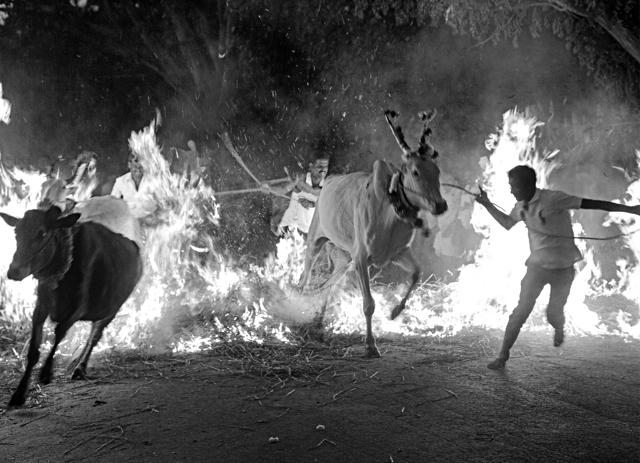
Man’s ability to overcome the fear of fire gave him an evolutionary edge over animals. Animals used for secondary products gained religious importance and were associated with ritual and ceremony.
Considered symbolic of ritual and spiritual purification, these oxen are forced to jump through a blazing wall of haystacks.
Amer Fort, Rajasthan
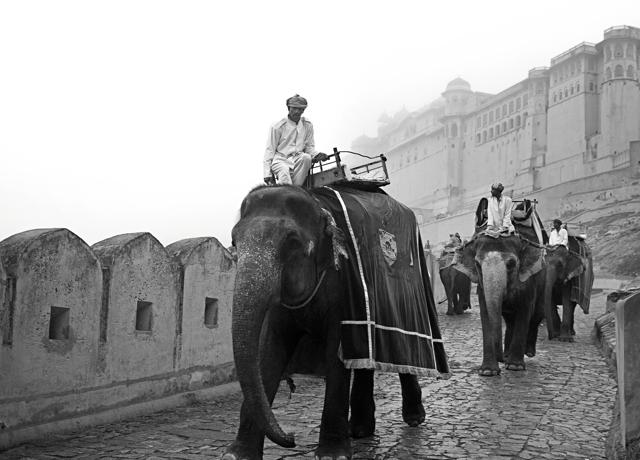
Elephants were first employed in India for war. Today, they are an integral part of temples, religious ceremonies and royal processions.
Forest elephants displaced from their natural wild habitat are used to provide joyrides to tourists in many parts of India.
Gypsy from the expert hunter and trapper Mirshikar community, Bihar
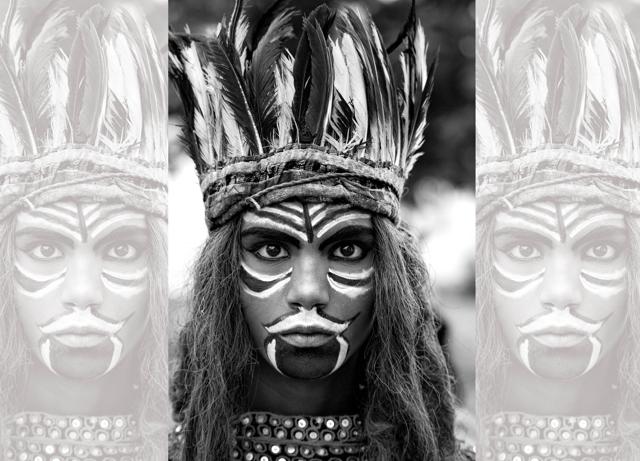
Visual likeness to an animal or bird has a survival advantage in hunting. Feathers, horns and bones are used as adornment in ancient cultures. Mimicry through sound, appearance, behaviour and scent is used to trap and kill prey.
Sand Tapping. Agra, Uttar Pradesh
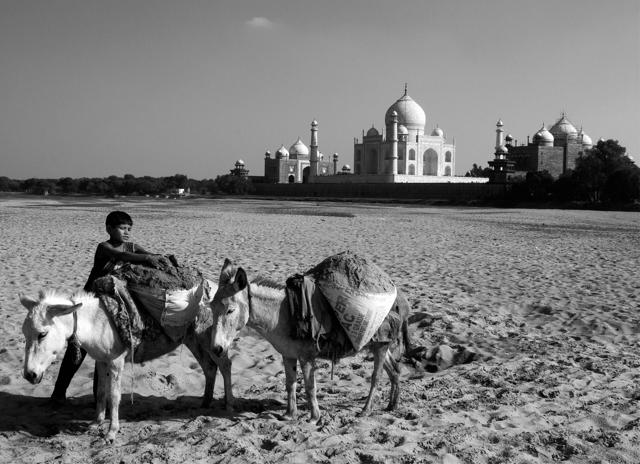
Animals, such as donkeys, that did not have any symbolic significance were neither worshipped nor slaughtered. They were used as beasts of burden to enable humans to work and transport more efficiently.
Man tamed only those wild animals that would lead to a social hierarchy in which humans could assume leadership. Domestication viewed the animal as a resource and led to the next stage of human evolution. Agriculture.
Bakharwal Nomad. Kashmir.
Pastoralism transformed the way humans viewed animals. It marked a significant categorisation of animals and ownership.
There was a clear distinction between wild and tame; game and produce. Animals became the interface between nature and civilisation.
From HT Brunch, September 24, 2022
Follow us on twitter.com/HTBrunch
Connect with us on facebook.com/hindustantimesbrunch


