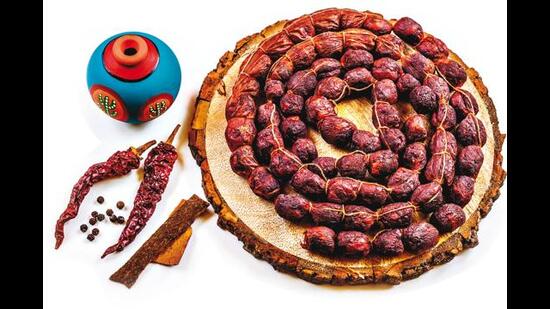
Most of us know the Hank Williams song Jambalaya (or at least the Carpenters’ version). But what we may not know is that jambalaya is a dish from the South of the United States, whose primary constituents include rice and the local, spicy sausage.
Wherever you find rice, you will usually also find a sausage and rice dish. In the Far East, where rice is the staple, it is common to fry it with slices of slightly sweet Chinese sausage. In North Africa, the Merguez lamb sausage goes into rice dishes. And In Italy, spicy fresh sausage adds flavour to risotto.
But the home of the rice and sausage combination is the Iberian Peninsula. The Arabs took rice to Spain, Portugal and other European countries, including Italy, where it found fame in such dishes as risotto and paella. (The name paella may be derived from pulao; the two dishes are similar.) Ironically, the Arabs had no idea that the rice they gave the Europeans would end up being paired with sausages, most of them made from pork, which no Arab Muslim would eat for religious reasons.
It is hard to put an exact date to the invention of the sausage because it seems to have occurred independently in many parts of the world. But we can date the invention of the chorizo, Spain’s greatest gastronomic gift to the world, because it uses pimentón, a powdered dried chilli that is often smoked. So we know that it must be after 1502, the date of Christopher Colombus’s last voyage to South America (where he found chillies) and most authorities date it to sometime in the 16th Century.
{{/usCountry}}It is hard to put an exact date to the invention of the sausage because it seems to have occurred independently in many parts of the world. But we can date the invention of the chorizo, Spain’s greatest gastronomic gift to the world, because it uses pimentón, a powdered dried chilli that is often smoked. So we know that it must be after 1502, the date of Christopher Colombus’s last voyage to South America (where he found chillies) and most authorities date it to sometime in the 16th Century.
{{/usCountry}}It is typical of colonialism that the Spanish created a spicy sausage with South American chillies and then took that sausage back to South America as a Spanish dish. Now, a version of chorizo crops up in nearly every South and Central American country.
At around the same time that Columbus was arriving in a country he mistakenly thought was India, Vasco da Gama was dropping anchor in the real India. The Portuguese came as traders, tried setting up an empire here and were finally restricted to Goa, which they ruled for centuries. Many of the food items they introduced still remain popular there: vinegar, bread, chillies, cashew nuts and the chorizo.
The Portuguese chorizo has a different flavour from the Spanish chorizo (some Portuguese versions use vinegar, for instance) but both countries have two basic types of chorizo – a salami-like dried chorizo that can last for months, and a fresh sausage-like variety that has to be cooked before it can be eaten. The Portuguese popularised the sausage version in Goa. (Perhaps the salami-like version could not last very long in Goa’s heat.)
That sausage, still called chorise, continues to be popular in Goa. It has more chilli than the Portuguese original which is funny because Goans had no idea what chilli was until the Portuguese showed it to them. It is a popular street snack in Goa (as chorise pao) and is a kitchen staple in many Goan households. It is also a constituent of popular Goan rice dishes, either as part of pulao or a fried rice.
You probably know this already either from holidays in Goa or because chorise rice has now started turning up on menus all over India. Its ubiquity coincides with the rise in popularity of the Goa chorise among top chefs all over India. You will often find a dish that is flavoured with chorise on trendy menus. This new-found fame has come as a boon to chorise fans like myself, who used to buy many sausages in Goa and then bring them back to Delhi. Now, there are home cooks who make excellent chorise in Delhi, and most internet meat suppliers will offer some version of the Goa sausage, though the ones I have tried are shamefully inauthentic.
Contrary to what Goans like to think, I have rarely seen chorizo-rice on menus in Portugal and Spain. The Spanish tend to use the salami version of chorizo, and get very agitated when foreign chefs add chorizo to paella. In 2016 when Jamie Oliver published a paella recipe that included chorizo, there was a national outcry in Spain, which increased when the Spanish discovered that chorizo also turned up in paella recipes by Nigella Lawson and Gordon Ramsay.
The Spanish say that if you put chorizo in paella, it will dry up as it cooks, leaking fat into the rice and becoming chewy when the paella is ready. This is probably true but, in my experience, a few, thin slices of chorizo, in rice that is quickly fried, will add flavour without becoming too tough. It’s not haute cuisine, of course, and that may explain why chorizo fried rice remains a simple home-cooking dish in Spain.
With the Goan version of the chorise, which is usually a sausage not a salami, the dryness objection does not hold. Most versions of the Goan chorise tend to fall apart when you cook with them and are so fattily moist that the oil they give out will quickly flavour the rice. In much of Europe, when sausages of any kind are used with rice, they tend to throw away the skin and use the meat inside, which is how the Italians add sausage to risotto and pasta. The Goan chorise breaks free of its skin on its own.
So, is the Goan chorise pulao a traditional dish? The usual recipe is a sort of simplification of the paella method. You cook the chorise with vegetables, onions, spices etc. (the soffritto), then add rice and water or stock and cook until the liquid has evaporated and the rice is done. Goans will tell you that they learned the recipes from their mothers/grandmothers, but there is no agreement over when the dish was invented.
I asked the food writer Marryam Reshii, who is a Goan, how old the dish was. She said she knew it from her childhood in the 1960s and 1970s, but did not think it was particularly ancient. Later, she forwarded me messages from Goan friends who insisted that it was an ancient Portuguese dish.
The chef Avinash Martins said that his Portuguese ancestors always made the pulao and referred me to the Portuguese Arroz Refogado, which he said the dish is derived from.
I asked Rahul Gomes Pereira, the chef who specialises in Portuguese-Goan cooking. He agreed that there may be a link to Refogado, which he described as rice cooked in chicken stock with tomatoes, onions, cloves, pepper and cinnamon. The sausage element however, he said, was a recent short cut.
I am inclined to agree with Rahul. If chorise rice is such an ancient dish then why doesn’t it have a Konkani name? For instance, curry-rice is xit -kodi in Konkani. Why isn’t this ever called xit-chorise?
And finally, the method. Goans all tend to reference the pulao method for making chorise rice. However, a fried-rice method is quicker and often makes for a tastier dish. At Mumbai’s O Pedro restaurant, the late Floyd Cardoz put his mother’s delicious pulao on the menu. But his protégé, Hussain Shahzad, who now runs the kitchen, has changed the recipe. Hussain makes a sauce with chorise and dried shrimp and fries day-old cooked rice with the sauce while adding whatever he has in the kitchen that day: vegetables, bits of pork belly etc.
The result is a perfect chorise rice packed with flavours, moist without being wet, in which every mouthful tastes of chorise but the chorise never overwhelms the other flavours.
So here’s my conclusion: don’t be bound by traditional recipes, which may or not be truly ancient. The taste of Goa’s chorise is one of India’s great flavours. Experiment with it and create your own recipes. It’s hard to go wrong with chorise.