
 E-Paper



Your Type by Tanya George: Colourful language

 Prefer HTon Google


Look around you. Multilingual signs do more than translate. They indicate where a business is from and how far it has come
What if a signboard could tell you who belongs — and who doesn’t? In India, where most people speak more than one language, signs in multiple scripts do precisely that. One message, repeated over and over in a different script? It’s just hoping that its intended audience will understand at least one of them.
In bustling Indian marketplaces, a shop or brand sign must accomplish two goals: Inform (about shops, services, or directions) and persuade (that the goods or services are worth their attention). So, before a designer even begins to choose bright colours or stylish fonts, shopowners must make a key decision: Who’s the sign for? Which communities do they want to speak to? Whom do they want to invite in? In a linguistically diverse India, everyday business rides on this.

Take this sign in Berhampur, at the southern tip of Odisha — it includes English and Odia, but also Telugu, since Telangana lies just a few kilometres away. It visibly affirms who is seen, recognised, and welcomed into public spaces. The idea of a “neutral” language is a myth in India, and barely useful. So, why not embrace the rich diversity instead?
The bonus: The joy in watching languages interact visually. In Ahmedabad’s old city, a garment shop named Autograph uses a handwritten-style English logo with a dramatic underline — and sits between a Gujarati version in the same casual form, and also a Devanagari-based Hindi rendering that omits the headline stroke, so everything matches across scripts.

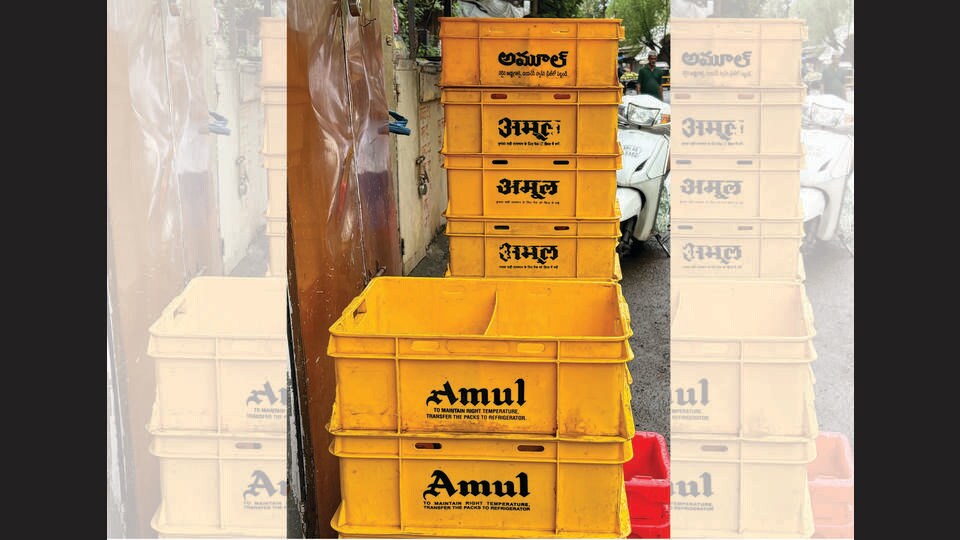
This visual harmony is no accident. My first strong memory of it was the Amul logo. Even as a child, I noticed its Gothic style, originating from scribal traditions in Medieval Europe and a design Gutenberg took inspiration for his first font back in the 1500s. It suggested history, tradition, authority. And in India, where English often represents aspiration, adopting that style seemed to confer legitimacy. Designers have, over the years, created matching letterforms in Indian scripts, as if authority in English visuals could magically transfer across languages by mimicry. It’s fascinating how visual ideas migrate with Amul showing examples of Blackletter Devanagari and Telugu!
The trend continues. Serifs, those pointy strokes at the ends of Times New Roman or Garamond letters, have crept into Indian font designs, lending it a kind of formality. There is no actual historical grounding for these serifs in Devanagari or Malayalam, but they persist. Simple bracketed serifs are used to match the designs for the English and Malayalam letters at this warehouse in Kochi. Many designers believe that there is no space for serifs in Indian fonts. But these designs are not listening to anyone. They’re going nowhere. And as long as someone doesn’t typeset entire books with them, I am happy to not wage a war on them.

Earlier this year, the Supreme Court rejected a challenge to the use of Urdu by a municipality in Maharashtra. “Our misconceptions, perhaps even our prejudices against a language… must be tested against the reality of this great diversity of our nation,” it declared. “Our strength can never be our weakness. Let us make friends with Urdu and every language.” That declaration resonates deeply with me. Why limit signage to just the government‑mandated languages? Let polyglotism be our strength, not our obstacle. Multilingual signs do more than communicate. They affirm identity, invite inclusivity, and celebrate India’s plurality, and that’s a worthy cause to champion.
From HT Brunch, July 26, 2025
Follow us on www.instagram.com/htbrunch


