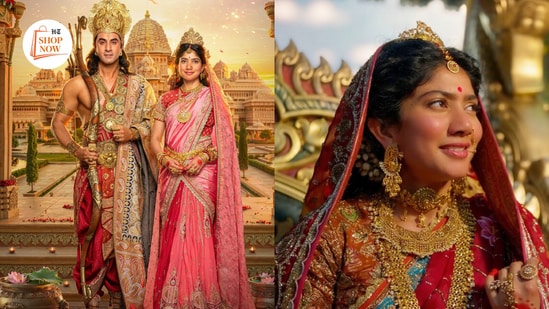
The costumes in Nitesh Tiwari's Ramayana have become a talking point, but there's more to Sai Pallavi's portrayal of Sita than elaborate mythological styling. Behind her onscreen wardrobe is an extensive exploration of Indian textiles, archival embroidery and traditional craftsmanship.
Costume designers Rimple and Harpreet Narula, who have previously worked on period dramas such as Padmaavat and Heeramandi, approached the film with the challenge of dressing characters who already hold a special place in people's imagination. Their starting point was not simply historical research, but the way devotees see and dress their deities in temples, paintings and traditional calendar art.
And the result is a wardrobe that brings together heritage textiles, intricate embroidery and carefully considered details.
Sai Pallavi's Sita wedding sari features fine silk and gold embroidery
One of the most striking pieces in Sita's wardrobe is her wedding sari. The designers created a fine silk sari featuring sucha gold embroidery, complemented by rare embroidery patches from their personal archive.
Rather than relying entirely on new embellishments, they brought together older archival pieces and newer interpretations sourced from dealers. The combination helped create a look that feels rooted in traditional craftsmanship while retaining a cinematic finish.
The designers also studied antique Nepalese textiles while developing Sita's costumes. Since Sita is believed to have been born in Janakpur, they explored the colours, motifs and embroidery found in these historic textiles to inform her visual identity.
An archive of thousands of textiles inspired the costumes
The research behind the film extended far beyond a few reference photographs. The designers revealed that they have an archive of approximately 7,000 to 8,000 old textiles, which they regularly study for historical projects.
For Ramayana, their mood board included works by artists such as Raja Ravi Varma and MV Dhurandhar, alongside historical murals, calendar art and earlier interpretations of the epic.
{{/usCountry}}For Ramayana, their mood board included works by artists such as Raja Ravi Varma and MV Dhurandhar, alongside historical murals, calendar art and earlier interpretations of the epic.
{{/usCountry}}They also collaborated with weaving clusters in Banaras for brocades and developed a sun motif for Lord Ram's Ayodhya sequence. Rare, century-old textiles were sourced from dealers in Ahmedabad, while some traditional shawls came from Uttar Pradesh.
The idea was to bring the richness of Indian textile traditions to a film intended for audiences beyond India.
Cotton, khadi and Chanderi define Sita's vanvaas wardrobe
The film's more understated costumes required just as much thought as its elaborate wedding and royal ensembles.
For the vanvaas sequences, the designers worked with simpler fabrics such as cotton, khadi and Chanderi. These garments were handwoven and dyed using organic colours, with particular attention paid to the natural irregularities and slubs in the fabric.
Instead of making every outfit heavily embroidered, the team used texture to communicate the characters' circumstances and emotional journeys.
The designers explained that the vanvaas makes up a significant portion of the film, with the characters retaining similar outfits through much of this phase. The challenge was to make the clothes look lived-in and aged. They experimented with different washes to achieve that worn-in appearance.
It's an interesting reminder that costume design isn't always about adding more. Sometimes, the texture and fall of a fabric can tell a story more effectively than elaborate embellishment.
The jewellery and craftsmanship behind Sita's look
The costumes were developed alongside the film's jewellery, with the designers collaborating with Amrapali to conceptualise pieces for the characters.
The brand's historical jewellery archives and understanding of traditional techniques informed the designs. Artificial gems sourced from Jaipur were also used to recreate the appearance of precious stones.
The larger costume universe incorporated several traditional materials and craft techniques, with artisans contributing to the handmade armour and other detailed elements.
For the designers, the intention was to create a visual interpretation that felt culturally rooted while allowing the actors enough comfort and freedom of movement.
Why the costumes in Ramayana are worth looking at closely
The conversation around mythological costumes often centres on whether they match familiar depictions of the characters. But the design process behind Ramayana reveals a more layered approach.
By drawing from temple imagery, archival textiles, regional weaving traditions and traditional embroidery, the designers have attempted to create a distinct visual language for the epic.
Sai Pallavi's Sita wedding sari, in particular, is a reminder of how much storytelling can go into a single garment. Beyond its fine silk and gold embroidery, it brings together archival craftsmanship, cultural references and the work of artisans.
It's not just a costume designed for a scene; it's a showcase of the textile traditions that continue to shape Indian fashion.
Similar stories for you:
Ankur Rathee on men's fashion, jewellery and why personal style matters
I tried 3 Typsy Beauty makeup products. Here's what I'd buy again
I bought two V-neck T-shirts, and they've become my everyday staples
Sai Pallavi's Sita wedding sari in Ramayana: FAQs
Who designed Sai Pallavi's costumes in Ramayana?
What inspired the costumes in Ramayana?
Which fabrics were used for the vanvaas costumes in Ramayana?
What is special about Sai Pallavi's Sita wedding sari?
Disclaimer: At Hindustan Times, we help you stay up-to-date with the latest trends and products. Hindustan Times has an affiliate partnership, so we may get a part of the revenue when you make a purchase. We shall not be liable for any claim under applicable laws, including but not limited to the Consumer Protection Act, 2019, with respect to the products. The products listed in this article are in no particular order of priority.
Catch your daily dose of Fashion, Taylor Swift, Health, Festivals, Travel, Relationship, Recipe and all the other Latest Lifestyle News on Hindustan Times Website and APPs.
Catch your daily dose of Fashion, Taylor Swift, Health, Festivals, Travel, Relationship, Recipe and all the other Latest Lifestyle News on Hindustan Times Website and APPs.