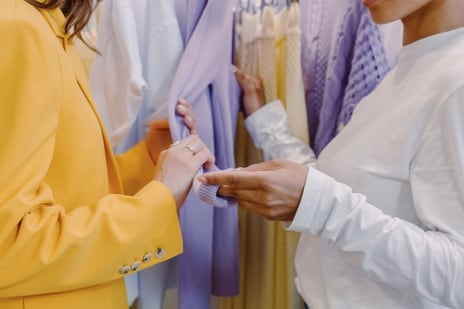
Ever wondered why some outfits immediately look polished and luxurious while others, despite being expensive, don't have quite the same effect? According to designer Payal Jain, the answer isn't about a visible logo, an elaborate embellishment or simply how much a garment costs.
The founder and designer of Payal Jain Design believes that the perception of luxury comes from a combination of details, including fabric, cut, proportions, craftsmanship, finishing and the way a garment sits on the body.
We asked her what makes an outfit look expensive and refined, and her answer offers some useful lessons for anyone looking to build a more polished wardrobe.
1. Start with the fabric
For Jain, fabric is the first thing she considers when evaluating what gives a garment a luxurious appearance.
“What makes a garment look expensive is rarely one obvious thing. It is usually a combination of elements that the eye registers instinctively, from the quality of the fabric to the precision of the cut, the proportions, how beautifully a garment is finished, and how it falls, fits and drapes on the body,” she says.
Her emphasis on textiles is unsurprising given her long association with textile-led design.
“After working with textiles for decades, textile is my very first response, from its inherent character to the depth of its colour, the weave, the texture, and the way it drapes and responds to movement,” Jain adds.
This is an important distinction when shopping for clothes. A fabric does not necessarily need to be the most expensive available to look refined. What matters is how it behaves, holds its shape, catches light and falls on the body.
A fabric with a beautiful drape can often make a relatively simple silhouette feel more considered.
2. Pay attention to fit and proportions
An expensive-looking outfit is not necessarily about having a complicated design. The proportions of the garment can make a significant difference to how the final look comes together.
Jain points to precision of cut and proportion as two of the elements that the eye registers, even when we aren't consciously analysing them.
{{/usCountry}}Jain points to precision of cut and proportion as two of the elements that the eye registers, even when we aren't consciously analysing them.
{{/usCountry}}This is why a simple shirt, pair of trousers or dress can sometimes look more polished than a heavily detailed outfit. When the shoulders, waist, length and overall silhouette are considered carefully, the garment feels intentional.
For everyday dressing, this can translate into paying closer attention to whether your clothes actually fit you rather than simply choosing a particular brand or trend.
A well-cut garment doesn't need to be overly embellished to stand out.
3. Look beyond visible embellishment
When people think about luxury fashion, embroidery and embellishment often come to mind first. But Jain believes craftsmanship extends much further.
“Craftsmanship is equally important, and it extends far beyond embroidery to the construction and finishing, the placement of a motif, a hand-finished edge, and details that never draw attention, yet are crucial to the final garment,” she says.
That last point is particularly relevant.
Some of the details that make a garment feel refined may not be immediately visible. The finishing of an edge, the placement of a print or motif, the construction of a seam or the way different parts of a garment come together can influence how it looks and wears.
In other words, good design doesn't always announce itself.
4. Don't underestimate simplicity
Jain has long been drawn to understated dressing and believes that restraint can be more powerful than adding more elements.
“I have always been drawn to understated simplicity. I genuinely believe less is more,” she says.
That philosophy can be useful when putting together an everyday wardrobe.
Instead of adding statement jewellery, multiple colours, elaborate details and bold accessories to make an outfit feel special, consider whether one or two strong elements are enough.
A beautifully cut blazer with a simple top and trousers, for instance, can create a more polished impression than an outfit where every individual piece is competing for attention.
Simplicity isn't necessarily minimalism. It is about knowing which elements need attention and which can remain quiet.
5. Think about how every element works together
Perhaps the most important part of Jain's advice is that there isn't one single ingredient responsible for making clothes feel luxurious.
“The most luxurious clothes are those where you cannot separate the fabric from the cut, the craft from the proportion, or the detail from the whole,” she explains.
This is where styling and design meet.
A beautiful fabric can lose its impact if the cut doesn't work. Intricate craftsmanship can become overwhelming if the proportions are off. A strong silhouette may not work as intended if the fabric doesn't move or drape properly.
The individual components need to support one another.
6. Balance is harder than adding more
Jain believes that achieving harmony between different elements is one of the most difficult parts of design.
“Nothing feels excessive, all elements simply work in harmony, and together they create what is luxury. The sense of balance is the hardest thing to achieve in design and remains most valuable to me,” she says.
For someone putting together an outfit, this can be a useful rule to keep in mind.
If the silhouette is dramatic, the accessories don't necessarily need to be equally dramatic. If the fabric has a strong texture, you may not need several additional statement details. And if the outfit already has intricate craftsmanship, keeping the styling restrained can allow those details to stand out.
The goal isn't to make every part of an outfit look expensive individually. It is to make the whole look feel considered.
What can make an outfit look more expensive?
Jain's approach comes down to a few fundamentals: quality and character of fabric, precise fit, thoughtful proportions, careful finishing, considered craftsmanship and restraint.
None of these necessarily requires buying designer clothing.
In fact, her emphasis on balance suggests that a more refined wardrobe can often be built by becoming more selective rather than simply buying more.
Look at how a garment is cut. Notice how the fabric falls. Check the finishing. Consider whether the details work together. Most importantly, don't assume that adding more embellishment automatically makes an outfit look more luxurious.
As Jain puts it, the most successful garments are those where “all elements simply work in harmony.”
That may be the most useful lesson of all: when an outfit looks effortlessly expensive, the effort has usually gone into the details you don't immediately notice.
Similar stories for you:
Are we losing personal style? How social media trends are making us dress alike
The 'Quiet Luxury' secret: 5 Simple fashion hacks to look expensive on a budget
5 Capsule fashion investments for September 2026 that skip the microtrend noise
How to make your outfit look expensive, a designer suggests: FAQs
What makes an outfit look expensive?
What does Payal Jain consider the most important element of luxury design?
How can you make everyday clothes look more polished?
Does an outfit need embellishment to look luxurious?
Disclaimer: At Hindustan Times, we help you stay up-to-date with the latest trends and products. Hindustan Times has an affiliate partnership, so we may get a part of the revenue when you make a purchase. We shall not be liable for any claim under applicable laws, including but not limited to the Consumer Protection Act, 2019, with respect to the products. The products listed in this article are in no particular order of priority.
Catch your daily dose of Fashion, Taylor Swift, Health, Festivals, Travel, Relationship, Recipe and all the other Latest Lifestyle News on Hindustan Times Website and APPs.
Catch your daily dose of Fashion, Taylor Swift, Health, Festivals, Travel, Relationship, Recipe and all the other Latest Lifestyle News on Hindustan Times Website and APPs.