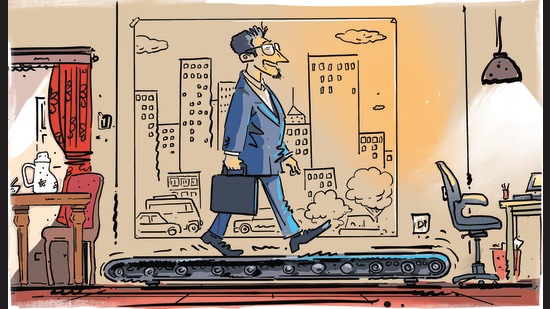
For many, it was the only part of the weekday spent outdoors. It was vacant time that could be used to organise one’s thoughts, construct the day, talk to loved ones or just do nothing.
It wasn’t evident how much this time mattered until it was gone. Since March, the commute has been extinct for most urban Indians. The day begins as soon as one gets out of bed, and continues in relentless monotony, a repetitive cycle of work and chores. In an attempt to alleviate that monotony and reclaim some sense of control, there’s been a trend towards what’s being called the fake commute.
This is the pandemic-era habit of dressing up and stepping out at the same time every day, to take a walk or a ride, get coffee, garden, cycle or meet a friend, all in the hours when one would normally have been commuting.
As the months drag on, people are seeing how the work-from-home model can hamper productivity and damage work-life balance rather than improve it, says management writer Charles Assisi. “People’s lifestyle has gone for a complete toss. Contrary to what was expected, the number of working hours has risen. Many working professionals are also battling mental health issues and physical ailments.”
Fake commutes at the start and end of the day can then act as buffers between work and life, vital bridges between the way things are now and the way they used to be. It’s a good use of this time too, because the alternative — filling it with work or chores — is counterproductive since it adds to the sense of sameness.
{{/usCountry}}Fake commutes at the start and end of the day can then act as buffers between work and life, vital bridges between the way things are now and the way they used to be. It’s a good use of this time too, because the alternative — filling it with work or chores — is counterproductive since it adds to the sense of sameness.
{{/usCountry}}“For many, the commuting was a ritual. It’s a good idea to replace that ritual with a new one — but one that fills this time with a creative or at least a pleasant pursuit,” Assisi says. “That way, the time can be used to help you relax, build up to the day ahead of you, and wind down from it at its end.”
The term “fake commute” is credited to Nils Backhaus, a 34-year-old research and policy adviser for Germany’s Federal Institute for Occupational Safety and Health. He used it to describe the rides he started to take every morning, during the pandemic, before he began each workday from home. In an interview with BBC in September, he described how the fake commute was really a revision of an existing German concept — feierabend, literally, the time after work is completed for the day, and the period when leisure and rest begin.
So how exactly can a fake commute help? “It can become a time for the individual to focus on the things they enjoy,” says psychiatrist Dr Sagar Mundada. “This helps alleviate stress and anxiety, and improve quality of sleep — poor quality and quantum of sleep have been a common problem in the pandemic.”
The fake commute has positive potential in structuring daily schedules too. It can energise the individual, create a sense of anticipation and a sense of satisfaction caused by the positive moments they can look forward to. “The fake commute can thus end up boosting productivity through the day, improving focus and concentration levels, which have been suffering from the sense of fatigue of life in the pandemic,” says Dr Manoj Kumar Sharma, professor of clinical psychology at the National Institute of Mental Health and Neurosciences (NIMHANS).
If you are going to fake it, you should do it right. To create a healthy fake commute …
Set aside a minimum of half an hour. Any less and the impact will be compromised. Try and set this time aside at either the start or end of the work day.
Use the time for an activity you enjoy. Don’t use it to perform chores, send work emails or catch up with to-dos. Pick something that relaxes you and gives you a sense of joy or contentment.
Try and spend this time outdoors. Go for a run, a walk in the park, do some gardening, meet up with a friend.
Step into the sun. Vitamin D deficiencies — already rampant in urban India — are worsening. Use this time to boost immunity and tire your body out in a healthy way, making it easier to also sleep deeply and longer at the end of the day.
Catch your daily dose of Fashion, Taylor Swift, Health, Festivals, Travel, Relationship, Recipe and all the other Latest Lifestyle News on Hindustan Times Website and APPs.
Catch your daily dose of Fashion, Taylor Swift, Health, Festivals, Travel, Relationship, Recipe and all the other Latest Lifestyle News on Hindustan Times Website and APPs.