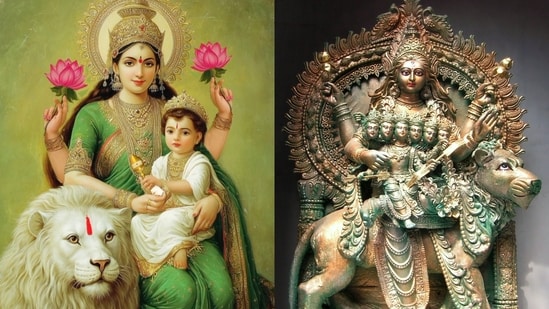
The fifth day of Sharad Navratri honours Maa Skandamata, the mother of Lord Kartikeya. Her image shows her holding her child, a symbol of care, protection and love. But this form of the Goddess can also invite you to reflect on a difficult question: Who takes care of you when everyone depends on you?
Vedic astrologer Poonam Dutta of BV Astro tells Hindustan Times that Skandamata's symbolism can offer a spiritual perspective on hyper-independence, emotional exhaustion and the need to accept support.
Also Read Sharad Navratri Day 4, 2026: What Maa Kushmanda teaches you about joy and self-care
What is the spiritual meaning of Maa Skandamata?
Maa Skandamata represents motherhood, nurturing and protection. Devotees worship her on the fifth day of Navratri and seek her blessings for their families and loved ones.
The astrologer also asks you to look beyond the familiar image of motherhood. If you always care for others but struggle to accept help, you may find it difficult to protect your own well-being.
Her message is not about giving up responsibility. It is about understanding that you can care for others without carrying every burden alone.
Why do you feel responsible for everything?
{{/usCountry}}Her message is not about giving up responsibility. It is about understanding that you can care for others without carrying every burden alone.
Why do you feel responsible for everything?
{{/usCountry}}You may be the person your family calls when something goes wrong. At work, you may handle every detail because you worry that someone else will make a mistake. You might even find it hard to ask a friend or partner for support.
Over time, this pattern can leave you emotionally and physically drained. Maa Skandamata's symbolism offers a moment to consider whether your sense of responsibility leaves enough room for your own needs.
Why is asking for help so difficult?
Hyper-independence describes a pattern in which you rely heavily on yourself and find it difficult to trust others with tasks or responsibilities. Past experiences, fear of disappointment or a desire to maintain control may contribute to this behaviour.
Astrologer Poonam Dutta connects Skandamata's symbolism with learning to trust and share responsibility. You can start small. Choose one task that someone else can handle, explain what you need and resist the urge to take over immediately. However, you do not need to stop caring. You can learn to care without doing everything yourself.
Also Read Sharad Navratri Day 2, 2026: Why Maa Brahmacharini is worshipped and what her blessings represent
Things to practice on the fifth day of Sharad Navratri
You may use the fifth day of Navratri to try one practical change. These steps can help you build healthier habits without neglecting the people who depend on you.
- Delegate one task: Let a colleague or family member take responsibility for something manageable.
- Accept support: If someone offers genuine help, allow yourself to receive it.
- Set a boundary: Say no when your schedule or energy cannot accommodate another request.
- Make time for rest: Protect a short period for a walk, prayer, journaling or quiet time
Also Read Sharad Navratri Day 1 2026: What Maa Shailputri brings to spiritual seekers
What is the spiritual significance of Maa Skandamata?
Some spiritual discussions use the term mother wound to describe emotional pain connected with early experiences of care, attachment or a relationship with one's mother. In certain religious and Tantric interpretations, Skandamata also represents maternal protection.
These ideas belong to different frameworks, so you should not treat them as interchangeable or assume that every difficulty with independence comes from a relationship with your mother. The term Matru Shaapa, mentioned in some spiritual contexts, is a religious concept rather than a medically established explanation for emotional exhaustion.
Maa Skandamata's message can l prompt a useful reflection: you deserve care and support, too. Learning to share responsibility does not make you weak. It can help you build more balanced relationships and protect your well-being.
Disclaimer: This article explores religious symbolism and an astrologer's spiritual interpretation. HT does not claim authority for these practices.