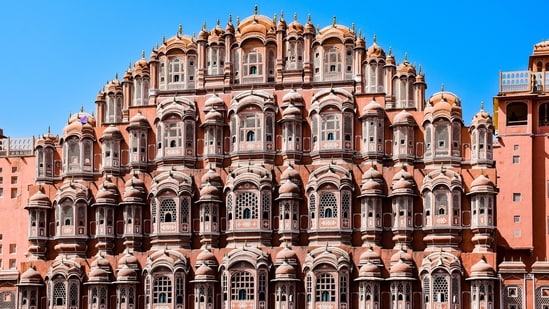
India has a rich trove of architectural history, no matter which corner you travel to. One such architectural marvel, and the most stunning example of Rajasthani royal heritage, is the Hawa Mahal, or Palace of the Winds, in Jaipur, Rajasthan.
Hawa Mahal: Rajasthan's royal legacy
Built in 1799 by Maharaja Sawai Pratap Singh, the grandson of Maharaja Sawai Jai Singh and designed by Lal Chand Ustad, the iconic Hawa Mahal is a landmark situated right in the heart of Jaipur. The monument gets its name from the astonishing 953 windows, also known as ‘jharokhas’, cleverly set into its walls to create a honeycomb cooling system that keeps the palace well-ventilated and cool, even in the sweltering summers of Rajasthan.
According to Incredible India, Hawa Mahal's architecture is a stunning fusion of Islamic and Rajput heritage. Moreover, its lovely red and pink sandstone façade makes it even more iconic, serving as a reminder of Jaipur's other name, the Pink City.
{{/usCountry}}According to Incredible India, Hawa Mahal's architecture is a stunning fusion of Islamic and Rajput heritage. Moreover, its lovely red and pink sandstone façade makes it even more iconic, serving as a reminder of Jaipur's other name, the Pink City.
{{/usCountry}}Moreover, the structure of Hawa Mahal is the jewel in Jaipur’s crown because a pyramidal structure atop it signifies the crown of Lord Krishna. Owing to this resemblance, it is also fondly called 'the crown of Jaipur.'
The tallest building in the world without a foundation
According to Incredible India, at five storeys, Hawa Mahal is also the tallest building in the world without any foundation, and this architectural wonder is possible because it is curved and leans at an angle of 87 degrees.
The first floor houses the Sharad Mandir, which is decorated with colourful cultural glasswork for autumn celebrations. The second floor belongs to Ratan Mandir. The last three storeys constitute Vichitra Mandir, Prakash Mandir, and Hawa Mandir. A museum is also situated inside the Hawa Mahal, which houses Rajasthani miniature art.
The history
Maharaja Sawai Pratap Singh decided to build the palace as an extension of the royal women's chamber. In 1799, the palace was built with the beautiful local pink sandstone. Later, when Queen Victoria's husband, Prince Albert, was about to visit the city, the Maharaja painted the entire city in a romantic, dusky pink hue to welcome him.
The prince and the queen loved the colour so much that they nicknamed Jaipur the 'Pink City'. A law was also passed making it illegal to paint buildings in any colour other than Jaipur Pink, thereby retaining Jaipur's status as the 'Pink City'.
The unique grill, called the Aakash Patal Jali, was added by Maharaja Sawai Pratap Singh with the help of Lal Chand Ustad to allow the ladies to observe the junta around Johari Bazaar while remaining unseen by people on the street.
Catch your daily dose of Fashion, Taylor Swift, Health, Festivals, Travel, Relationship, Recipe and all the other Latest Lifestyle News on Hindustan Times Website and APPs.
Catch your daily dose of Fashion, Taylor Swift, Health, Festivals, Travel, Relationship, Recipe and all the other Latest Lifestyle News on Hindustan Times Website and APPs.