In the sixth phase of the Lok Sabha elections on Sunday, Uttar Pradesh registered the lowest turnout among the seven states that had gone to vote, recording a voter turnout of 54.29% till 8 pm, according to figures released by the Election Commission.
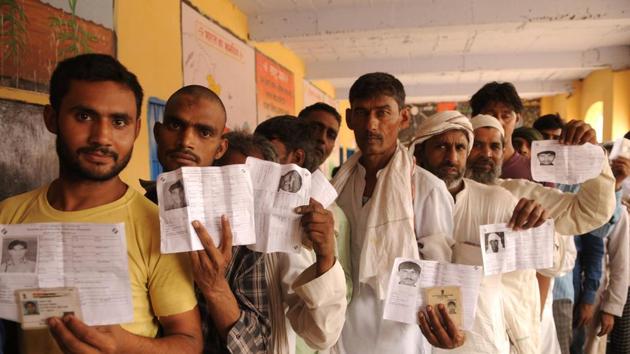
Fifty nine constituencies across 7 states, including all seven Lok Sabha seats of Delhi, went to polls on Sunday, with West Bengal registering the highest voter turnout of 80.35%. The overall voter turnout in the 59 seats that went to polls was 64 per cent.
With the end of the sixth phase of voting, votes have been cast in nearly 89 per cent of the 543 Lok Sabha constituencies. The last phase of voting will take place on May 19 for the remaining 59 seats, after which counting of votes will take place on May 23.
The voter turnout in Delhi was at 59.03% while Bihar was slightly ahead at 59.29% till 8pm, according the voter turnout app released by the Election Commission. Delhi’s voter turnout was about five per cent lower than what it had registered in the 2014 Lok Sabha elections, the Delhi chief electoral officer said, who added that the voter turnout was not as high as was expected by the election commission.
“In 2014, it was around 65 per cent, but this time it might turn out to be around 61 per cent, which is a disappointment,” Delhi chief electoral officer Ranbir Singh said.
{{/usCountry}}“In 2014, it was around 65 per cent, but this time it might turn out to be around 61 per cent, which is a disappointment,” Delhi chief electoral officer Ranbir Singh said.
{{/usCountry}}In Haryana, the voter turnout was 66.95%, Madhya Pradesh registered a voter turnout of 64.22%, Jharkhand saw 64.50% turnout.
Among those who voted in Delhi were President Ram Nath Kovind, Congress’s Rahul Gandhi, Priyanka Gandhi Vadra, Sheila Dikshit, BJP’s Sushma Swaraj, Manoj TIwari Gautam Gambhir, AAP’s Arvind Kejriwal and Manish Sisodia.
Speaking to the media after voting Rahul Gandhi said, “Narendra Modi used hatred in the campaign and we used love and I am confident love will win.”
WATCH: LS polls | In BJP vs Cong vs AAP war, does Delhi mood foretell 2019 result?
When polling started Prime Minister Narendra Modi urged young voters to vote in record numbers. “Yet another phase of the 2019 Lok Sabha elections is here! Urging all those whose constituencies are polling in today’s sixth phase to go out and vote,” the Prime Minister had tweeted.
“I hope youngsters are voting in record numbers. After all, their participation makes the polls even more special,” he wrote. The Prime Minister has tweeted ahead of every phase since the first one to remind voters to cast their franchise.
Among early voters were cricketer Virat Kohli and BJP’s Pragya Thakur, Manohar lal Khattar; Congress’s Jyotiraditya Scindia, Arvinder Singh Lovely and AAP’s Atishi.
In West Bengal, BJP candidate from Ghatal, Bharati Ghosh, alleged she was attacked and heckled by Trinamool supporters when she went to cast her vote.
“I am the candidate. I am being pushed around and heckled. Those assaulting me and preventing my polling agent to enter the booth should be arrested,” said Ghosh.
Read: All eyes on Delhi in 6th round of polling for Lok Sabha elections
Long queues were seen outside booths in Delhi, UP and West Bengal as people tried to beat the mid-May heat. VVPAT glitches were reported from a few places in West Bengal and Delhi.
Among the 979 candidates in the fray are Maneka Gandhi, Varun Gandhi, Rita Bahuguna Joshi, Dilip Ghosh, Meenakshi Lekhi (all BJP), Digvijaya Singh, Jyotiraditya Scindia, Sheila Dikshit, Ajay Maken, Bhupinder Singh Hooda, Kirti Azad (all Congress), Akhilesh Yadav (Samajwadi Party) and Manas Bhunia (Trinamool).
Over 1.43 crore people in Delhi are eligible to vote in this election which will decide the fate of 164 candidates, of which 18 are women. There are 43 independent candidates.
While the BJP, which had won all seven seats in the 2014 polls, is keen to regain the turf, the Congress, that ended up at the third spot in the last Lok Sabha elections, is looking to bounce back. Delhi CEO Ranbir Singh has said all arrangements for voters have been made and paramilitary personnel have been deployed at critical polling stations to ensure smooth polling.
Also read: Key contests to watch out for in phase 6 of Lok Sabha polls
In Uttar Pradesh, the battlefield has now moved eastward, with constituencies such as Sultanpur, Pratapgarh, Allahabad, Ambedkarnagar, Azamgarh, and Jaunpur voting today.
Of the 14 seats, the BJP had won all in 2014, barring Azamgarh, which was won by Samajwadi Party (SP) patriarch Mulayam Singh Yadav. This time, his son and party chief chief Akhilesh Yadav is contesting from here.
The BJP faces a tough challenge now that the SP has forged an alliance with the Bahujan Samaj Party (BSP). It will be a triangular contest between the BJP, the SP-BSP alliance, and Congress in some seats.
In Haryana, the ruling BJP had won seven of the total 10 Lok Sabha seats in 2014, INLD won three, while Congress won two.
Also read: ‘Your participation makes polls even more special’, PM tells young voters
Not only will the BJP be looking to maintain, if not increase, its tally, 2019 will also be a prestige battle for the once- main opposition party, INLD, especially with splinter outfit, JJP, formed by Hisar MP Dushyant Chautala, in the fray.
In Madhya Pradesh, the Gwalior-Chambal region, besides parts of Bundelkhand and central Madhya Pradesh, are voting today.
The eight constituencies include four in the GwaliorChambal region — Gwalior, Guna, Morena and Bhind (a seat reserved for candidates from the Scheduled Caste categories)— and three are in central MP, including Bhopal, Vidisha and Rajgarh. The remaining seat is Sagar, which falls in Bundelkhand region.
In the 2014 elections, the BJP won all these seats, except Guna that was won by Congress general secretary Jyotiraditya Scindia. The saffron party won 27 of the 29 seats in the state. However, the December assembly elections put the Congress back in power after 15 years.
Stakes are high for the BJP in Bihar, as out of the eight seats going to polls in the sixth phase, the party had won seven while its alliance partner, the Lok Janshakti Party (LJP), had won one.
Bihar has already voted for 24 seats out of 40 in the previous five phases.
Vaishali and Purvi Champaran have the maximum number of candidates in a seat, 22 each. While Ram Vilas Paswan’s LJP had won Vaishali in 2014, the BJP had won the rest, including Paschim Champaran, Siwan, and Maharajganj among others.
All the eight constituencies that go to polls in West Bengal today fall in the western part of the state with the most politically significant fight in Medinipur, where the BJP state unit president Dilip Ghosh is pitted against seven-time MLA and former Trinamool Congress (TMC) Rajya Sabha MP Manas Bhunia.
In Jharkhand, all four seats going to polls are held by the BJP. While the BJP has repeated three sitting MPs from their respective seats — Dhanbad, Jamshedpur and Singhbhum — it has given the Giridih seat to its regional ally, All Jharkhand Students Union (AJSU).