The Yogi Adityanath government may not have foreseen the elephant in the room when it had decided to ban illegal animal trade and slaughterhouses immediately after coming to power in March 2017.
After over a year-and-a-half, the UP government has realised the implications of its decision after public outcry over fast-increasing number of abandoned cows and bulls regularly unleashed by farmers when they become unproductive for them.
According to people familiar with the developments, the decision of levying cess to generate additional funds to build cow shelters could have been an outcome of public resentment over stray cattle menace ahead of the crucial Lok Sabha elections.
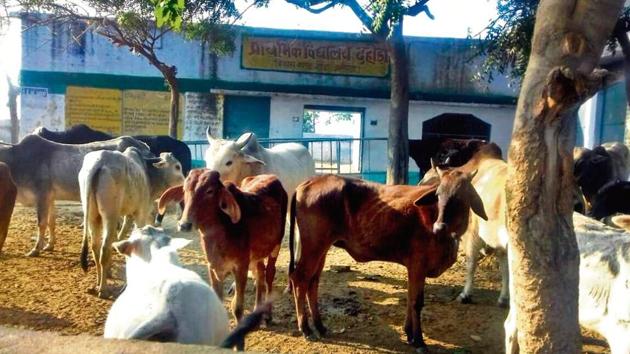
The public anger came to light recently when angry locals started locking up stray cattle in government schools and hospitals in Aligarh, Agra and Mathura districts as a mark of protest giving tough times to authorities.
Principal secretary, animal husbandry, Sudhir M Bobde said: “There is much hue and cry everywhere over large herds of stray cattle destroying crops and causing road accidents. The government could not afford to be a mute spectator to such a burning issue. Hence, the decision to levy cess was taken.”
{{/usCountry}}Principal secretary, animal husbandry, Sudhir M Bobde said: “There is much hue and cry everywhere over large herds of stray cattle destroying crops and causing road accidents. The government could not afford to be a mute spectator to such a burning issue. Hence, the decision to levy cess was taken.”
{{/usCountry}}He said the cess would generate adequate additional funds to set up cow shelters in every village panchayat, kshetra panchayat, zila panchayat, nagar panchayat, nagar palika and nagar nigam.
The UP cabinet had on Tuesday given its nod to a proposal seeking introduction of a ‘gau kalyan’ (cow welfare) cess, an additional 0.5% levy on excise items, to fund construction and maintenance of temporary cow shelters that can be dismantled when not required under all the rural and urban local bodies across the state.
Besides, a cess of 0.5% will be levied on toll tax collected by government agencies and on profit earned by public enterprises and construction agencies while levy on mandi cess will also be enhanced from the existing 1% to 2 % to support the initiative.
“For now, we have only framed the policy. The estimate of fund needed for the purpose and the amount which is likely to come from cess is being made,” Bobde said.
Currently, there is hardly any shelter for stray cattle in Uttar Pradesh. Earlier, the government had made ₹1 crore each available to the district magistrates of all 75 districts to set up a cow shelter in each village panchayat.
“Soon it was realised that the money was too little considering the requirement of more cow shelters in view of the growing number of stray cattle,” said an official who did not wish to be named.
“The government, therefore, came out with the new cess to fund cow shelters to effectively deal with the situation,” he added.
The swelling herds of stray cattle destroying standing crops in the fields in villages and also causing accidents on highways or charging people and disrupting traffic movement in cities had already been worrying the authorities.
The reports of agitated farmers locking up stray cattle into government schools and hospitals and the fear of this becoming a trend is said to have disturbed the government.
“It was felt that if not contained, the cattle menace may become a major issue in the Lok Sabha elections. Hence, the government hurriedly took this unusual but right decision,” another government officer said.