Out of 10,128,663 child labourers in India, UP has 2,176,706, says a report on State of Child Workers in India. . UP’s incidence of child labour (percentage of working children between 5-14 ) is 4.3% as opposed to 3.9% for India, says the report.
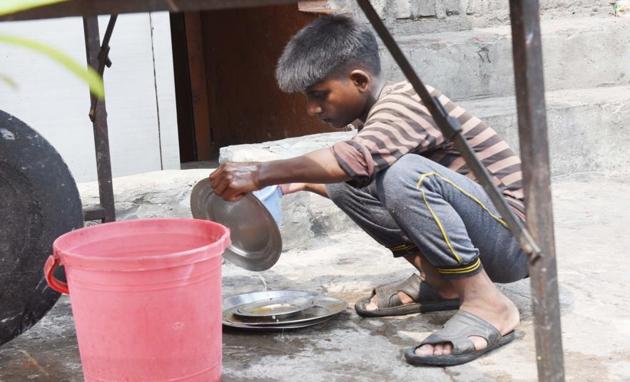
Of India’s top 20 cities in terms of number of child labourers, 13 are in UP, namely Lucknow, Agra, Ghaziabad, Varanasi, Allahabad, Bareilly, Firozabad, Gorakhpur, Jhansi, Mirzapur, Ballia, Faizabad, Gonda. Eight of these are in the top 10. The report is based on study from Census 2001 and 2011 to analyse status of child labour in the country.
The two top-ranking districts in terms of literate children as main workers are in Gujarat, namely, Surat and Ahmedabad, with 78.2% and 78.1% literate children respectively. Further, North 24 Parganas in West Bengal (76.0% ), Bangalore in Karnataka (75.6% ), Pune (75.2% ), Nashik (73.9% ), and Thane (71.3% ) in Maharashtra also stand out as districts with larger proportions of literate child workers.
{{/usCountry}}The two top-ranking districts in terms of literate children as main workers are in Gujarat, namely, Surat and Ahmedabad, with 78.2% and 78.1% literate children respectively. Further, North 24 Parganas in West Bengal (76.0% ), Bangalore in Karnataka (75.6% ), Pune (75.2% ), Nashik (73.9% ), and Thane (71.3% ) in Maharashtra also stand out as districts with larger proportions of literate child workers.
{{/usCountry}}“Among cities, Ballia in Uttar Pradesh had the highest incidence (10.9% ) of child labour, followed by Secunderabad in Telangana with 10.7% , whereas Lucknow in Uttar Pradesh had the lowest incidence of 5.9% ,” stated the report.
Commenting on the statistics,Lenin Raghuvanshi, head of People's Vigilance Committee on Human Rights (PVCHR) and an activist who has been working to curb child labour, said eliminating child labour needed a multi-pronged strategy and the first was to ensure the parents of such children got minimum wages as per the law so that they were able to survive. “If parents earn enough they would think of sending kids to school and not work,” he said, adding: “Also if the primary education and places such as anganwadi centres are functioning well, kids will have a place to stay while parents go to work.”
Patna in Bihar accounts for 55.1% of literate child main workers, Bareilly in Uttar Pradesh accounts for 54.0% of literate child workers and Kurnool in Andhra Pradesh accounts for 49.4% of literate child workers.
WHERE ARE KIDS WORKING
Child workers continue to be engaged, among others, in the footwear industry of Agra, glass industry in Firozabad, silk-weaving industry in Varanasi, zari industry in Bareilly, handmade carpet industry in Mirzapur-Bhadoi and the lock-making industry of Aligarh.
In the glass industry in Firozabad, children work at different stages of production of bangles, utensils, decorative pieces and bulbs. They are introduced to work in the manufacturing units either by their family members or relatives. “Family circumstances and economic conditions are reported as reasons that force the parents to send their children to glass factories,” said the report.
In the carpet belt of Uttar Pradesh, children are forced to supplement the income of their impoverished families that is much below the subsistence level. The static technology with low-level of productivity and low income level generates a situation where the demand for child labour is very high. Employers benefit by employing children, as their wage rate is generally more flexible than that of adults.
In Allahabad, Kaushambi, Varanasi, Jaunpur, Sonebhadra, Faizabad, Sant Ravi Das Nagar (Bhadohi), and Mirzapur districts, zari making is by and large carried out in home-based units of the families that have been engaged in this work for generations.
In Rampur district of Uttar Pradesh, children are engaged in knife-making, beedi making, karchobi (zari) and patch-work. Children work with their family members in their own dilapidated houses or as hired labourers.
In Moradabad district of Uttar Pradesh, child labour in the brassware industry is accepted as a structural phenomenon that gets typically associated with poverty, illiteracy, subsistence wage, low investment, and least mechanization.