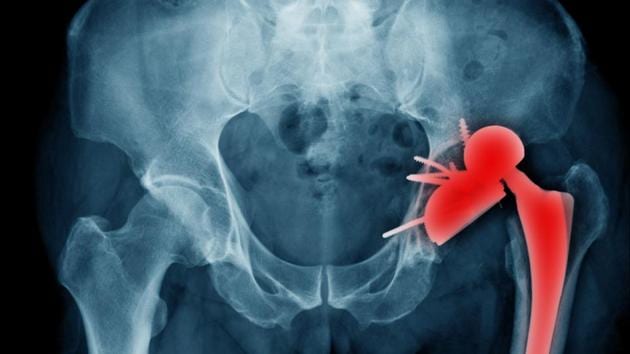
Scientists have developed a new tool that helps to identify which patients undergoing total hip replacement may be at higher risk for an implant dislocation after surgery.
The researchers showed that spinal deformity was a significant risk factor for dislocation and subsequent revision surgery. In a hip replacement, an artificial joint comprising a ball and socket is implanted to replace the natural ball and socket in the pelvis, enabling movement that is typical of the hip joint.
While dislocations only occur in about 1 % of patients after hip replacement, certain individuals may be at a higher risk.
“Dislocation is a common reason for a total hip replacement to fail, and when it happens, sufferers can experience significant pain and require another surgery to fix the problem,” said lead author Jonathan Vigdorchik, assistant professor at the New York University School of Medicine.
For the study, researchers reviewed data on 1,082 total hip replacements performed using computer navigation, during which period no dual-mobility implants were used. The overall implant dislocation rate among this cohort was found to be 1.8 %. Of this group, 320 patients had spinal disease and deformity as evidenced by imaging scans, and of them, 10 experienced dislocations, suggesting a dislocation rate of 3.1 % for high-risk patients, or about three times higher than normal.
The surgeons then used the standardised risk prediction model and treatment algorithm developed at NYU Langone Medical Centre, which factored in data collected from preoperative imaging taken while the patient was sitting and standing, and other measures that might affect risk for dislocation. Using the risk assessment tool, the researchers identified 192 of 1,009 patients as high risk for a dislocation after surgery.
{{/usCountry}}The surgeons then used the standardised risk prediction model and treatment algorithm developed at NYU Langone Medical Centre, which factored in data collected from preoperative imaging taken while the patient was sitting and standing, and other measures that might affect risk for dislocation. Using the risk assessment tool, the researchers identified 192 of 1,009 patients as high risk for a dislocation after surgery.
{{/usCountry}}All 192 patients underwent a total hip replacement through the high-risk algorithm, with dual mobility implants being used in 143 of the cases. The researchers reported only one dislocation in this high-risk group (or 0.5 % of high-risk patients), compared with 3.1 % in the previous group not assessed with the risk assessment and treatment algorithm.
These findings, presented at American Academy of Orthopaedic Surgeons 2018 Annual Meeting, represent a six-fold decrease in the rate of dislocation in the high-risk group.
Follow @htlifeandstyle for more