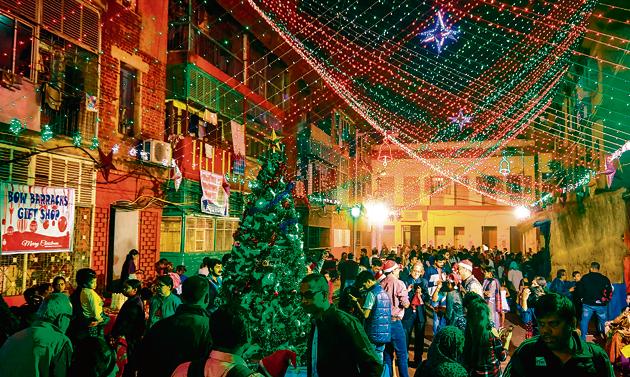
There’s a nip in the Kolkata air and that can mean only one thing – Christmas is peeking cheekily around the corner, reminding us all to be nice, or Santa will put us on his Naughty List and fly by, the cookies and milk bribe notwithstanding. The latest pop songs give way (not too gracefully) to carols, and people hum along while getting their lists together: cake, presents, trees and lights, menus for family lunch or dinner. Food ends up as the centrepiece of every festival celebrated in Kolkata, and Christmas is no different. From the fruit cake to rose cookies and kull-kulls, homemade wine and traditional lunches and dinners, Christmas in Kolkata is one big smorgasbord of culinary delights.
While many rely on the local roti-wala (breadman) and his ready-made cakes, most Anglo-Indian families prefer to ‘make’ their own; that is to say they mix the ingredients at home and then take the mix down to the local bakery for baking, all the while standing watch like hawks over the process so that they “don’t get ripped off, men!”. A month or so before the Big Day, it’s off to New Market to pick up the ingredients from the ‘masala’ range, which takes on a colourful and festive look as each shop displays glass bottles filled with red-yellow-green tutti-frutti, red and green ‘dyed’ orange peels, glazed red cherries, green and black raisins, and almonds, walnuts and cashews.
The market, not the quietest of places in ordinary times, lifts itself up to new decibels of cacophony, each shopkeeper yelling out, “Madam, here Madam... My nuts are best”. This of course elicits much mirth (and smirks) among the shoppers, who steadfastly ignore all entreaties until they have reached ‘their shop’, the one where they faithfully buy their stores through the year. Back home, the tedious task of chopping the ingredients begins, and the raisins and cherries are soaked in rum and brandy. The mix itself also gets a generous dollop of rum to give the cake “a nice kick”.
Besides the traditional fruit cake, other Chrismassy musts are kull-kulls, rose cookies, homemade wine and salted beef. My Nan would make salt meat at home. At least 8 to 10 kg of beef rump, well washed, were soaked in a large earthenware gamla along with salt, saltpetre, lime and water for 10 to 14 days, the meat being turned over every few days so that the liquid can soak in evenly through holes punched in it. After this the beef was given yet another thorough wash, cooked on a slow fire till tender, and finally drained till it was “dry but not so dry that it tasted like cardboard”. This deliciously moreish, tender salt-and-limey beef can be eaten plain, made into sandwiches or added to traditional Christmas dinner as a side dish. There was a time when most families would make this at home but that’s rare now and, sadly, this is a tradition neither my mum nor I took forward. Generations after my Nan’s have taken the shortcut by ordering it from the meat shops in New Market or from the now-erstwhile Kalman’s.
{{/usCountry}}Besides the traditional fruit cake, other Chrismassy musts are kull-kulls, rose cookies, homemade wine and salted beef. My Nan would make salt meat at home. At least 8 to 10 kg of beef rump, well washed, were soaked in a large earthenware gamla along with salt, saltpetre, lime and water for 10 to 14 days, the meat being turned over every few days so that the liquid can soak in evenly through holes punched in it. After this the beef was given yet another thorough wash, cooked on a slow fire till tender, and finally drained till it was “dry but not so dry that it tasted like cardboard”. This deliciously moreish, tender salt-and-limey beef can be eaten plain, made into sandwiches or added to traditional Christmas dinner as a side dish. There was a time when most families would make this at home but that’s rare now and, sadly, this is a tradition neither my mum nor I took forward. Generations after my Nan’s have taken the shortcut by ordering it from the meat shops in New Market or from the now-erstwhile Kalman’s.
{{/usCountry}}Though Bara Din is mostly associated with an elaborate Christmas dinner, this is not strictly the norm. There can be, and are, elaborate lunches too. You are likely to find kofta curry and yellow rice rubbing shoulders with three different types of vindaloo and some kind of roasted bird with stuffing. We get more traditional if we’re doing a dinner. There will be at least a couple of roasts. Turkey and duck are cooked, but they are hard to cook and a bit expensive, so many go for chicken instead. Stuffing made from liver and gizzard is a must, with dollops of garlic butter, parsley and dill. You can go crazy with the salads. From Russian to parsley potato (tossed with bits of crispy bacon, and the bacon oil goes in as well) to potato and mayonnaise with juicy pineapple bits and finely chopped green peppers, and even fresh salad on a bed of lettuce. All this rounded off with soft bread rolls.
Lunch or dinner, there has to be a little something (oh, okay a lot of something!) with which to wash it all down. So there, proudly displayed on the bar, is a variety of homemade wines – grape, raisin, blueberry, and ginger – alongside bottles of rum, whiskey, vodka, gin, brandy; just name your poison. Because it’s a Merry Christmas, isn’t it? And Anglos know how to be merry!
Despite the advent of high-tech everything, I don’t think we’ve lost the ability to keep it as traditional as possible. I know my kids are thrilled with the little tidbits they find in their stockings on Christmas morning. They love putting up the tree and decorations while listening to carols and drinking wine (oh don’t panic... I’m doing the wine-drinking!). They may not really believe in Santa, but why not keep up the game? I think we have held on to the basics and that’s all we can ask for in these quicksilver times.
A very Merry Christmas, and a Happy New Year to all.
--Stephanie Sweeney is a former journalist based in KolkataFollow more stories on Facebook and Twitter