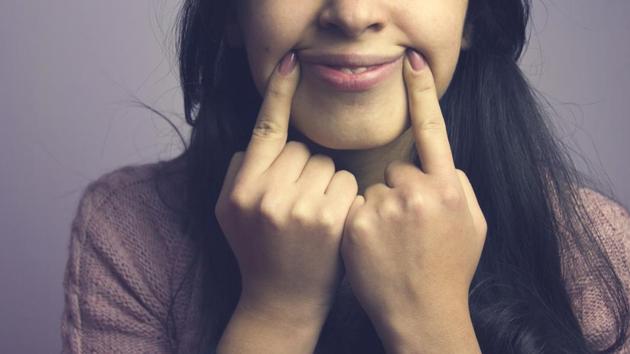
Scientists have decoded three types of smiles that convey expressions other than happiness - reward, affiliation and dominance - and found the facial muscle combinations that make them.
The smile may be the most common and flexible expression, used to reveal some emotions, cover others and manage social interactions that have kept communities secure and organised for millennia.
“When distinguishing among smiles, both scientists and laypeople have tended to focus on true and false smiles. The belief is that if you smile when you’re not happy, the smile is false,” said Paula Niedenthal, a professor at the University of Wisconsin-Madison in the US. “But people smile in many different circumstances and during many emotional states. So asserting that only smiles that result from states of happiness are ‘true’ smiles limits our understanding of this important facial expression,” said Niedenthal.
Researchers from Cardiff University and the University of Glasgow in the UK conducted a set of experiments that seek to expand our understanding of the human smile. They showed three distinct, reliably recognised expressions - smiles of reward, affiliation and dominance - and describing the facial muscle combinations that make them. Each smile hinges on an anatomical feature known as the zygomaticus major, straps of facial muscle below the cheekbones that pull up the corners of the mouth.
Participants in the study looked at thousands of computer-generated expressions with random combinations of facial muscles activated - with one exception. “We varied everything that could be varied in an expression, but our stimuli included some action from the smile muscle, the zygomaticus,” said Magdalena Rychlowska, a postdoctoral researcher at Cardiff. “We asked participants to tell us when they see a reward or affiliative or a dominance smile, and when the expression is not a smile,” said Rychlowska.
{{/usCountry}}Participants in the study looked at thousands of computer-generated expressions with random combinations of facial muscles activated - with one exception. “We varied everything that could be varied in an expression, but our stimuli included some action from the smile muscle, the zygomaticus,” said Magdalena Rychlowska, a postdoctoral researcher at Cardiff. “We asked participants to tell us when they see a reward or affiliative or a dominance smile, and when the expression is not a smile,” said Rychlowska.
{{/usCountry}}The researchers turned their participant-sorted smiles back on two more sets of observers, checking recognition and social messages until they had recipes for each smile. The reward smile is the kind you would use with a baby, so he will smile back or do things you like, researchers said. It is a symmetrical hoist of zygomaticus muscles plus a dash of eyebrow lift and some sharp lip pulling, according to the study published in the journal Psychological Science.
Affiliative smiles - used to communicate tolerance, acknowledgment, or a bond - come with a similar symmetrical upturn to the mouth, but spread wider and thinner with pressed lips and no exposed teeth. Dominance smiles are used to signify status and manage social hierarchies. They dispense with the symmetry, pairing a bit of lopsided sneer with the raised brows and lifted cheeks typically associated with expressing enjoyment. With precise physical descriptions of smile types, researchers can better classify subtypes and study the use and effects of smiles in pivotal human interactions.
Follow @htlifeandstyle for more