In just the first two months and four days this monsoon, Mumbai has already received its entire seasonal average rainfall.
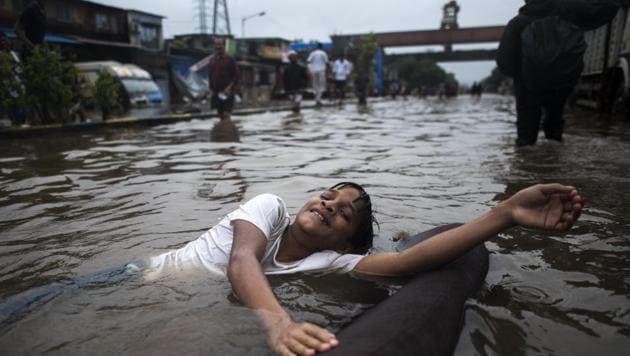
The southwest monsoon spans across four months for Mumbai from June to September, which means excess rainfall will continue for the remainder of the season. The Mumbai suburbs weather observatory recorded 204mm (very heavy) rain over 24 hours (8.30am on Saturday to 8.30am on Sunday) taking the tally for the season to 2,394.3mm (till 8.30pm on Sunday) against the seasonal average of 2,317.2mm.
This is also the second highest 24-hour August rain since 2011. On August 30, 2017, Mumbai recorded 331.4mm, which is the highest for the decade, while 232.9 was recorded on August 29, 2011.
The all-time August 24 hour rain was recorded on August 23, 1997 at 346.2mm.
Last monsoon, Mumbai recorded 2,239.6mm rain over four months, which was 77.6mm less than the season’s average. In 2017, the city had recorded 3,029.9mm rain, the highest in six years.
Over the past 48 hours, Mumbai received 337.9mm rain which took it past the annual average.
Earlier this season, two spells of extremely heavy rain days – July 1 and 2 when 375.2mm was recorded in 24 hours and 219.2mm from July 26 to July 27 – were ‘extreme rainfall’ events that took the record past the season’s average.
Persistent widespread intense rain continued from Saturday night through to Sunday morning, with isolated areas in Mumbai recording ‘extremely heavy’ showers.
{{/usCountry}}Persistent widespread intense rain continued from Saturday night through to Sunday morning, with isolated areas in Mumbai recording ‘extremely heavy’ showers.
{{/usCountry}}Between 8.30am on Saturday and 8.30am on Sunday, south Mumbai recorded 142mm. More rain was recorded in the suburbs during the same time, with some areas such as Malad recording over 400mm in 24 hours, followed by Mulund at 385mm, Powai 325mm, and Bhandup and Jogeshwari-Vikhroli Link Road close to the 300mm mark.
Neighbouring parts of Mumbai, falling within the Mumbai Metropolitan Region (MMR), such as Thane recorded 372mm, Kalyan 307mm, Ambarnath 271mm, Ulhasnagar 240mm, all falling under the ‘extremely heavy rain category’.
Records were broken across areas Alibaug 411mm, which recorded its all-time highest 24-hour rainfall, while Matheran recorded 440mm, Ratnagiri 154mm, and Bulsar 178mm.
The weather bureau categorises rainfall above 204.5mm in a 24-hour period as “extremely heavy”, while 15.6mm to 64.4mm of rain is considered ‘moderate’, 64.5mm to 115.5mm ‘heavy’, and 115.6mm to 204.4mm ‘very heavy’.
The weather bureau said intense rain activity was likely to continue for Thane and Palghar, while Mumbai could expect a drop in rain intensity. On Sunday, the Mumbai suburbs and south Mumbai recorded 20.1mm and 9.6mm from 8.30am to 8.30pm, highlighting a significant reduction in rainfall.
“Rainfall over 24 hours varied across south Mumbai, with most areas receiving 100mm, while parts of the suburbs recorded over 250 mm. Strong westerly winds and heavy showers will continue on Sunday under the influence of weather systems being activated along the west coast due to a low pressure formation over northwest Bay of Bengal,” said KS Hosalikar, deputy director general, western region, India Meteorological Department (IMD).
Private weather forecasting agency Skymet said non-continuous showers were expected through Sunday and rain intensity would reduce from Monday.
“Rain-bearing weather systems are likely to die down by Sunday evening resulting in reduced rain activity from Monday onwards up till August 9 for Mumbai, as the monsoon conditions will shift to south Konkan and interior Maharashtra,” said Mahesh Palawat, vice-president (meteorology and climate change), Skymet.
Independent meteorologists also pointed out that the weather systems that brought heavy rain showers in the MMR during the weekend had weakened. “As a result, the situation started normalising from the second half of Sunday itself. Overall rainfall amount and intensity in the MMR are expected to remain on the lower side during most of the week,” said Akshay Deoras, meteorologist and PhD researcher at the department of meteorology, University of Reading, UK. “Rainfall in the last 24 hours was primarily driven by thunderstorms and concentrated more towards the Thane region than over Mumbai.”
Stay updated with all the Breaking News and Latest News from Mumbai. Click here for comprehensive coverage of top Cities including Bengaluru, Delhi, Hyderabad, and more across India along with Stay informed on the latest happenings in World News.
Stay updated with all the Breaking News and Latest News from Mumbai. Click here for comprehensive coverage of top Cities including Bengaluru, Delhi, Hyderabad, and more across India along with Stay informed on the latest happenings in World News.