They are building metros, they are building airports, they are making the city walkable, they have not only stepped into what was considered to be a man’s world, but have gone way ahead.
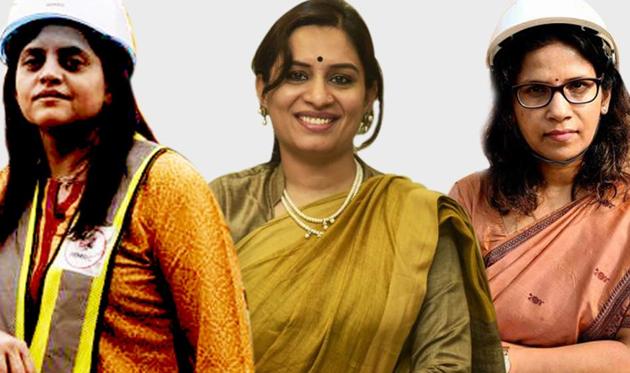
On International Women’s Day (March 8), HT speaks to women officials of the Maharashtra government who are breaking every barrier to change the city’s landscape, improve the quality of life and make it better for its citizens. The challenges they face in the bargain are innumerable - long hours at work, visits to dusty construction sites even at odd hours, staying away from children and juggling between family and work.
What keeps them going, however, is their immense passion and dedication to provide infrastructure that the megapolis deserves. And yes, they are not expecting any special treatment for being women.
‘Being a woman can never be an excuse’
ASHWINI BHIDE, MD, MMRC
She is heading a project which India’s Metro man E Sreedharan has termed the “most difficult, most challenging and the most complex Metro project the country has ever undertaken”.
Dealing with the project, being in a field considered to be male-dominated and not having a background in engineering -- nothing has dithered Ashwini Bhide’s passion for her work. The one principle that the managing director of the Mumbai Metro Rail Corporation (MMRC) has followed in her career spanning more than two decades is “being a woman can never be an excuse”.
{{/usCountry}}Dealing with the project, being in a field considered to be male-dominated and not having a background in engineering -- nothing has dithered Ashwini Bhide’s passion for her work. The one principle that the managing director of the Mumbai Metro Rail Corporation (MMRC) has followed in her career spanning more than two decades is “being a woman can never be an excuse”.
{{/usCountry}}“My first e counter with urban infrastructure was when I was appointed at the Mumbai Metropolitan Regional Development Authority (MMRDA). I was an arts graduate, I had no engineering background and here I was heading several major infrastructure projects in a completely male-dominated arena,” says Bhide. “But I didn’t hesitate to learn on-field. Through the years, I also learnt that projects are not always about engineering, there are a lot of social aspects involved. It needs managerial skills and good co-ordination to complete an infrastructure project.”
An IAS officer from the 1995 batch, Bhide is credited for the execution of several infrastructure projects in the city, including the 16.8-km Eastern Freeway, the Mumbai monorail and the city’s first Metro from Versova to Ghatkopar. Her contribution towards rehabilitating 5,000 families, affected by many infrastructure projects, is also considered to be a case study.
Today, Bhide heads a company that is executing a 33.5-km underground Metro corridor from Colaba in South Mumbai to Seepz in the western suburbs. Once commissioned in 2021, it is expected to change the way the city travels.
Since its inception, however, the project has also been mired in controversy, including resistance to a car-depot in Aarey, tree-cutting across the city and complaints of damage caused to old buildings owing to the works. Family support has given the strength to carry on in her long journey, she says. “My family always understood that the job as an IAS officer in this mega city can be demanding.”
Bhide recalls an incident when she had to take her two young children to Mussoorie, where she had to attend a month-long training programme. “I took special permission to bring my children, my mother-in-law and a house help because my children were very young,” she says. However, Mussoorie was followed by a three-week programme in South Korea, for which Bhide had to seek help from her extended family to look after her children in Mumbai. “I remember when the Milan and Dahisar rail-overbridges were being executed, a major part of the work was to be done at night. I used to be at the site from 11pm to 3am for days,” she says.
‘My journey from Rajasthan to Mumbai feels like a dream’
NIDHI CHOUDHARI, DEPUTY MUNICIPAL COMMISSIONER (SPECIAL), BMC
Tasked with one of the controversial, expansive and ongoing project of dealing with encroachments in Mumbai and freeing public space, Nidhi Choudhari, the deputy municipal commissioner (special) in the Brihanmumbai Municipal Corporation (BMC), says her journey from Didwana (a small town in Rajasthan) to becoming an Indian Administrative Service officer was almost unimaginable.
“I had not been outside my town until I completed my post-graduation. I first stepped outside Didwana when I got a job in the Reserve Bank of India in Chennai. The first job brought a positive change in me, made me more independent,” said Choudhari.
Fighting the probability of child marriage, she said the journey was difficult. “Where I have reached is like a dream,” said Choudhari, who makes it a point to keep ‘Beti Bachao, Beti Padhao’ plank on her desk.
“The journey was not only difficult for me but mostly for my parents who had to hear taunts like ‘will you make her collector and who will marry her?’ My parents were considered unlucky because they had two daughters.”
An IAS officer from 2012 batch, before joining the BMC, Choudhari was the chief executive officer of Palghar district council and assistant collector, Pen sub-division in Raigad district, where she worked to make six tribal blocks free of open defecation and introduced social networking portals. Notably, during her time, the Palghar Zilla Parishad released its first Gender Budget.
In Mumbai, she has been given the task of removing encroachments, including 739 illegal religious structures in the city, which has faced political pressure and also implementing hawkers’ policy. After her appointment in October, the BMC has demolished over half the illegal religious and hawkers’ policy has been moved to final stages of implementation. Choudhari says the present task also requires similar dedication and planning.
Choudhari has also been a front-runner in organising career guidance workshops, talks for employees’ daughters and self-help groups.
“Through my work, my aim is to provide support and motivate all girls. Sometimes, the social pressure may make women think that marriage or having a child is the end of their dream or life. I want all women to be an individual first and then look at different roles.”
‘People don’t judge on gender, but on ability’
PRAJAKTA LAVANGARE VERMA, JOINT MD, CIDCO
She took a 25-day child care leave when her daughter was unwell, but the mother also had another responsibility -- she was the joint managing director of the City and Industrial Development Corporation (CIDCO), which is executing the Rs16,700-cr plus Navi Mumbai airport.
“I had to take care of my daughter but at the same time there were many crucial meetings that I had to attend. I was also working from home to ensure there were no delays,” says Prajakta Lavangare Verma, an IAS officer of the 2001 Maharashtra batch. “All of us struggle to maintain a work-life balance. A male officer may not struggle with the same intensity, but I guess we learn to create a support system over time,” said Verma, whose daughter is in a day-care facility in Navi Mumbai, as Verma spends long hours away from home. Here, she also specifies the need for institutional support that will facilitate women to not give up their careers after marriage or child-birth. “I could not find a lot of day-care centres in south Mumbai. Our society has to create these institutions to support women,” said Verma.
In her 17-year career, Verma has handled several responsibilities, including that of the director general of information and public relations, deputy director general of shipping. She has also been the chief executive officer of the Ahmednagar district and collector at Dhule, which enriched her experience in dealing with both -- rural and urban affairs. Today, she is a part of a project that is going to have major impact on the megapolis. The second airport, which is meant to ease the load off the congested Mumbai airport, is expected to take off by the end of 2019. The state government is keen to get the project started early, which means Verma and her colleagues have to work at breakneck speed.
Her job involves planning and execution of work and getting the villagers who are losing land to the project, on board. Ask her about the struggle of being a woman officer in the infrastructure arena, which is considered to be a man’s world, and Verma lists out the benefits of the gender. “The most challenging aspect of the executing the airport project is rehabilitation of 3,000 families who will be affected by land acquisition. A woman officer makes a huge difference here when it comes to getting villagers’ trust. We are here with them,” she said.
She said infrastructure projects are not devoid of human issues. “Although it is a technical field, it is traditionally a male-dominated area. To say that infrastructure projects are devoid of any human issues would be wrong. The main stakeholders -- the villagers in this case -- don’t judge you based on your gender, but solely your ability as an officer who can resolve their issues,” she said.
Stay updated with all the Breaking News and Latest News from Mumbai. Click here for comprehensive coverage of top Cities including Bengaluru, Delhi, Hyderabad, and more across India along with Stay informed on the latest happenings in World News.
Stay updated with all the Breaking News and Latest News from Mumbai. Click here for comprehensive coverage of top Cities including Bengaluru, Delhi, Hyderabad, and more across India along with Stay informed on the latest happenings in World News.