The city loses 27% or 900 million litres of water every day owing to pipeline leakages and water thefts even as it reels under a 20% water cut.
Could this have been prevented by the Brihanmumbai Municipal Corporation (BMC)?
The answer is yes.
More than half the water Mumbai is losing currently could have been saved if the BMC had just followed its own plans. This included replacing old, creaky and dilapidated pipelines, a project pending since 2014.
Experts have time and again pointed out how the city’s age-old pipelines are in the need of urgent repairs.
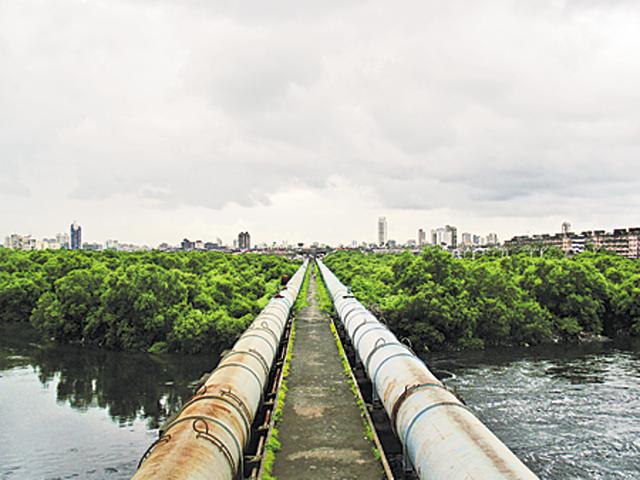
Consider this: The BMC’s ambitious plan to replace the old Tansa pipeline is yet to be completed. The 200-km line was to be replaced two years ago. But the civic body has so far managed to replace only 70% of the Tansa network, said civic officials.
The civic body has also been unable to carry out work to strength Upper Vaitarna and Modak Sagar lakes’ water network as the water bodies have seen continuous operations since 1974 and 1958, respectively. The civic body had also planned to replace around 170km of water pipelines in the city owing to thefts, leakages and rising contamination complaints. However, the plan remains pending.
There are about 27 service reservoirs (local reservoirs) that were to be structurally repaired, but with a shortage of water, the plan has been put on hold as the civic body cannot afford any more water cuts to carry out repair works. Even the repair of the Bhandup reservoir has been put on hold. The he reservoir has not been repaired for the past 30 years, said civic sources.
{{/usCountry}}There are about 27 service reservoirs (local reservoirs) that were to be structurally repaired, but with a shortage of water, the plan has been put on hold as the civic body cannot afford any more water cuts to carry out repair works. Even the repair of the Bhandup reservoir has been put on hold. The he reservoir has not been repaired for the past 30 years, said civic sources.
{{/usCountry}}To add to the mess, plans such as a automated meter reading plan for 100% metering and the Sujal Mumbai Abhiyan, for better water supply in the city, have not yielded any positive results.
A civic official, said, “We are trying to build larger pipelines and tunnels to replace the older rusty ones. About 70% of the network has been replaced. We plan to replace pipelines between Bhandup and Powai this year. Plans to repair reservoirs are also underway.”
Critics said the BMC does not have a map to detect the pipelines, let alone repair them. Gautam Kirtane, a research fellow from Observer Research Foundation (ORF), Mumbai said, “The replacement of pipelines would have conserved water, but more importantly, the civic body should know where these pipelines are and whether they have been damaged or need to be repaired. GIS mapping of pipelines should have been in place by now and this would have helped solve the leakage and contamination issue.”
Stay updated with all the Breaking News and Latest News from Mumbai. Click here for comprehensive coverage of top Cities including Bengaluru, Delhi, Hyderabad, and more across India along with Stay informed on the latest happenings in World News.
Stay updated with all the Breaking News and Latest News from Mumbai. Click here for comprehensive coverage of top Cities including Bengaluru, Delhi, Hyderabad, and more across India along with Stay informed on the latest happenings in World News.