
 E-Paper



What awaits Mexico’s first female president
As Mexico’s first female president, Sheinbaum faces high expectations, particularly from the country’s active feminist movement.

 Prefer HTon Google


The Latin American region has been characterised by anti-incumbency for the past decade-and-a-half, with incumbent parties losing in all but three of the past 20 free and fair elections. On Sunday, Mexicans bucked that trend by voting in Claudia Sheinbaum from the Morena party with a decisive mandate of 32 million votes, more than double those received by her closest rival Xóchitl Gálvez. Sheinbaum benefits from the popularity of her predecessor Andrés Manuel López Obrador, commonly known by his initials, AMLO.
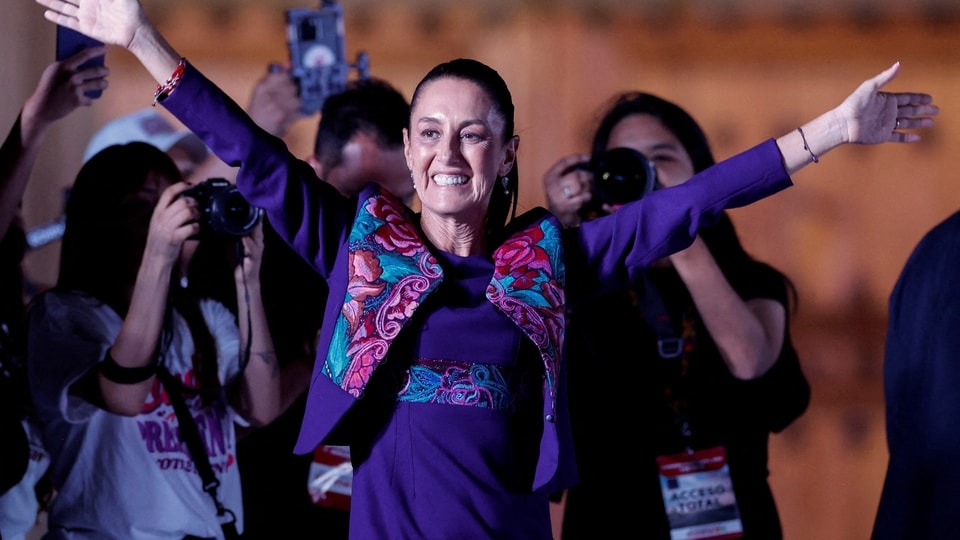
As Mexico’s first female president, Sheinbaum faces high expectations, particularly from the country’s active feminist movement. Sheinbaum also bears the responsibility of being only the third Leftist candidate to be elected president in Mexico, after Adolfo López Mateos in 1958, and AMLO in 2018. She inherits both the good and the bad from AMLO — her coalition’s majority in both houses of parliament will grant a long honeymoon period, and she will benefit from Mexico’s propitious position as a nearshoring destination bordering the United States (US); but she will also have to contend with an exceedingly high budget deficit and rising levels of violence.
At the outset, Sheinbaum must confront two immediate domestic challenges. The first is a perennial problem that has stumped Mexican leaders for the past three decades – rising levels of violence stemming from drug trafficking and gangs. But this is a near-impossible task for Sheinbaum or indeed anyone occupying the country’s highest office. Mexico has the grave misfortune of being sandwiched between producers of cocaine to its south and massive consumers of the drug to its north; this equation will not change anytime soon and will prove to be a challenge for the remainder of Sheinbaum’s term.
The second and, perhaps, more pressing challenge facing Sheinbaum is her ability to grow out of AMLO’s shadow. Many of her critics paint her as a stand-in for her predecessor — but this may be premature. AMLO ends his six-year term with approval ratings of 60% and will not want to taint his legacy by overstaying his welcome, even if it is from the shadows. It would be a mistake to underestimate Sheinbaum, the daughter of two Jewish immigrants and intellectuals, who has transitioned seamlessly from the world of science and academia to the unforgiving arena of politics. A renowned physicist with a doctorate in energy engineering, Sheinbaum is not a conventional politician. She proved her credentials as mayor of Mexico City during the Covid-19 pandemic, often implementing policies contrary to AMLO’s rather sceptical approach towards combating the virus.
These elections will have repercussions in Mexico’s neighbourhood, specifically in the US but also in the Latin American region. Sheinbaum and her Morena party have many detractors in the US, some of whom even view her as a threat to Mexican democracy due to her party’s overarching influence across institutions in Mexico. Such fears are overblown. Mexico is not a perfect democracy and faces several challenges, but to term these as existential issues seems exaggerated. The re-election of Morena bodes well for Leftist political parties in Latin America, which are in power in many countries in the region, including Brazil, Colombia, and Chile. The Left is cementing its place as a recurring actor in mainstream politics in Latin America.
The Mexican economy has only grown in strength over the past decade. Today it is the 12th largest economy measured by gross domestic product, larger than South Korea, Spain, or Indonesia. Much like India, Mexico has a fast-growing middle class and a rather young population and has reaped the benefits of the realignment of global value chains away from China to countries more amenable to the West.
Mexico is also one of India’s most important partners in the Latin American region, second only to Brazil. Today, India exports more to Mexico than to Japan, and India-Mexico trade is more than India’s trade with Canada, Nigeria, or Spain. More than 200 Indian companies have invested $3 billion in Mexico over the past two decades. Despite its domestic preoccupations, New Delhi should court Mexico as a partner in economic diplomacy. The Latin American region remains the last frontier in India’s foreign policy calculus, and Mexico’s salience is only growing with time.
Hari Seshasayee is a Latin America-based analyst and a visiting fellow of the Observer Research Foundation. The views expressed are personal


