As a child soldier with Nepal’s Maoists, Mira Rai learned to fire guns, disarm opponents and race down trails, little imagining that her guerrilla training drills would one day help make her one of the world’s top ultra marathon runners.
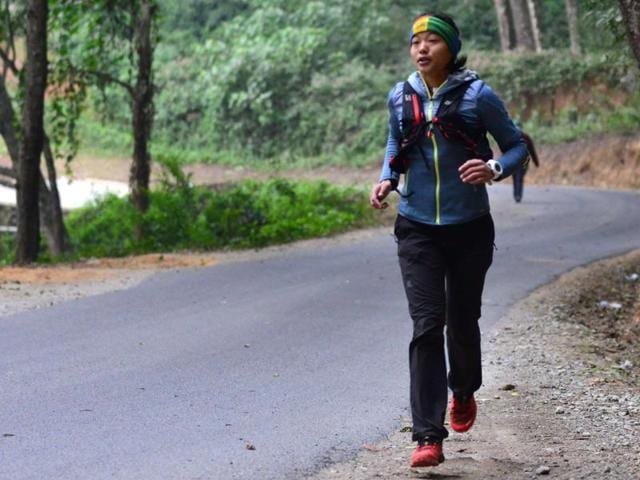
“It is like a dream, beyond anything I ever imagined. I was just a girl from a village,” Rai told AFP.
The daughter of a poor Nepali farmer, Rai was only 14 when she ran away from home to fight alongside Maoist rebels seeking to overthrow the government.
“In our society, girls are supposed to behave in a certain way. I didn’t want to be confined by that,” said Rai, now aged 26.
She chafed at the rules she was expected to obey as a teenage girl living in a patriarchal country and the Maoist call for revolution resonated with her. “The Maoists gave opportunities to women, they treated us equally. I saw that women could fight like men, be brave. I built up my confidence there,” Rai said.
She practised firearm drills and competed with other cadres in running contests designed to build endurance. “I did very well, I even used to outrun the boys,” she recalled.
{{/usCountry}}She practised firearm drills and competed with other cadres in running contests designed to build endurance. “I did very well, I even used to outrun the boys,” she recalled.
{{/usCountry}}Today, Rai ranks among the world’s leading ultra runners after a record-breaking win in the 80-kilometre (50-mile) Mont Blanc race in Chamonix, France, last June, when she beat her nearest rival by 22 minutes. Any distance greater than that of a regulation marathon (42.195 km) is considered an ultra marathon, but they generally start from 50 km and upwards.
But when the decade-long insurgency ended in 2006, Rai, like many Maoist foot soldiers, was left with little in the way of cash or career prospects. Desperate for work, she prepared to leave Nepal for a job in a Malaysian electronics factory before being scouted by a Kathmandu-based karate instructor, Dhurba Bikram Malla, who urged her to stay.
Rai gave up her plans and started training -- initially doing practice runs on the capital’s congested roads because she could not afford the 15-cent bus fare to the nearest stadium.
“She was very single-minded. If you told her to do something, she would just do it,” Malla told AFP.
“She is very consistent in her speed (and) never seems to get tired.”
Running in $4 shoes
Rai made her racing debut in March 2014, running a steep 50-kilometre course along the hills overlooking the Kathmandu valley. Dressed in a cheap t-shirt and shoes that cost $4 (about Rs 265), she ran for hours before she felt dizzy and stopped.
“I borrowed money to buy juice and noodles and started running again,” she said.
Soon, Rai crossed the finish line, winning her first race and prizes that included a new pair of running shoes.
Since then, she has notched up an impressive set of victories, bagging gold in 13 of the 20 national and international races she has taken part in, including Italy’s 83-kilometre Trail Degli Eroi. Her victory at Chamonix vaulted her to second place among female ultra runners in the Skyrunners World Series which involves races in five continents.
Although Nepal is considered an ideal spot for trail running, racing remains a niche activity with the Himalayan nation hosting just a handful of events each year, including the world’s highest marathon held in the foothills of Mount Everest.
Other Nepali athletes are making their mark in ultra running, with soldier Samir Tamang crowned Asian men’s skyrunning champion after winning this year’s 50-kilometre MSIG Sai Kung 50 in Hong Kong.
Both Rai and Tamang are supported by Trail Running Nepal, an organisation that promotes ultra running, but finding sponsors is a challenge for local athletes.
“Sponsorship is near impossible,” Richard Bull, founder of Trail Running Nepal, told AFP.
“For trail running to grow in Nepal, we need people to organise (more) races. If it grows, then finding sponsors will be easier.”
Rai, now sponsored by the multinational sports equipment company Salomon, is a rare success story, with a recent race yielding $1,500 in prize money, double Nepal’s annual per capita income.
Yet she shrugs off her accomplishments, insisting she has been lucky.
“I have been fortunate to get opportunities... I want to inspire other women, tell them that nothing is impossible if we work hard,” she said.
“There must be so many other Mira Rais in Nepal.”