People living at Sector 3 in Panchkula had a reason to feel safe even when Sirsa-based Dera Sacha Sauda followers were adding up by the hour before the CBI court verdict on Friday.
The army’s Western Command headquarters at Chandimandir is just minutes away. Much closer than it is to our home, two kilometres away in Chandigarh.
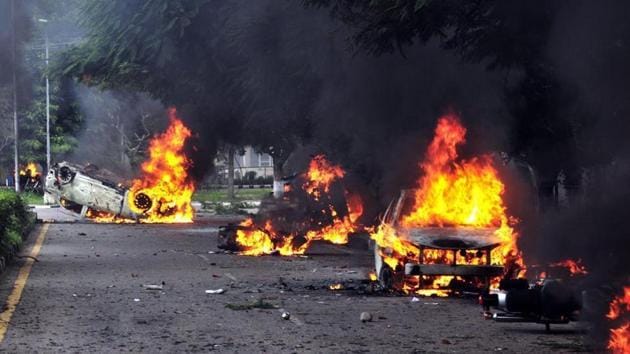
But within minutes of the CBI court holding sect head Gurmeet Ram Rahim Singh guilty of rape, we could see a cloud of dark smoke over Panchkula and heard gunshots from our rooftop.
In no time, friends and acquaintances living in nearby sectors started sending videos and pictures with one of them of a blood-stained man lying outside a house.
And this all bore an eerie resemblance to what I saw last year when Rohtak burned in the wake of the Jat quota riots.
This time, it was happening closer home, in the posh suburb of Chandigarh that houses most of Haryana government offices and officers. The Rohtak mayhem was a scene out of medieval times. Right from the toll plaza at the entry of the town to schools, shops, hospitals and homes, there was a method to the way the rampaging mobs targeted non-Jats and their properties. It was only after the protests had turned violent on February 18 that the Manohar Lal Khattar government requisitioned the army.
The deployment, the government had then claimed, was hampered for a day as protesters had laid siege to highways and the first batch of troops had to be flown in by Indian Air Force choppers. The troops had then carried placards of ‘Army’ written in bold red letters while holding a flag march in Rohtak on February 20! The arson and rioting had continued till next day and then Haryana DGP Yash Pal Singhal had told journalists that “people who are protesting are also residents of Haryana. There is no provision in law to give a free hand to the Army. Army is deployed in a state for the aid of civil administration. It is not deployed to kill people.”
{{/usCountry}}The deployment, the government had then claimed, was hampered for a day as protesters had laid siege to highways and the first batch of troops had to be flown in by Indian Air Force choppers. The troops had then carried placards of ‘Army’ written in bold red letters while holding a flag march in Rohtak on February 20! The arson and rioting had continued till next day and then Haryana DGP Yash Pal Singhal had told journalists that “people who are protesting are also residents of Haryana. There is no provision in law to give a free hand to the Army. Army is deployed in a state for the aid of civil administration. It is not deployed to kill people.”
{{/usCountry}}Having learnt his lessons from handling of the Jat agitation last year, the Haryana CM had already sounded the Centre early on and the Army was kept on standby in Panchkula. But it took over only after some Haryana cops were seen abandoning their posts and paramilitary forces were outnumbered by the protesters.
The Rohtak police had then blamed a video of Jat students being allegedly beaten up by some cops going viral on social media on February 18 and flash mobs coming from villages in tractors, cars and vans with rods and petrol bombs after setting fuel stations on fire. So the Haryana government had banned mobile internet a day before the verdict. In hindsight, the government would know a “peaceful gathering” — as one of Khattar’s key ministers Ram Bilas Sharma described it a day before the verdict — does not need internet to go unruly. All it took was a war cry from the followers.
Like in Rohtak, the state intelligence agencies had warned of violence in Panchkula but the signals were ignored. The followers walked into Panchkula holding bags, passing police check posts. They were not stopped nor checked. If the Khattar government had excuses for letting Rohtak burn, it now has an apology. The CM has admitted to lapses in handling the Dera situation. While another commission of inquiry will be formed to look into the lapses and loss of life and property will be quantified, there is also a psychological cost to the rioting. The OPD (outpatient department) of psychiatry department at PGI, Rohtak, had reported cases of post-traumatic stress disorder after the violence. People came complaining of severe anxiety, fear, flashbacks and nightmares days after riots ended. Another year and another town in Haryana has been left with similar scars.