An astronomer who claimed a piece of one of Elon Musk’s Falcon 9 booster rockets was going to slam into the moon in March has admitted making a mistake — he now says the hunk of space junk belongs to a Chinese rocket.
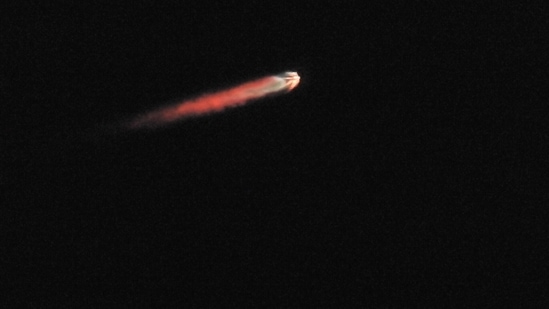
Bill Gray set the astronomy world abuzz when he made a very specific prediction about a moon impact on March 4, 2022.
While Gray has slightly tweaked his calculations to put the impact a few kilometers away from the original impact spot, he now thinks the “long cylinder, spinning slowly” is not part of a Space Exploration Technologies Corp. booster, but belongs to a Chinese rocket sent to the moon in October 2014.
In an amended blog post at the weekend, Gray, of Project Pluto, which supplies software to amateur and professional astronomers, wrote: “We now know that this object is not actually the SpaceX booster: that was a misidentification, by me.”
And in a fresh post entitled “Corrected identification of object about to hit the moon,” he wrote: “Back in March 2015, I (mis)identified this object as 2015-007B, the second stage of the DSCOVR spacecraft. We now have good evidence that it is actually 2014-065B, the booster for the Chang'e 5-T1 lunar mission. (It will, however, still hit the moon within a few kilometers of the predicted spot on 2022 March 4 at 12:25 UTC, within a few seconds of the predicted time.)”
So if it isn’t a part of Elon’s rocket, where did that end up?
{{/usCountry}}So if it isn’t a part of Elon’s rocket, where did that end up?
{{/usCountry}}“I wish I had a good answer,” Gray wrote. “But I strongly suspect that no one does. I don’t think SpaceX knows. If they did they could have raised their hand in the last couple of weeks and said ‘That’s not our rocket stage hitting the moon.’”
Gray said his best guess is that the booster followed the DSCVR weather satellite launched by the Falcon 9 on its million-mile journey into deep space, and is now probably in an orbit around the sun.