NASA's new moon rocket sprang another hazardous leak Saturday, as the launch team began fuelling it for lift off on a test flight that must go well before astronauts climb aboard. However, NASA later posted that the launch controllers had resumed the flow of liquid hydrogen to the core stage after the leak.
“Launch controllers have resumed flow of liquid hydrogen to the core stage after warming up a quick disconnect in the engine section where a hydrogen leak was detected in the cavity between the ground and flight side plates of the quick disconnect. Teams warmed up the quick disconnect to attempt to reseat it and set a proper seal,” NASA stated in its blog post.
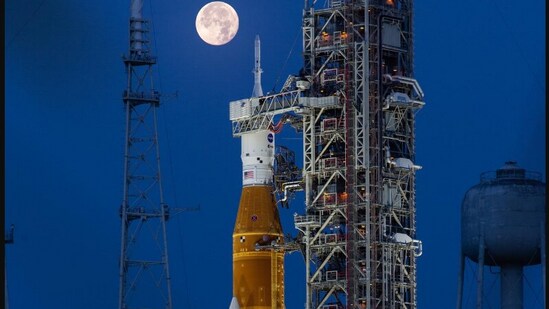
For the second time this week, the launch team began loading nearly 1 million gallons of fuel into the 322-foot (98-meter) rocket, the most powerful ever built by NASA. Monday’s attempt was halted by a bad engine sensor and leaking fuel.
As the sun rose, an over-pressure alarm sounded and the tanking operation was briefly halted, but no damage occurred and the effort resumed, NASA's Launch Control reported. But minutes later, hydrogen fuel began leaking from the engine section at the bottom of the rocket. NASA halted the operation, while engineers scrambled to plug what was believed to be a gap around a seal.
The countdown clocks continued ticking toward an afternoon lift off; NASA had two hours Saturday to get the rocket off.
{{/usCountry}}The countdown clocks continued ticking toward an afternoon lift off; NASA had two hours Saturday to get the rocket off.
{{/usCountry}}NASA wants to send the crew capsule atop the rocket around the moon, pushing it to the limit before astronauts get on the next flight. If the five-week demo with test dummies succeeds, astronauts could fly around the moon in 2024 and land on it in 2025. People last walked on the moon 50 years ago.
Forecasters expected generally favourable weather at Kennedy Space Center, especially toward the end of the two-hour afternoon launch window.
At the same time, the rocket's lead engineers expressed confidence in the tightened-up fuel lines and procedure changes.
On Monday, a sensor indicated one of the four engines was too warm, but engineers later verified it actually was cold enough. The launch team planned to ignore the faulty sensor this time around and rely on other instruments to ensure each main engine was properly chilled.
Before igniting, the main engines need to be as frigid as the liquid hydrogen fuel flowing into them at minus-420 degrees Fahrenheit (minus-250 degrees Celsius). If not, the resulting damage could lead to an abrupt engine shutdown and aborted flight.
Mission managers accepted the additional risk posed by the engine issue as well as a separate problem: cracks in the rocket's insulating foam. But they acknowledged other problems could prompt yet another delay.
That didn't stop thousands from jamming the coast to see the Space Launch System rocket soar. Local authorities expected massive crowds because of the long Labor Day holiday weekend.
The $4.1 billion test flight is the first step in NASA's Artemis program of renewed lunar exploration, named after the twin sister of Apollo in Greek mythology.
Twelve astronauts walked on the moon during NASA’s Apollo program, the last time in 1972.
Artemis — years behind schedule and billions over budget — aims to establish a sustained human presence on the moon, with crews eventually spending weeks at a time there. It's considered a training ground for Mars.