As the chequered flag fell on a chaotic, rain-soaked afternoon at Interlagos, George Russell crossed the line in fourth and Kimi Antonelli safely secured fifth. In that single instant, an agonising five-year wait ended. The Silver Arrows had flown back to the absolute summit of Formula 1.
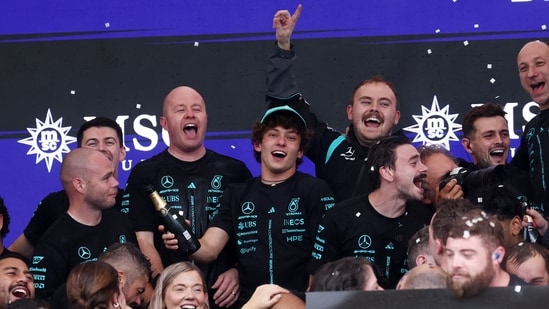
Down in the pit lane, the tension and anticipation that had gripped the Mercedes garage the entire weekend dissolved into a thunderous roar of jubilation. Toto Wolff was at the centre of it all.
Usually the epitome of stoic Austrian intensity behind his headset, the Mercedes team principal let loose entirely. Jumping, dancing, and leading the charge with arms outstretched, Wolff hugged mechanics, engineers, and strategists alike; his energy set the tone for a team that had climbed back to the top.
“It was a very strong beginning of the season that got us over the line. These last few races have been challenging,” said an elated Wolff. “I'm so proud of the organisation. We've taken a few years to be back on the top spot, and not many teams have been able to come back from that situation.”
This triumph in Sao Paulo capped off a brilliant fortnight for the German outfit. Just seven days prior in Mexico City, prodigy Andrea Kimi Antonelli delivered a historic masterclass to seal the world drivers’ championship, cementing his status as the youngest champion in the history of Formula 1.
{{/usCountry}}This triumph in Sao Paulo capped off a brilliant fortnight for the German outfit. Just seven days prior in Mexico City, prodigy Andrea Kimi Antonelli delivered a historic masterclass to seal the world drivers’ championship, cementing his status as the youngest champion in the history of Formula 1.
{{/usCountry}}Witnessing the sensational 20-year-old Italian clinch his maiden crown, immediately followed by the team locking down the constructors’ crown in Brazil, felt like the triumphant realisation of a meticulously plotted renaissance.
Yet, the road back to glory was anything but a gentle slope; it was a gruelling, multi-year cauldron of engineering heartbreak and unyielding persistence.
When the sweeping ground-effect regulations slammed into Formula 1 in 2022, Mercedes found themselves fundamentally wrong-footed. For the proud powerhouse of Brackley and Brixworth, accustomed to an era of total supremacy, the early-to-mid 2020s were defined by a tough-to-digest paradox.
They had built a car — the infamous ‘zeropod’ (no sidepods) concept — that looked revolutionary on paper but proved extremely rebellious on track. Sunday afternoons that once promised routine victories turned into exhausting exercises in damage limitation as their machines bounced violently down the straights, punishing their drivers’ bodies and completely confounding their aerodynamicists.
The psychological toll was immense. For an organisation that measured success strictly in trophies and championships, enduring long dry spells meant unlearning old certainties and confronting deeply uncomfortable truths.
There were countless sleepless nights in the wind tunnel, painful post-mortem meetings, and heavy public scrutiny from critics who openly wondered if the giants had lost their golden touch.
They had to endure the bitter pill of watching rival teams — particularly Red Bull and McLaren — pull away. Design philosophies had to be painfully and publicly abandoned under the relentless pressure of a global young fanbase who were accustomed only to winning.
The Silver Arrows also had to deal with the departure of seven-time world champion Lewis Hamilton, former Mercedes performance director Loic Serra, former driver development director Jerome d’Ambrosio, all of whom defected to Ferrari, with their chief aerodynamicist Gioacchino Vino also leaving for Aston Martin.
With no choice left, Mercedes rolled up their sleeves. Wolff brought in Antonelli against the wishes of some of their sponsors, former Ferrari chief designer Simone Resta and Enrico Sampo, who was Ferrari's long-time head of driver simulator applications.
They restructured their technical departments and poured every ounce of energy into decoding the complex aerodynamic riddles of the ground-effect era. Every missed podium became a vital lesson, every flawed data point became a stepping stone.
Behind closed doors, the quiet architects at Brixworth were already looking further ahead, channelling their championship DNA into a major regulatory reset waiting for 2026.
Knowing that both the engine and chassis rulebooks would simultaneously flip to a new hybrid power split, advanced sustainable fuels, and active aerodynamics, Mercedes seized their moment. They gambled boldly, out-innovated the competition in power unit (PU) efficiency, and engineered a masterpiece that bridged raw power with sublime handling.
This latest triumph also carries profound historical weight. With this ninth constructors' title, Mercedes climbed to joint third on the all-time F1 constructors’ success list, standing shoulder-to-shoulder with Williams. Only Ferrari (16 titles) and McLaren (10) are ahead.
As the champagne flowed on the podium at Interlagos and Wolff soaked in the celebrations, the paddock was reminded of why Mercedes remains a benchmark of sporting as well as engineering excellence.
Mercedes are back on the throne with a generational talent leading the drivers’ standings. The Silver Arrows have proven once again that when the rulebook changes, the crown inevitably finds its way home.