
The 2026 Fide World Chess Championship match between Javokhir Sindarov and Gukesh D saw its third consecutive draw on Thursday. This one, however, had the contest step up in intensity, lasting almost five hours and 60 moves.
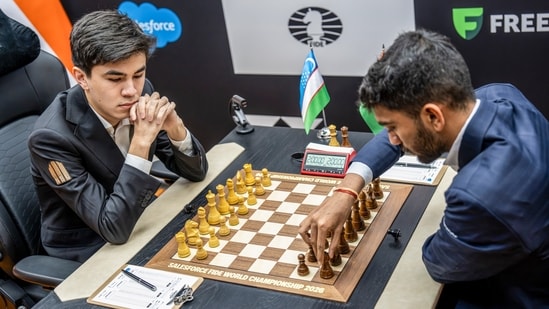
For the first time in the match, Sindarov remained planted in his chair for the first hour, burning through time on his clock. It was an unlikely sight.
The Uzbek GM opened with 1.e4, and Gukesh answered with 1...e5 2. Nf3 Nc6 3. Bb5 Nf6, to bring on the Berlin Defense just like in Game 1. Then, the defending champion pulled a rabbit out of his hat.
A Money Heist of a surprise — Berlin, with a dash of Rio.
Playing Black, Gukesh, instead of retreating his knight to steer the game into the Berlin Endgame as in Game 1, played 5...Be7, prompting Sindarov to do a double take.
It was the Rio de Janeiro Variation in the Berlin, a relatively rare and offbeat line that is hardly a trendy choice at the elite level. Also, perhaps in part considered unplayable.
Unlike the traditional Berlin Endgame, it keeps the queens on the board and typically leads to a more complex, dynamic middlegame.
Grandmaster Peter Leko let viewers in on a trivia nugget from his 2004 World Championship match against Vladimir Krmanik on the Fide broadcast. He spoke of preparing the Rio de Janeiro Variation before Game 14 but eventually deciding not to use it.
In Thursday’s game, as move 40 approached, Sindarov found himself navigating an intricate endgame, having to tread carefully to secure a draw while Black appeared to be pressing without taking any real risks.
{{/usCountry}}In Thursday’s game, as move 40 approached, Sindarov found himself navigating an intricate endgame, having to tread carefully to secure a draw while Black appeared to be pressing without taking any real risks.
{{/usCountry}}The challenger was down to just six seconds on his clock at move 40 but survived the time scramble. With 41. Ke3, White’s king controlling Black’s passed pawn, he appeared to have found safety.
Opposite-coloured bishop endgames can be complicated, and this one was no exception. The game had already seen its share of twists and shifts in momentum, with Sindarov probing and Gukesh finding the answers. The evaluation bar barely budged from a draw throughout, but that hardly told the story of the battle on the board.
Both players pressed, countered and cancelled each other out, neither willing to blink first, each waiting for the other to crack. “Maybe there’s such a thing as loving chess too much that you continue playing way past the point it’s reasonable,” grandmaster Peter Svidler, offered.
Unlike in the earlier two games, Sindarov got little time to spend in the players’ lounge on Thursday, between moves. An avid gamer, he was earlier asked what he would like to have in the players’ lounge if he had a choice. “Maybe a PS5,” was his response.
If Gukesh was the one doing the pushing in almost every game of the 2024 World Championship match, in rainy, chilly Geneva he opted for solidity in the first two games.
Of course, he has something to lose this time — the crown — and is up against an ambitious, extremely well-prepared opponent. If the match came alive with a tense, high-quality battle in the Berlin in Game 1, Game 2 was a quiet, slow affair, with neither player willing to take risks. It ended abruptly in a repetition of moves after just 20 moves.
Asked why he chose to shut down Game 2 so early despite having the White pieces, Gukesh said the problem with playing on was that “you hope your opponent will go wrong, but you’ll also get into trouble.”
Gukesh left it to Sindarov to claim the draw by threefold repetition in the first two games. Of course, a quick draw with White in Game 2 was in itself an admission of not having got what he wanted out of the opening.
Friday is a rest day in the match, giving both players a chance to regroup and sift through what they’ve learnt about each other over the first three games. The scores remain level at 1.5-1.5 each.
Gukesh will have the White pieces next, and the rest day will give him some extra time to prepare.
Team Gukesh must be pleased with the opening surprise working in Game 3 and the defending champion has shown that he’s hardly the underdog, as was imagined by many.
“I don’t think it’s a missed opportunity for either side,” grandmaster Judit Polgar said on the broadcast. “It’s a very fair result. There were beautiful ideas being alternated. It wasn’t one sided. It was just a great battle.”