The PlayStation 5 Pro launched on 7 November 2024, and Sony’s proprietary upscaling technology, PSSR, debuted alongside it. Sony’s top-of-the-line gaming console already had a huge performance ceiling due to its custom AMD RDNA 2 chipset. The new AI upscaling helped it distribute its power to more critical areas, including ray tracing, by offloading the work of rendering images at higher resolution. But deep down, Sony seemed to realise that not many gamers worldwide would experience its benefits, as the PS5 Pro accounted for 13% of PS5 console sales in the USA alone in 2026.
You may be interested in
70% OFF
Sounce Dust Plug for PS5, 9 Pcs Dust Plug Kit, Slim Console, PS5 Silicone Plug Protector, Antidust Cover, Dustproof PlayStation 5 Disk/Digital Console Slim Game Accessories (Black)
Sounce Dust Plug for PS5 9 Pcs Dust Plug Kit Slim Console
₹299
₹999Get This
I say this because the Japanese tech giant announced QSSR, a similar AI upscaling technology, for its base PS5 console, which hit 100 million sales this year, on 1 October. And the timing of the new AI upscaler’s arrival couldn’t be better. GTA 6, one of the most anticipated games, launches on 19 November, and QSSR could help more gamers enjoy Rockstar’s game at higher quality despite their console’s ageing hardware.
But this begs the question: does QSSR actually improve the gaming experience on the base PS5? Or is this another underhanded marketing ploy by Sony to steal sales from its competitors? So I put my detective goggles on and played Spider-Man 2 with QSSR for hours. Here’s what I found:
Before heading to the main section, I want to preface that I've added images to this article to help you understand QSSR's advantages. But the website compression may make its effects less apparent.
Sony's QSSR adds visual depth and clarity to Spider-Man 2 on the base PS5
QSSR brings sharper hair details and more natural lighting to characters
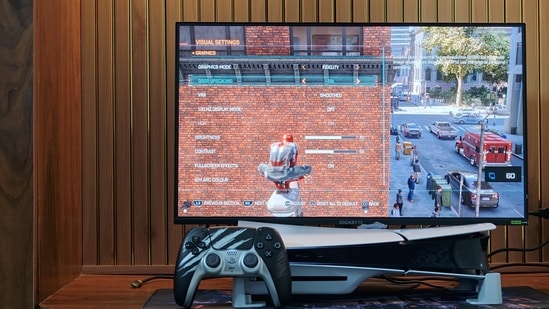
In Spider-Man 2, QSSR is buried in the visual settings and is deactivated by default. Once turned on, I found it made significant differences in the game, but only in certain aspects. In the mission ‘Roll like we used to’, a particular moment shows up when Mary Jane looks at Peter Parker with her back against the door. With QSSR enabled, the ends of her flyaway hairs grow slightly and become more defined.
Beyond this, the lighting in her hair feels imposed, with lifted blacks that disobey the science of shadow from an angled light source, when Sony’s AI upscaling is disabled. Together, the frame comes across as a bit fake, but turning on QSSR subdues overblown highlights in her hair and increases contrast, making it look more natural and consistent with the scene's lighting.
{{/usCountry}}Beyond this, the lighting in her hair feels imposed, with lifted blacks that disobey the science of shadow from an angled light source, when Sony’s AI upscaling is disabled. Together, the frame comes across as a bit fake, but turning on QSSR subdues overblown highlights in her hair and increases contrast, making it look more natural and consistent with the scene's lighting.
{{/usCountry}}This change becomes more pronounced when Mary Jane steps outside the home into an area lit by dusk sunlight.
Sony's AI upscaling improves environmental details and lighting consistency
In the very same mission, ‘Roll like we used to’, Harry Osborne reunites with Mary Jane and Peter Parker after recovering from his grim illness and takes Peter on a bicycle trip to their school. Activating QSSR does four things in the frame in which both characters pass through a suburb with lush greenery:
- The upscaling technology removes artefacts from the car grille, making it look sharper. It also softens the reflection of tree branches to better match how it appears in the real world.
- In the very same car, QSSR tones down the brightness of its wheel rims and deepens the shadows to make them more consistent with the sun’s position.
- Conversely, it slightly brightens areas of the yellowish green house where sunlight hits.
- It also reduces the forced brightening of foliage, boosts contrast, and removes noise to help the PS5 render tree branches more naturally.
When Harry Osborn and Peter Parker are just a few peddles away from the school, activating QSSR makes the grass patch's oil-paint-like texture a bit more defined.
More realistic shadows and reflections give indoor scenes greater depth
In the specific part of the mission, ‘Roll like we used to’, teenage Harry Osborn and Peter Parker walk past the trophy cabinet to evade the security guard and the janitor.
Here, QSSR reduces the intensity of light reflections on every golden trophy and deepens the shadows slightly to add depth. It also brightens the highlights on the balloon strings to make them pop.
Just a few scenes later, when both characters reach Peter’s locker and he opens it, QSSR adds shadows to Peter’s sleeve because it is away from the light, while slightly brightening Harry’s jacket sleeve because it is directly beneath the overhead tube light.
This shows that Sony’s AI upscaling technology also affects how light should behave based on the source’s position.
QSSR brings greater clarity to cityscapes and realism to outdoor lighting
QSSR’s involvement in better lighting also shows up when Kraven’s fleet enters New York City’s airspace.
Here, activating Sony’s AI upscaling technology brightens the sea's highlights exactly where the sunlight hits and makes them much more uniform.
Having said that, QSSR’s substantial benefit emerges when the camera pans up to reveal New York City’s skyline.
First, it makes the separators between glass panes on high-rise buildings sharper. It even sharpens distant skyscrapers. QSSR softens reflections on nearby buildings to match how they appear in the real world.
QSSR makes subtle but noticeable improvements to Spider-Man's suit
But these are the changes I observed in the side characters and the overall landscape. As for the titular character, Spider-Man, I found that Sony’s AI upscaling technology adds shadows to his visor to add depth.
It then slightly darkens the zips on his jacket, as he is facing away from the sun. QSSR also reduces the brightness of the bright spots on Spider-Man’s jacket to make them more consistent with the sun’s position.
Having said that, I am just reporting the tangible changes I noticed when I played Spider-Man 2 with QSSR turned on. I don't have the tools or software to check what resolution Sony’s upscaling technology starts from, or what ceiling it hits on the base PS5 in this game. If I had to guess, considering this is Insomniac’s second game, besides Wolverine, to get this feature, it could be upscaling the game from 860p to 1440p.
By the way, gamers can benefit from QSSR in these games as well:
- Control Resonant
- Arc Raiders
- The Finals
- No Man's Sky
- Wolverine
- Ghost of Yotei
- Hell Let Loose: Vietnam
So, what's the deal?
However, I can say with confidence that GTA 6 and the upcoming God of War Laufey, a game from PlayStation first-party studio Santa Monica, could greatly benefit from QSSR’s introduction in the base PS5. Whether it’s Leonida’s cityscape in Rockstar’s game or the character Begtse in God of War Laufey, I’m certain both will look sharper with QSSR enabled, even though Sony’s base console hardware is six years old.