Researchers at University of Washington (UW) have developed ‘FeverPhone,’ an app to ‘transform’ smartphones into thermometers, that too without adding a new hardware to the former for the purpose.
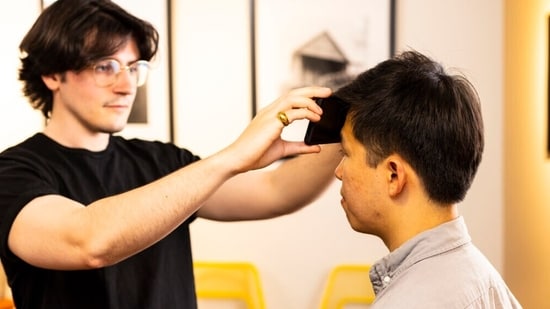
Joseph Breda, a UW doctoral student, worked as the lead author on the study that led to the development of FeverPhone, which, the institute says, is the ‘first app to use existing phone sensors to estimate whether people have fevers.’
“In undergrad, I was doing research in a lab where we wanted to show that you could use the temperature sensor in a smartphone to measure air temperature. When I came to the UW, my adviser and I wondered how we could apply a similar technique for health," A UW press release quoted Breda as saying.
"We decided to measure fever in an accessible way. The primary concern with temperature isn’t that it’s a difficult signal to measure; it’s just that people don’t have thermometers,” he added.
On March 28, the team published its findings in Proceesings of the ACM on Interactive, Mobile, Wearable and Ubiquitous Technologies. You can read the findings here.
How does FeverPhone work?
Smarpthones have thermistors to monitor the temperature of the former's internal components. These sensors, however, are also sensitive to warm entities in contact with the device. It is this sensitivity, that FeverPhone puts to use: to estimate a person's core body temperature, the phone's touchscreen is is placed against their forehead.
{{/usCountry}}Smarpthones have thermistors to monitor the temperature of the former's internal components. These sensors, however, are also sensitive to warm entities in contact with the device. It is this sensitivity, that FeverPhone puts to use: to estimate a person's core body temperature, the phone's touchscreen is is placed against their forehead.
{{/usCountry}}The temperature and raw capacitance – sensed by a thermistor and touchscreen respectively – are used to capture features describing the rate of transfer of heat from the body to the device. With these features, a machine learning model then infers a user's core body temperature.
The test
FeverPhone was tested at the emergency department of UW's School of Medicine. For this clinical trial, 37 participants were recruited, including 16 with mild fever. They pressed the touchscreen against their foreheads for 90 seconds.
The results
Overall, it estimated the patient core body temperatures with an average error of about 0.41 Fahrenheit (0.23 degrees Celsius); this is in the clinically acceptable range of 0.5 Fahrenheit.