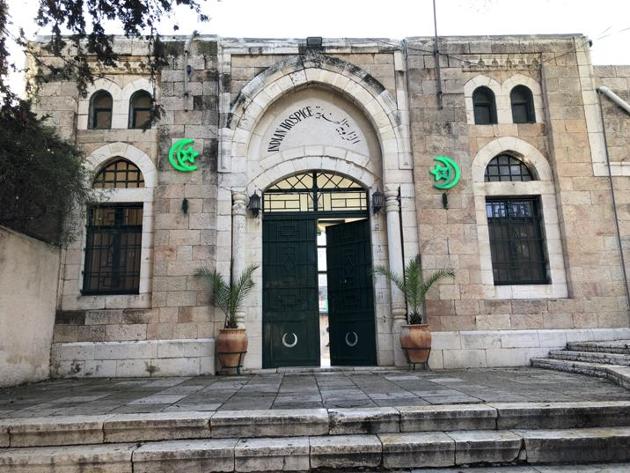
In the eastern part of Jerusalem lies the Old City, enclosed by a wall about 15 metres high and more than 4 km long, which Suleiman the Magnificent re(built) in the middle of the 16th century. To the east of the wall’s northern face is Herod’s Gate, one of the six original entrances to the old city — and the gateway to a bit of India in this land sacred to the three Abrahamic religions.
Beyond the arched gateway, behind the fruit and vegetable stalls, a flight of stairs leads to a large iron gate painted green, framed by pillars of white stone on which are inscribed in English, ‘Indian Hospice’ and in Arabic, ‘Zawiya al-Hindiya’. ‘Little India’ is a neutral corner in the theatre of the world’s bitterest conflict, unlikely to ever be resolved.
The history of the hospice goes back to about 1200 CE, when the Sufi mystic Fariduddin Ganj-i-Shakar, or Baba Farid, visited Jerusalem. He stayed in a waqf property that comprised two rooms and a mosque on a hillock opposite Bab al-Zahera (Herod’s Gate), praying in isolation for 40 days in a cave on the premises.
The property, which later came to be known as Zawiya al-Faridiya, became a shrine for Indian Muslims travelling to the Holy Land. Over the centuries, donations and exchanges of land helped expand the hospice to its current 7,000 sq metres.
Pilgrims and tourists at the hospice today are almost exclusively Indian, often recommended by India’s diplomatic missions in Tel Aviv and nearby capitals. They stay in modest rooms built around a courtyard at the centre of which stand lemon and orange trees heavy with fruit, and adjacent to a private mosque and Baba Farid’s sacred refuge, a large portrait of the saint guarding the entrance to his cave. Baba Farid, incidentally, is said to have died in 1265.
{{/usCountry}}Pilgrims and tourists at the hospice today are almost exclusively Indian, often recommended by India’s diplomatic missions in Tel Aviv and nearby capitals. They stay in modest rooms built around a courtyard at the centre of which stand lemon and orange trees heavy with fruit, and adjacent to a private mosque and Baba Farid’s sacred refuge, a large portrait of the saint guarding the entrance to his cave. Baba Farid, incidentally, is said to have died in 1265.
{{/usCountry}}Since 1952, the guardian of the Indian hospice has been Sheikh Mohammad Munir Ansari, the son of Sheikh Nazir Hassan Ansari, a member of the All-India Khilafat Committee who travelled to Jerusalem from Saharanpur in UP in 1924 at the request of the Grand Mufti of Palestine to be the trustee of the Indian Wakf and sheikh of the Indian hospice.
Sheikh Munir is now 91, and lives with his family — all except one member of which carry Indian passports — at the hospice. He is a recipient of the Pravasi Bharatiya Samman, awarded by the President to notable Overseas Citizens of India, and someone nearly every Indian dignitary visiting Israel makes the effort to meet.
“Recently, he took our entirely family, more than 30 members, to Saharanpur in Uttar Pradesh — it was a homecoming he wanted us all to experience,” says Nazeer Ansari, the Sheikh’s younger son, who manages most of the affairs of the hospice today, with his wife, Wafa.
For nearly a century, four generations of the Ansari family have witnessed the hatred, prejudice, violence and unrest of multiple wars and two Intifadas. Through the political turmoil, despite personal losses and extensive damage to the hospice, they have kept the Tricolour flying on Zawiyat al-Hunood Street. Through firmness and dignity, goodwill and tact, Sheikh Munir has ensured an enduring Indian presence in the most contested 1-sq-km patch of land in the world.
“Please remember your visit,” he says. “And tell your sons, your daughters, your relatives, that you went to Jerusalem, the holiest city in the world, and that you visited the Indian hospice and the Ansari family, which comes from India… Bahut bahut shukriya.” Shukriya to you, Sheikh Munir.
Catch your daily dose of Fashion, Taylor Swift, Health, Festivals, Travel, Relationship, Recipe and all the other Latest Lifestyle News on Hindustan Times Website and APPs.
Catch your daily dose of Fashion, Taylor Swift, Health, Festivals, Travel, Relationship, Recipe and all the other Latest Lifestyle News on Hindustan Times Website and APPs.