Social media is divided over a photo of multiple airport passengers using wheelchair assistance. Sceptics claim travellers are exploiting the service for convenience, but many rushed to defend them, pointing out that navigating long terminals is physically exhausting for older adults regardless of visible illness.
What does the picture show?
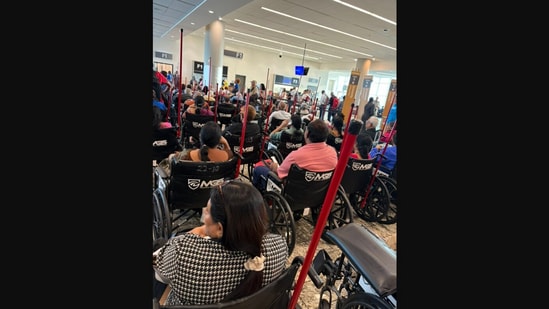
The picture, shared on X, with a claim that it shows people from a certain region, captures several passengers in wheelchairs at an airport.
Founders, CEOs join debate
The post prompted various remarks from people, including several Indian founders and CEOs.
“This will blow up”
A Haryana-based founder, Priyesh Sharma, reacted to the post and wrote, “This will blow up! This will cost our people dearly. The abuse is blatant and the world is watching. Beyond the usual racism and the issues that social media presents, this unfortunately has no reasoning. If you really want to assist them, help them understand the airport, let them know that the airport will provide basic information on gates and what needs to be done, book direct flights wherever possible or if you still think the need is real M&G (can be expensive), but it is what it is.”
“It has everything to do with uncertainty”
{{/usCountry}}A Haryana-based founder, Priyesh Sharma, reacted to the post and wrote, “This will blow up! This will cost our people dearly. The abuse is blatant and the world is watching. Beyond the usual racism and the issues that social media presents, this unfortunately has no reasoning. If you really want to assist them, help them understand the airport, let them know that the airport will provide basic information on gates and what needs to be done, book direct flights wherever possible or if you still think the need is real M&G (can be expensive), but it is what it is.”
“It has everything to do with uncertainty”
{{/usCountry}}Entrepreneur Ram, who claimed to be a frequent traveller between India and the US, shared his thoughts on X.
He wrote, “I travel often between the US and India. This is quite a common sight. I thought about this for a while, discussed and debated with many. I also did some work for the airlines. You won't see this on domestic flights. This behavior has got nothing to do with disability. It has everything to do with uncertainty,” adding, “Air travel is loaded with uncertainty. Airlines and Airports are well designed, if you are a frequent traveler. If you are an infrequent traveler, it can get very confusing. Terminal changes, boarding gate changes, flight delays, tight connections, rebooking, rerouting, missed bags are all too much to deal with, especially if your English isn't good enough. These are rough even for frequent travelers.”
He continued, “These travelers and their children want to avoid uncertainty. Imagine being stranded at some European airport, not knowing the language nor the airline procedures. So they are using a loophole in the system. This is not sustainable. Airlines have to figure out a solution for this problem. A small fee won't solve the problem. The problem to solve is not the wheelchair use, but the uncertainty.”
“The photo is telling, but…”
An IITian, Malay Krishna, who works as a director of product management, argued that there is more to the picture than what meets the eye. He argues that while airport wheelchair misuse exists, high demand on some routes is driven by elderly travellers struggling with massive terminals.
He cautions against public shaming and suggests age-based eligibility or modest fees rather than compromising genuine accessibility.
Take a look at his full post:
Many were quick to critique the picture. Just like an individual who posted, “It’s hard to put into words how disgusting this is.” Another wrote, “Start charging for wheelchairs. All these will run to their planes.”
Ultimately, the viral image underscores a delicate balance between systemic efficiency and genuine empathy. As debate rages online over potential abuse, experts and travellers alike agree that finding a solution is necessary, whether through clearer airport guidance, reasonable fees, or age-based policies.