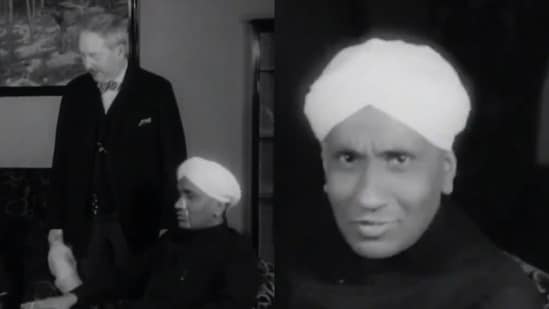
The Nobel Prize has shared archival footage of Indian physicist Sir Chandrasekhara Venkata Raman arriving in Stockholm, Sweden, in 1930 to receive his Nobel Prize in Physics. The video was posted on November 6, on the eve of Raman's 138th birth anniversary, which falls on November 7.
(Also read: Henri Kagan wins Nobel Prize at 95: Who are the oldest Nobel laureates in history?)
The black-and-white clip offers a glimpse of the scientist during his visit to Sweden, where he was honoured for his groundbreaking discovery of the Raman Effect.
Nobel Prize shares archival video of CV Raman
Taking to X, the Nobel Prize's official account shared the footage with the caption: "On the eve of Sir Chandrasekhara Venkata Raman's birthday, take a look at this clip from 1930 when Raman had just arrived in Stockholm, Sweden to receive his Nobel Prize at the Nobel Prize Award Ceremony on 10 December."
The footage shows Raman shortly after his arrival in Stockholm ahead of the award ceremony on December 10, 1930.
{{/usCountry}}The footage shows Raman shortly after his arrival in Stockholm ahead of the award ceremony on December 10, 1930.
{{/usCountry}}Take a look here at the post:
The Nobel Prize also shared the footage on its official LinkedIn page, explaining the scientific discovery that earned Raman the prestigious honour.
The video is not newly released. The Nobel Prize's official account had also shared the archival footage in November 2020.
Why CV Raman received the Nobel Prize
Born on November 7, 1888, in Tiruchirappalli, now in Tamil Nadu, Raman became the first Asian to receive a Nobel Prize in a scientific field.
According to his official Nobel Prize biography, Raman discovered the phenomenon that would later bear his name on February 28, 1928.
According to Lindau Nobel Laureate Meetings, Raman received the 1930 Nobel Prize in Physics "for his work on the scattering of light and for the discovery of the effect named after him".
The Raman Effect describes how a small proportion of light changes its wavelength when scattered by molecules. The discovery laid the foundation for Raman spectroscopy, a technique used to identify substances and examine their molecular structure.
(Also read: Anne Carson, winner of Nobel Prize in Literature, has a little-known India connection)
CV Raman's scientific legacy
Raman's contributions extended beyond the discovery that earned him the Nobel Prize. His research covered acoustics, optics and the properties of crystals.
He was awarded the Bharat Ratna, India's highest civilian honour, in 1954.
India observes National Science Day on February 28 every year to commemorate his discovery of the Raman Effect.
Raman died on November 21, 1970, aged 82. His work continues to influence scientific research across the world.