
 E-Paper



Anne Carson, winner of Nobel Prize in Literature, has a little-known India connection
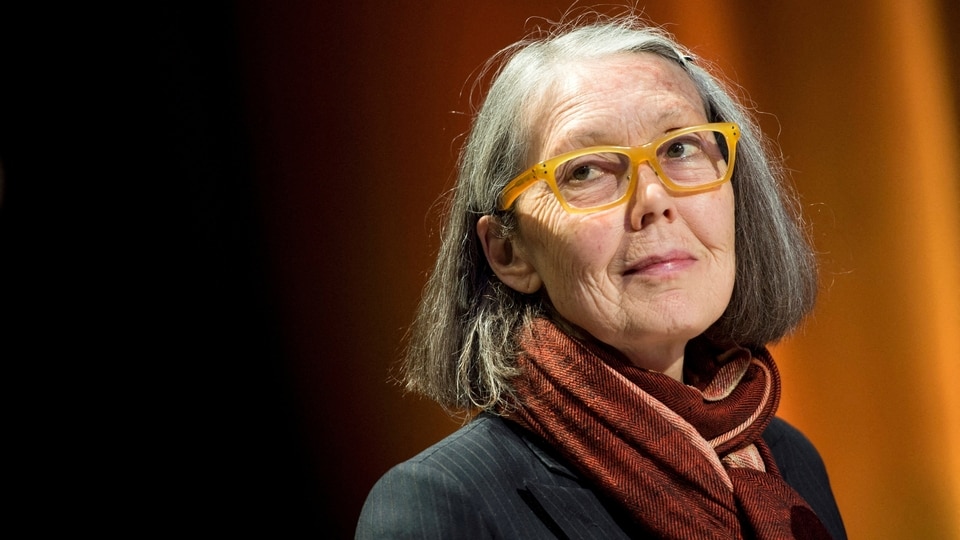
Anne Carson, who won the 2026 Nobel Prize in Literature on Thursday, has a little-known India connection through her elder brother Michael Carson.

 Prefer HTon Google


Canadian writer Anne Carson, who won the 2026 Nobel Prize in Literature on Thursday, has a little-known India connection through her elder brother Michael Carson, who spent years travelling across India and Europe after leaving Canada. Michael’s life and mysterious death became the subject of Anne’s 2010 memoir ‘Nox’, a book-length elegy that brought together memories, photographs, letters, poems and other memorabilia related to her brother.
According to a report by The Irish Times, Michael left Canada in 1979 to escape being arrested for dealing drugs. He spent more than two decades moving between India and Europe under false passports. He eventually settled in Copenhagen, where he died in 2000 at the age of 55.
Anne recorded his life and death in 'Nox', named after the Roman goddess who personified the night. The volume compiled stamps from Denmark, hotel stationery from Kashmir and a letter believed to have been written by Michael from Kashmir, as per a 2011 report by The Irish Times.
Anne had said in an interview that Michael had spent 22 years moving around India and Europe after fleeing Canada. He contacted his family only about half a dozen times during that period.
She said she idolised her brother as a child. He was bullied as a boy, was homeless for a period after leaving Canada and married at least twice.
Anne had hoped to meet her brother one last time. Days before his death, Michael called her office in 2000 from Copenhagen and used her childhood nickname, “Pinhead”, while asking her to visit him. However, about a week before she was due to make the trip, Anne learnt that he had died.
(Also Read: How an Indian professor's research helped pave way for the Nobel-winning discovery in medicine)
How Anne Carson made Nox
Anne built Nox around Roman poet Catullus’s Poem 101, an elegy written for his brother, who died far from home. Anne began working on the project after Michael’s death.
The book was published as a single accordion-folded sheet in a box, replicating the notebook she had made by hand. It combines photographs, letters, translations, drawings and other fragments to reconstruct the life of a brother who had remained largely absent from hers.
Anne has said that she did not consider Nox a book about grief. "It's not about grief. It's about understanding other people and their histories as if we are all separate languages. That's what I was trying to explore. Exploring grief would have made it a book about me, and I didn't want that,” she said.
(Also Read: Who is Anne Carson? Nobel Prize winner’s books, career and writing style explained)
Nobel Prize committee praises Nox
The Nobel committee singled out Nox after announcing Carson as the 2026 Nobel Literature laureate, describing it as an “unforgettable work”.
"Published in 2010, it was written in memory of her brother Michael, who was mysteriously absent prior to his death in Denmark in 2000. Palpable here is a deep sense of loss that works its way up from below,” the committee said in a social media post.
“The result is a creation as sculptural as it is literary, an epitaph in the form of a box containing an accordion-fold-out of pictures, letters and other written texts dedicated to her dead brother. There is moreover a third voice that provides temporal depth in the shape of the Roman poet Catullus, with his famous elegy 101 in honour of his own departed brother, who like Michael died on foreign soil. Present also is Carson’s moving translation of the poem,” it added.
(Also Read: Nobel Prize in Literature awarded to Anne Carson for creating 'new forms for contemporary literature)
Anne Carson wins Nobel Prize in Literature
The Nobel Prize committee said that Carson was given the award “for her bold and inventive oeuvre that, in playful dialogue with the classical tradition, has created new forms for contemporary literature."
Her major works include Autobiography of Red (1998), Red Doc> (2013), Eros the Bittersweet (1986), If Not, Winter (2002), Float (2016), and translations of several ancient Greek tragedies.


