
 E-Paper



Indian tourist detained in Thailand airport for trying to smuggle live monkeys
The Indian tourist detained for trying to smuggle rare monkeys is being charged with violations of the Wildlife Conservation and Protection Act.

 Prefer HTon Google


An Indian tourist has reportedly been arrested for trying to smuggle two rare monkeys at Suvarnabhumi Airport in Thailand. The protected primates were discovered by customs officials in the suspect's luggage.
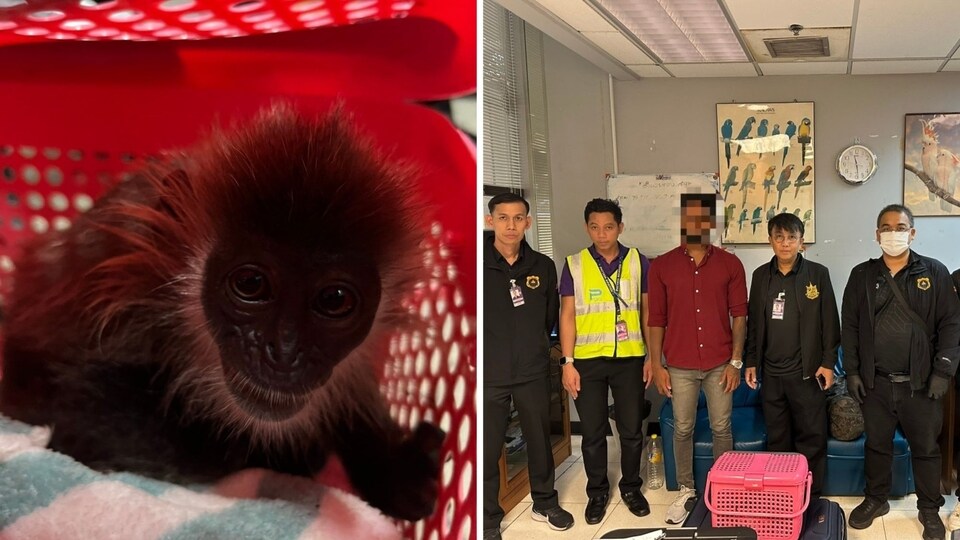
The Indian man was trying to board a plane to Mumbai with two live Indochinese Lutungs, Thailand’s Department of National Parks, Wildlife and Plant Conservation said in a social media post. The customs officials detained the suspect in a joint operation with the Wildlife Checkpoint.
Also Read: ‘A nightmare’: Indian-American man jailed over fake Walmart kidnapping now sues accuser, police
According to the outlet, the primates are valued at around 100,000 baht (approximately ₹2.9 lakh).

“Incident took place at 11:30 pm On February 3, the investigators arrested Mr. Karthick, 28 years old, Indian national, a passenger of Thai Airlines flight TG351 Bangkok route (BKK) heading to Mumbai (BOM), India,” the department stated.
“The inspection revealed two live Indochinese Lutungs hidden amongst personal items. The animals were immediately seized, and the suspect was taken into custody to face legal proceedings,” Santanee Phairattanakorn, director of the Passenger Inspection Customs Office at Suvarnabhumi Airport, told Nation Thailand.
Social media is furious:
After the news broke, it prompted an intense backlash on social media with people demanding strict punishment for the arrested individual. A social media user posted, “What is wrong with some people?” Another added, “Why are you doing this? You should go straight to jail.”
A third expressed, “The monkeys could have died in there.” A fourth wrote, “But, why?” The same question was asked by a few others too.
What is the man charged with?
The suspect is facing charges under two pieces of legislation, the outlet reported. The Wild Animal Conservation and Protection Act (2019) and the Customs Act (2017).

As per the Wild Animal Conservation and Protection Act (2019), the unauthorised export of controlled and protected wildlife is illegal. The Customs Act (2017) states that it is illegal to attempt to export goods from the Kingdom without undergoing official customs formalities.
What happened to the monkey?
Reportedly, the animals were safely rescued and handed over to wildlife specialists for care and health assessments.
About Indochinese Lutung:
It is the common name for Trachypithecus germaini. Also called Germain's langur, it has long tails and hair around its round face. Though the young monkeys of this species have bright orange fur, they turn blackish and greyish as they grow.
Also Read: Indian tourists allege racism at Thailand beach club, management responds
They are mainly found in Asia, specifically Thailand, Cambodia, Myanmar, and Vietnam.

According to a blog by Thai National Parks, “Germain's langur is a terrestrial arboreal species, often found in lowlands. They prefer evergreen and semi-evergreen, riverine, mixed deciduous, and gallery forests. They are not commonly found at high elevations or hills.”
The species mainly eats shoots, fruits, and leaves. However, it has been observed that the monkeys sometimes consume mushrooms.


