A brain surgery has left a 28-year-old man experiencing a rare visual disturbance that affects how he perceives faces. The case, which involves a striking mix of human and animal features, has also offered researchers an opportunity to study how the brain processes familiar faces.
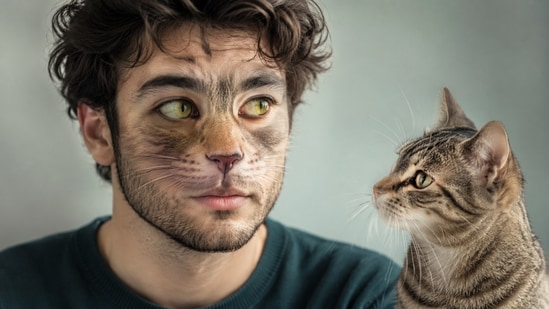
Identified only as Karl, the man has been experiencing these changes for around two years. His experience was reported by Newsweek and documented in a research paper published in the journal Cortex.
Why does the man see cat-like features on human faces?
Karl's symptoms started around two years ago, after he underwent surgery to remove an arteriovenous malformation, an abnormal tangle of blood vessels connecting arteries and veins, in the right posterior temporal lobe of his brain. This area is involved in recognising faces.
Since the surgery, Karl has sometimes seen features from one face appear on another. He may, for instance, notice his pet cat Luna's almond-shaped eyes, enlarged pupils and stripe-like markings on the faces of people around him. At other times, he sees the eyes and other facial features of someone he knows appear on Luna's face.
These episodes can last for hours and sometimes continue throughout the day.
{{/usCountry}}These episodes can last for hours and sometimes continue throughout the day.
{{/usCountry}}Brad Duchaine, a professor at Dartmouth College who helped document Karl's case, told Newsweek that the brain stores detailed memories of familiar faces. In Karl's case, features from those memories seem to appear when he looks at other faces, including those of people and his cat.
What is prosopometamorphopsia?
Karl has a rare condition called prosopometamorphopsia (PMO), which affects how people see faces. Facial features may appear stretched, misplaced, larger or smaller than they are. In some cases, even skin colour and texture can look different.
The condition can develop when areas of the brain responsible for face recognition are affected, including after a stroke, brain tumour, head injury, seizure or surgery. However, its cause is not always clear.
There is no established treatment for PMO, and symptoms vary. While some people experience these distortions for days or weeks, others, like Karl, may live with them for years.
A similar case was reported in 1986
Karl is not the first person to experience animal-like features appearing on human faces. A 1986 case report described a woman who had suffered a stroke nine months earlier. While travelling on a bus, she saw a poodle sitting on another passenger's lap. When she looked away, the dog's facial features appeared on the other passengers instead.
The distortion reportedly continued for around 30 minutes after she got off the bus.
The researchers also discussed this case in their report published in the journal Cortex, noting that such animal-to-human facial distortions are rare and offer clues about how the brain recognises faces.