Scientists have captured rare footage of a deep-sea creature with a transparent head and unusual green eyes in the depths of the Pacific Ocean. The fish, known as the barreleye, was spotted by researchers from the Monterey Bay Aquarium Research Institute (MBARI) during an expedition approximately 90 kilometres off Monterey Canyon.
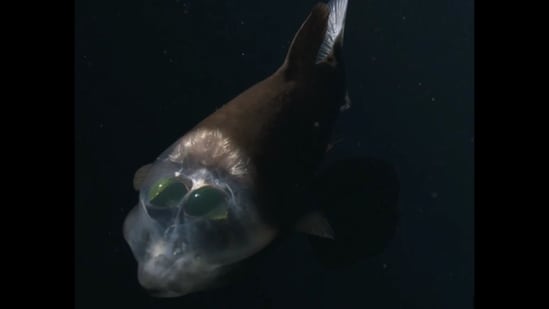
According to a report by the New York Post, the six-inch-long creature was filmed on October 22 at a depth of around 1,970 feet using a remotely operated vehicle (ROV) named Doc Ricketts. The researchers were aboard the research vessel David Packard as part of an expedition to document and collect deep-sea critters.
The MBARI team observed the unusual fish for around 20 minutes, capturing high-definition 4K footage of it hovering in the deep ocean.
Watch the video below:
Known scientifically as Macropinna microstoma, the barreleye is rarely seen as it inhabits the ocean’s twilight and midnight zones, typically at depths of 2,000 to 2,600 feet. Its most distinctive feature is its transparent, dome-shaped head, through which its distinctive green eyes can be seen.
{{/usCountry}}Known scientifically as Macropinna microstoma, the barreleye is rarely seen as it inhabits the ocean’s twilight and midnight zones, typically at depths of 2,000 to 2,600 feet. Its most distinctive feature is its transparent, dome-shaped head, through which its distinctive green eyes can be seen.
{{/usCountry}}(Also Read: Infinity: Rare 888.88-carat black diamond makes public debut in Dubai)
‘Such an amazing creature’
Speaking about the encounter, expedition senior scientist Steven Haddock said he had previously seen the barreleye a few times, but his last encounter was nine years ago, before the institute had 4K cameras on its submersibles.
“It is such an amazing creature, which looks like it was created by an imaginative child,” Haddock said, as per a report by BBC Wildlife.
“If you compare historical drawings of trawled specimens, the transparent dome surrounding their eyes has been stripped away. I didn’t even think they were illustrating the same species. So to see it alive with the dome of its ‘cockpit’ intact is a real privilege,” he added.
According to the outlet, the newly captured footage could now help scientists better understand how the fish and other deep-sea creatures use vision in the darkness of the mesopelagic zone.
“Macropinna reminds us of the surprising ways that animals have adapted to thrive in the ocean’s midwater. So many of them survive by looking for subtle optical cues, like a shadow passing overhead, and this sets off evolutionary competition, pitting bioluminescent camouflage against increasingly sophisticated visual capabilities,” Haddock explained.