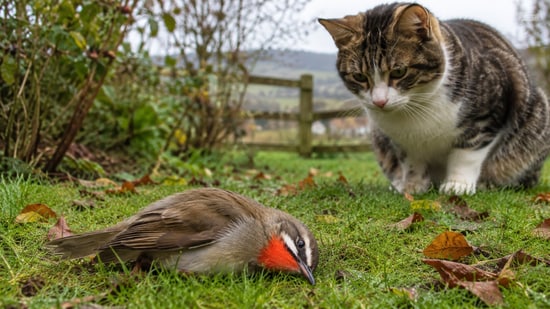
A rare migratory bird that apparently travelled thousands of miles from Siberia to Britain has met a tragic end after being caught by a domestic cat. The bird, identified as a Siberian rubythroat, was discovered in Cumbria, northwest England, far from its usual migration route.
(Also read: Giant 3.9-kg prehistoric bird related to modern chickens identified in Indonesian cave)
According to a report by The Guardian, the songbird was found in a remote valley after a woman's pet cat brought it into her home.
The discovery was particularly remarkable because the species is rarely recorded in Britain. Only 17 confirmed records have been documented in the UK, with 15 coming from Scotland's northern islands.
Woman discovers rare bird after cat brings it home
The incident occurred near Brampton, Cumbria, on November 8. The woman, who wished to remain anonymous, noticed the bird's striking orange-red throat but initially struggled to identify it.
Speaking to the BBC, she said: "I saw the bird’s distinctive, beautiful orange-red feather patch under its beak but I couldn’t recognise the species."
{{/usCountry}}Speaking to the BBC, she said: "I saw the bird’s distinctive, beautiful orange-red feather patch under its beak but I couldn’t recognise the species."
{{/usCountry}}Recognising that the bird might be unusual, she preserved its body in her freezer before contacting the Royal Society for the Protection of Birds (RSPB).
The organisation subsequently alerted Chris Hind, Cumbria's county bird recorder, who confirmed the exceptional discovery.
Hind described the finding as extraordinary, pointing out that the bird had been recorded only twice previously on mainland Britain.
The Siberian rubythroat is a secretive species that generally remains concealed among bushes, hedges and dense vegetation. Its elusive behaviour makes sightings particularly difficult, even for experienced birdwatchers.
Mystery surrounds bird's unusual migration
Siberian rubythroats ordinarily migrate south from their breeding grounds in Siberia to spend winter in southern and south-eastern Asia.
However, this particular bird apparently travelled west instead, reaching Britain thousands of miles away from its expected destination.
Experts remain uncertain why it followed such an unusual route. Some researchers have suggested that unexpected migratory movements may occasionally be deliberate rather than simply cases of birds losing their way.
(Also read: Rare egg of extinct giant moa bird to return to New Zealand after 60 years in US collection)
According to a report carried by AOL, Josh Jones, senior editor at BirdGuides, described the bird's death as tragic and encouraged cat owners to use collars fitted with bells to help warn wildlife.
Meanwhile, researchers are expected to examine the bird and collect scientific samples before its remains are transferred to Tullie House museum in Carlisle.
Hind hopes the exceptionally rare specimen can eventually be displayed, allowing visitors to learn about its remarkable journey and unfortunate end.