An Indian-origin professor at Purdue University in the United States has demonstrated an autonomous drone capable of following a person through dense forests without relying on GPS, pre-existing maps or cloud computing.
(Also read: Indian-origin surgeon removes cancer patient's prostate from 56 km away in first US robotic telesurgery)
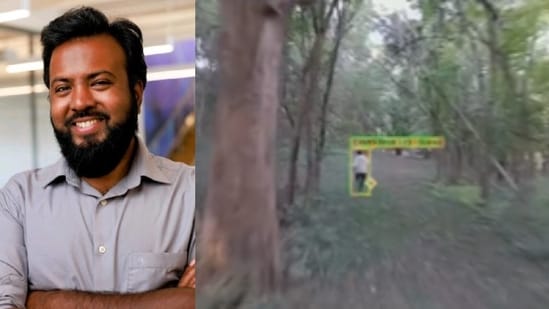
Aniket Bera, an associate professor of computer science and director of Purdue's IDEAS Lab, shared a 44-second video on LinkedIn on October 24, showing a quadcopter navigating between trees while tracking a moving person.
According to a report by TechSpot, the drone processes navigation decisions on its onboard computer, allowing it to operate in environments where satellite signals and internet connectivity may be unreliable.
How does the drone work?
The demonstration shows the drone manoeuvring around tree trunks and maintaining its path as the person moves through the forest.
{{/usCountry}}The demonstration shows the drone manoeuvring around tree trunks and maintaining its path as the person moves through the forest.
{{/usCountry}}One of its key features is occlusion prediction, which allows the system to estimate a person's likely direction when obstacles temporarily block the camera's view.
Rather than relying on GPS, the drone uses environmental sensing, mapping and motion-planning algorithms to navigate unfamiliar surroundings.
Explaining the technology, Bera wrote, "True Embodied AI must run on the chip, not in the cloud."
He said processing information directly on the drone was essential because even minor delays could affect its ability to avoid obstacles.
Questions over open-source technology
Bera initially claimed that his team had developed every layer of the drone from scratch, including its carbon-fibre frame and onboard software.
However, DroneXL reported that the demonstration's telemetry displayed references to "SUPER" and "FAST-LIO", open-source navigation tools developed by the University of Hong Kong's MaRS Lab.
(Also read: Body of missing Indian-origin woman Ajit Kaur found in California canal after 2-month search)
In an update to his LinkedIn post, Bera acknowledged that the project involved several open-source tools but maintained that the team's novel planning and perception algorithms were developed internally. He added that a research preprint would be released soon.
Could the technology help rescue missing people?
The development could eventually support search-and-rescue operations, particularly in remote forests where conventional drones may struggle with unreliable GPS signals.
Autonomous navigation could also prove useful during disaster response and infrastructure inspections.
Separately, Purdue University announced in November 2025 that Bera's team had secured a five-year, $1.5 million agreement with the US Army Research Laboratory to develop autonomous aerial and ground robots capable of operating without GPS.
However, no direct connection between that funding and the forest demonstration has been established. The drone's effectiveness in real-world rescue missions also remains untested publicly.