The Perseid meteor shower is reaching its annual peak, giving sky watchers across the United States a chance to see bright meteors streak across the night sky. The shower peaks around August 12-13, with the best viewing generally coming after midnight and toward dawn on Thursday, August 13. NASA lists August 12-13 as the peak night and says the Perseids can produce dozens of meteors per hour under favorable dark-sky conditions.
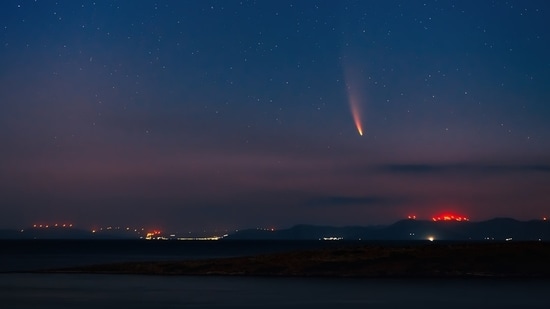
This year's display has an added advantage: the peak arrives around the new Moon, meaning there is little moonlight to wash out fainter meteors. The American Meteor Society lists the Perseids as active from July 17 through August 24, with the peak falling on August 12-13 and the Moon at essentially 0% illumination.
When is the Perseid meteor shower peak in 2026?
The Perseids are expected to reach their predicted maximum at about 14:53 UTC on August 13, according to astronomical forecasts. That converts to 10:53 a.m. EDT, 9:53 a.m. CDT, 8:53 a.m. MDT and 7:53 a.m. PDT in the United States. Because those times fall after sunrise, American observers will not see the exact maximum, according to News.AZ.
Also read: Is $20,000 visa bond the next US travel hurdle? What wider rollout could mean for visitors
{{/usCountry}}Also read: Is $20,000 visa bond the next US travel hurdle? What wider rollout could mean for visitors
{{/usCountry}}The practical takeaway is to watch during the pre-dawn hours of August 13, particularly from roughly midnight until dawn, when the Perseid radiant is higher in the sky. The mornings of August 12 and 13 are considered among the best opportunities, with some activity also possible around the peak night.
NASA says the Perseids are among the year's most prominent meteor showers and are known for bright meteors and occasional fireballs.
Where can you see the Perseids in the US?
The shower is best viewed from locations far from artificial light. Much of the United States can see the Perseids because the shower favors the Northern Hemisphere.
Some of the better-known dark-sky destinations for watching the meteor shower include:
- Great Basin National Park, Nevada: one of the country's recognized dark-sky destinations, offering exceptionally dark conditions away from major cities.
- Big Bend National Park, Texas: its remote location and limited artificial lighting make it a strong choice for stargazing.
- Death Valley National Park, California/Nevada: the vast desert landscape provides broad, unobstructed skies.
- Joshua Tree National Park, California: a popular Southern California destination for night-sky viewing.
- Cherry Springs State Park, Pennsylvania: one of the best-known stargazing locations in the eastern US.
- Arches and Canyonlands, Utah: remote desert skies can provide excellent meteor-viewing conditions.
- Glacier National Park, Montana: northern skies and relatively low light pollution offer strong viewing opportunities.
- Yellowstone National Park, Wyoming/Montana/Idaho: large areas away from developed zones can provide dark skies.
The exact quality of the view will depend on cloud cover, local light pollution and atmospheric conditions.
What direction should you look?
The Perseids appear to radiate from the direction of the constellation Perseus, which rises in the northeastern sky. But sky watchers should not stare only at Perseus. Meteors can appear across a much wider area of the sky, and a broad field of view can actually make it easier to catch longer streaks.
For the best chance of seeing meteors, find an open area with a clear horizon, get away from city lights and allow your eyes about 20 to 30 minutes to adjust to the darkness.
No telescope or binoculars are necessary.
Why does the Perseid meteor shower happen?
The Perseids are produced by debris from comet 109P/Swift-Tuttle, KSAT reported. As Earth travels through the stream of particles left behind by the comet, tiny pieces of material enter the atmosphere at extremely high speeds and burn up, creating the flashes commonly called shooting stars. NASA puts the Perseid meteor velocity at about 59 kilometers per second.
The shower remains active beyond its peak, so people who miss the best window on August 13 may still see Perseid meteors later in August, although activity will gradually decline.